Six Stands in one day: walking the Somme battlefield
Stand 1: Sheffield park
Then
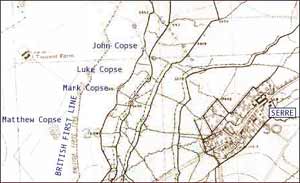
Two battalions, part of 31st Division, attacked Serre from the east edge of this wood (the modern Wood is an amalgamation of Mark and Luke Copses). Formally they were 12th Battalion The York and Lancaster Regiment and 11th Battalion The East Lancashire Regiment, but they prided themselves on their more familiar titles of the Sheffield City Battalion and the Accrington Pals.
The attackers went forward into heavy machine-gun and artillery fire. The Official History records how the German shellfire was so accurate and consistent that its explosions gave the impression of being 'a thick belt of poplar trees'.
The Sheffield City Battalion lost 17 officers and 495 men, and the Accrington Pals 21 officers and 564 men. A few British soldiers actually managed to get into Serre: their bodies were found there when the British briefly entered the village that autumn. It was not finally taken till the Germans pulled back from the whole area in early 1917.
Now
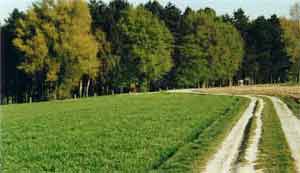
A ten-minute walk down a track from the Serre Mailly-Maillet Road. Visitors can sometimes see iron harvests of shells, left by farmers, where the track leaves the road.
The present wood was once three copses, nicknamed Mark, Luke and John. The wood still reveals shell-holes and the course of trenches. Matthew has been felled but its location remains visible south of the present wood.
A line of small cemeteries in the fields east of Serre, containing dead who were buried close to where they lay, roughly marks the position of the German wire. Dead collected later on lie in two huge 'concentration cemeteries' on the Serre road.
Source
The extended lines started in excellent order but gradually melted away. There was no wavering or attempting to come back, the men fell in their ranks, mostly before the first hundred yards of No Man's land had been crossed. The magnificent gallery, discipline and determination displayed by all ranks of this North Country division were of no avail against the concentrated fire effect of the enemy's unbroken infantry and artillery, whose barrage has been described as so consistent and severe that the cones of the explosions gave the impression of a thick belt of poplar trees.
Sir James E Edmonds, Military Operations: France and Belgium 1916
Stand 2: Sunken lane west of Beaumont Hamel
Then
Start line on 1 July for 1st Lancashire Fusiliers, part of the largely Regular 29th Division. Most of these men had already fought in Gallipoli and they were experienced, but they fared no better than most inexperienced battalions that day.
The first objective was the village of Beaumont Hamel. The village is dominated by Hawthorne Ridge, to its south-west, and a mine was exploded under this at 7.20 that morning. Although some British soldiers raced for the crater the Germans beat them to it.
The main attack failed: the fusiliers were machine-gunned as they came up out of the sunken lane. The battalion lost 7 officers and 156 men killed, and 14 officers and 298 men wounded.
Now
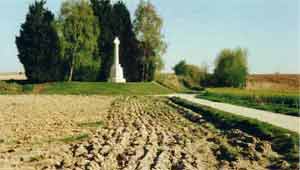
A memorial standing near the sunken lane's junction with New Beaumont Road commemorates not the 1 July attack, but 1/8th Battalion The Argyll and Sutherland Highlanders, who helped take the village on 13 November 1916.
The edges of the sunken lane are now lined by bushes. On its eastern edge warning tapes mark the position of a bunker which collapsed during ploughing in about 1999.
The German trenches ran along the edge of the trees across the field to the east: a small cemetery between the sunken lane and the German position marks the spot in no man's land where many of the attackers were killed.
Source
Miraculously, I breathlessly reached the sunken road, practically leaping the last yard or two and diving into its shelter. Picking myself up and looking around, my God, what a sight! The whole of the road was strewn with dead and dying men. Some were talking deliriously, others calling for help and asking for water... Once more we sprang into that fusillade of bullets. In a few moments I must have been alone and quickly decided to drop into a shell-hole... I could look back over no-man's-land towards our trenches. Hundreds of dead lay about and wounded men were trying to crawl back to safety; their heart rending cries for help could be heard above the noise of rifle fire and bursting shells.
Cpl George Ashurst, My Bit
Stand 3: The Thiepval Memorial
Then
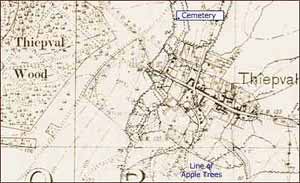
The memorial stands on one of the strongest parts of the of the German front line, which was attacked by 32nd Division on 1 July 1916: it was held by 99th Reserve Infantry Regiment. Thiepval village was attacked by 15th Battalion The Lancashire Fusiliers (The Salford Pals) who lost 21 officers and 650 NCOs and men.
Part of the ground to the north, between Thiepval and the River Ancre, was taken by 36th (Ulster) Division. But 32nd Division's inability to capture Thiepval meant that the German machine-guns there prevented the Ulstermen from being reinforced.
Thiepval was eventually taken by 18th Division on 26 September 1916 in a well-planned operation which reflected great credit on its commander, Major General Ivor Maxse, one of the most capable British generals of the war. No less than 60,000 shells (including 500 gas shells) were used in the three-day bombardment for this attack alone.
Now
All British and Dominion dead in both world wars have either a known grave or a Memorial. The Thiepval Memorial commemorates over 70,000 British and 830 South African officers and men killed in 1916-17 on the Somme. Over 1,000 of those mentioned on the memorial have since been found and so have known graves.
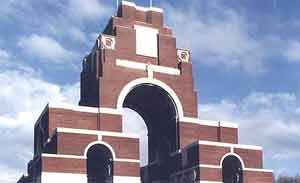
The Memorial, in the form of a brick and masonry arch standing approximately 150 feet high, was designed by Sir Edwin Lutyens and is the largest of the Memorials built by the Imperial (now Commonwealth) War Graves Commission. The names of the missing are carried on masonry panels.
The Memorial was built to symbolise the Allied effort: it is designed to fly a British and a French flag, and the cemetery adjoining it contains 300 British and 300 French dead.
Source
Major General Maxse paid a handsome tribute to the men of 18th Division, writing that: '...their achievement will bear comparison with any similar fear of arms in this war. The gallantry displayed by all ranks has been handsomely recognised by the award of numerous decorations and medals to the survivors, but I should be doing an injustice to heroic officers and men and incidentally to the 18th Division if I omitted to record in this official report my opinion of what was accomplished by those who fell in action. They did more than their fair share towards the achievement of the success which the survivors alone celebrate.'
Michael Stedman, Battleground Europe: Somme - Thiepval
Stand 4: Lochnagar Crater
Then
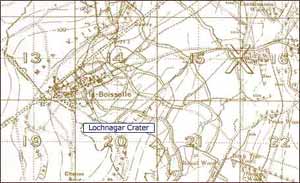
The largest of the mines exploded on 1 July. It contained 66,000lbs of ammonal in two charges 55 feet below the surface
The Somme, with its chalk, was ideal for mining. The work was done by Tunnelling Companies, Royal Engineers, which often recruited men who had been miners in civilian life.
The mine was blown at 7.28 on the morning of 1 July: the explosions constituted what was then the loudest man-made sound in history, and could be heard in London. The mine created a crater 90 yards across and 70 feet deep, with a lip 15 feet high.
The sector was attacked by the 34th Division, a New Army Division consisting of Tyneside Irish and Tyneside Scottish battalions. It lost 6,380 officers and men that day, and was the hardest-hit British division
Now
The site of the crater was bought by an Englishman, Mr Richard Dunning, who feared that farming would steadily encroach upon it. It is the largest surviving mine crater on the Western Front, although some of the mines exploded beneath Messines Ridge in 1917 contained more explosive. It is the scene of a moving commemoration at 7.30 am, zero hour, on 1 July each year.
Although it is sometimes said that the bodies of many British soldiers were buried in the crater, in fact all that could be found were eventually buried in Commonwealth War Graves Commission cemeteries. But evidently not all were discovered at the time, because remains of a British soldier were recently found on the lip of the crater. He was identified and buried with full military honours.
Source
Lochnagar crater stands on high ground with Sausage Valley to its south, named after the 'sausages' - German observation balloons - above it. To the north was Mash Valley, attacked by 2nd Battalion The Middlesex regiment. Lieutenant Alfred Bundy was with them.
'Went over the top at 7.30 am after what seemed an interminable period of terrible apprehension. Our artillery seemed to increase in intensity and the German guns opened up on No Man's Land. The din was deafening, the fumes choking and visibility limited owing to the dust and clouds caused by exploding shells. It was a veritable inferno.
I was momentarily expecting to be blown to pieces. My platoon continued to advance in good order without many casualties until we had reached nearly half way to the Boche front line. I saw no sign of life there. Suddenly however an appalling rifle and machine-gun fire opened against us and my men commenced to fall. I shouted 'down' but most of those that were still not hit had already taken what cover they could find.'
Malcolm Brown, The Imperial War Museum Book of The Somme
Stand 5: New Zealand Memorial
Then
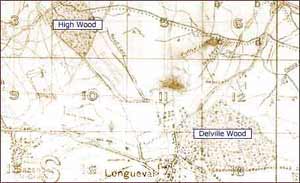
The Memorial stands on the ridge between High Wood and Delville Wood, ground taken in the first ever tank attack on 15 September.
There were 49 tanks in France, and 32 reached the start line for the attack. Some made good progress: one correspondent reported that one was walking up the high street of Flers with the British Army cheering behind it. Shocked Germans described tanks as 'the Devil's Chariots.'
This attack, officially the battle of Flers-Courcelette, made good progress, but ran out of momentum in the German third position with autumn at hand and a blighted battlefield standing between the attackers and their reinforcements.
Now
The New Zealand Division, fighting as part of XV Corps, lost 2,500 men capturing the ground on which its Memorial stands, and the words on the plinth 'From the Uttermost Ends of the Earth' emphasise the sheer distance these young men had travelled to did on the Somme.
In the First World War context the term British Army generally subsumes Australian, Canadian, Indian, New Zealand and South African continents too. Sometimes these were substantial: The Indian army had a corps in France in 1914-15 and a cavalry corps thereafter. Australian and New Zealand troops, eventually combined into the Australian and New Zealand Army Corps (ANZAC) played a distinguished part on the Somme. The Australians wore distinctive broad-brimmed slouch hats, while the New Zealanders had slightly different hats whose fluted peaks gave them the nickname 'lemon-squeezer' hats.
The South Africans provide a brigade of 9th Scottish Division, and helped capture Delville Wood, easily visible to the south of the NZ Memorial. There is a South African Memorial and museum in the wood, and a handy visitor centre on its southern edge.
Source
As they looked towards the English the blood froze in their veins as the two mysterious monsters came creeping over the cater fields... They have learned not to fear man, but here was something approaching which the human brain, with tremendous mechanical powers, had fitted out for a devil's trick, a mystery which oppressed and shackled the powers because one could not comprehend it with understanding - a fatality against which one seemed helpless. One stared and stared as if paralysed.
The monster approached slowly, hobbling, moving from side to side, rocking and pitching, but it came nearer. Nothing obstructed it: a supernatural force seemed to drive it onwards. Someone in the trenches cried 'the devil comes' and that word ran down the line like lightning. Suddenly tongues of fire leapt out of the armoured skins of the iron caterpillar, shells whistled over our heads and a terrible concert from a machine gun orchestra filled the air.
German newspaper quoted in The Times 25 September 1916
Stand 6: Newfoundland Memorial, Guedecourt
Then
Very nearly the limit of the advance in this sector. The Caribou here commemorates the Newfoundland Battalion, which had suffered more losses in its attack on Beaumont Hamel on 1 July than any other battalion, and was still fighting here at the battle's end, capturing a nearby trench on 12 October.
The scene of the last burst of fighting on the Somme, officially the Battle of Transloy Ridges, 7-20 October.
By this time the weather had broken. There was a sea of mud behind the British trenches. It took at least four men to carry a stretcher back, and there was no wheeled transport for 3,500 yards until a light railway track at Longueval. Frost bite and trench foot were running at about 1000 cases per week by the autumn.
A great tract of ground to the east was given up by the Germans in early 1917 when they fell back to the Hindenburg Line.
Now
Bapaume is visible to the north: it was a first day objective.
The Thiepval memorial, which stands on the 1 July front line, is visible to the east. Getting from Thiepval to this spot, now a fifteen minute drive had cost the British army over 400,000 men killed, wounded and missing.
Just south of the village is the AIF Burial Ground (AIF stands for Australian Imperial Force) which contains 3,450 graves, nearly two-thirds of them of unknown soldiers. Buried there is Second Lieutenant Ernest Shephard of the Dorsetshire Regiment. He had served in his regiment's 1st Battalion as a regular soldier, and was commissioned from the ranks into the 5th Battalion, but lived less than two months to enjoy his new rank. His diaries were published as A Sergeant Major's War.
Source
This map reflects the realities of battle during the latter stages of the Somme fighting. Wrecked tanks are marked because they were invaluable landmarks. Trenches have names for ease of description; battalion and company headquarters as well as dressing stations are marked. Dressing stations treated wounded who had been sent back from their Regimental Aid Post, and they went thence to Casualty Clearing Stations further back.
Advanced Dressing Stations often became cemeteries as soldiers died in them before they could be evacuated. The SOS line just in front of British positions marks the line that guns would be laid on when they were not engaged on other tasks. If the infantry was attacked it would simply need to call, by field telephone or signal rocket, for fire on the SOS. Radios, not in general use in World War One, would have made the co-ordination of artillery fire, and much else, a great deal easier.

 The extended lines started in excellent order but gradually melted away. There was no wavering or attempting to come back, the men fell in their ranks, mostly before the first hundred yards of No Man's land had been crossed. The magnificent gallery, discipline and determination displayed by all ranks of this North Country division were of no avail against the concentrated fire effect of the enemy's unbroken infantry and artillery, whose barrage has been described as so consistent and severe that the cones of the explosions gave the impression of a thick belt of poplar trees.
 Sir James E Edmonds, Military Operations: France and Belgium 1916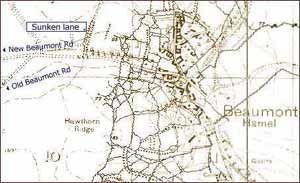

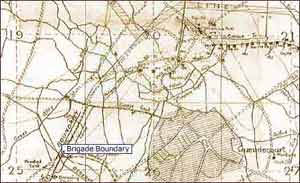
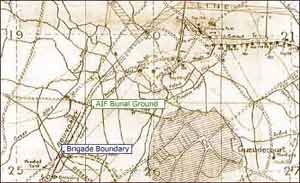
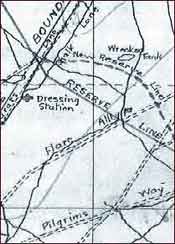 This map reflects the realities of battle during the latter stages of the Somme fighting. Wrecked tanks are marked because they were invaluable landmarks. Trenches have names for ease of description; battalion and company headquarters as well as dressing stations are marked. Dressing stations treated wounded who had been sent back from their Regimental Aid Post, and they went thence to Casualty Clearing Stations further back.