|
Victorian Dundee
Jute, Jam & Journalism
|  | |
Towards the end of the Victorian era, Dundee was famous for its three Js - Jute, Jam and Journalism.
Factsheet - Jute
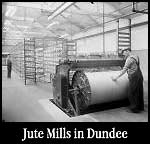 In the 18th century the city was already an established centre of textile production, mainly in linen, and made huge quantities of sail cloth for Europe. By the 1830s, jute was produced to supplement linen production and gradually took over until the city became known as ‘Juteopolis’. The rapid rise in the industry was matched by the growth in population: Dundee expanded fourfold in the 19th century and 50,000 people were employed in the mills and factories at its height. Jute production declined in the 1920s mainly due to fierce competition from the Indian jute industry. The Dundee industry is now completely gone and the city has suffered badly as a result. In the 18th century the city was already an established centre of textile production, mainly in linen, and made huge quantities of sail cloth for Europe. By the 1830s, jute was produced to supplement linen production and gradually took over until the city became known as ‘Juteopolis’. The rapid rise in the industry was matched by the growth in population: Dundee expanded fourfold in the 19th century and 50,000 people were employed in the mills and factories at its height. Jute production declined in the 1920s mainly due to fierce competition from the Indian jute industry. The Dundee industry is now completely gone and the city has suffered badly as a result.
The Verdant Works is a restored 19th century jute mill and a living history
museum preserving Dundee’s long association with the Jute Trade. Find out
about the beginnings of the jute trade in India, experience the harsh
conditions workers were subjected to in the mills through film shows and
interactive computers, and discover why the industry fell into decline.
- Jam
The story goes that it was a Dundee woman, Janet Keillor, who discovered
marmalade in the late 1700s. She came upon the recipe through trying to
find a use for bitter Seville oranges. Her recipe was developed by her son,
James Keillor, who opened Keillor’s factory, famous the world over for
producing jams and marmalades.
Journalism
DC Thomson, publishers of The Beano, The Dandy, The Sunday Post and the People’s Friend, was established in 1905 and still employs around 2000 people to this day. The home of Dennis the Menace and the Bash Street Kids is the Courier Building, headquarters of DC Thomson on the west side of Albert Square.
- Albert Square itself has the grandest Albert Memorial outside London, built by the city’s merchants and industrialists in 1867. Beside the memorial is the McManus Galleries, the city’s main museum and Art Gallery.
Dundee was also a major centre of the whaling industry in Victorian times and whale oil was used in jute production to soften the jute fibres before weaving. This became less viable by the late 19th century when excessive hunting exhausted the Arctic's whale stocks. 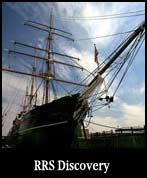 Dundee's expertise in constructing whaling ships that could withstand extreme weather conditions led to it becoming the 'City of Discovery'. In 1899 the National Antarctic Expedition Committee commissioned the Dundee Shipbuilding Company to construct an adapted whaler: the Royal Research Ship, Discovery. In March 1901 the ship was launched, taking Captain Scott on his first voyage to the Antarctic. The ship is still in Dundee today at Discovery Point, where the story is told of Captain Scott's polar expeditions, including the ill-fated attempt of 1910. Dundee's expertise in constructing whaling ships that could withstand extreme weather conditions led to it becoming the 'City of Discovery'. In 1899 the National Antarctic Expedition Committee commissioned the Dundee Shipbuilding Company to construct an adapted whaler: the Royal Research Ship, Discovery. In March 1901 the ship was launched, taking Captain Scott on his first voyage to the Antarctic. The ship is still in Dundee today at Discovery Point, where the story is told of Captain Scott's polar expeditions, including the ill-fated attempt of 1910.
- The other landmark which dominates the city of Dundee is her bridge over the Tay. The Tay Rail Bridge was opened in 1878 and was the longest bridge in the world on completion at over two miles long. It was a mammoth undertaking and cost a massive £300,000 to build. However, in December of the same year, the centre of the bridge collapsed during a storm while a train was crossing - 75 people were killed. An enquiry found the bridge had serious design faults. Incredibly, girders from the collapsed bridge were salvaged and used in the construction of a new railway bridge, which was completed in 1887. You can still see the piers of the original bridge beside its replacement today.
|
|