The Thistle and the Rose - British Union (II)
 |  |
The Warring Parliaments
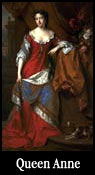 Matters were brought to a head when William died in 1702 and was succeeded by Queen Anne, who was from the Scottish House of Stuart, and who famously described the Scots as an ‘unreasonable and strange people’. The year before, the English Parliament had unilaterally passed the Act of Settlement, stating that, if Anne died childless, the crown would pass to the Protestant Elector of Hanover rather than back to the exiled Catholic Jacobite claimant, James Stuart (the putative James VIII). Matters were brought to a head when William died in 1702 and was succeeded by Queen Anne, who was from the Scottish House of Stuart, and who famously described the Scots as an ‘unreasonable and strange people’. The year before, the English Parliament had unilaterally passed the Act of Settlement, stating that, if Anne died childless, the crown would pass to the Protestant Elector of Hanover rather than back to the exiled Catholic Jacobite claimant, James Stuart (the putative James VIII). In 1703 the first Scottish Parliament of Queen Anne’s reign was faced with the dilemma that they would either have to accept the Hanoverian succession, which would pull them into further disruptive Continental warfare and abandon their ancient line of Stuart Kings, or restore the Stuarts to Scotland, thus breaking the Union of the Crowns of 1603 and ushering in the inevitable warfare that could result in the conquest of Scotland.
The Scottish Parliament immediately responded with the Act of Security, which asserted Scotland’s sovereign rights to make their own decision on the future of the monarchy. They followed this up with the Act Anent Peace and War to prevent Scotland being dragged into foreign wars by Anne’s successor. The English Parliament’s riposte was the Alien Act, which threatened to ban the Scots from all English trade. Relations between the two Parliaments were at their lowest ebb. To the English Government it was unthinkable that the Scots could go their own way, they had to close the Scottish back door to the Jacobites and their French allies. The English Government recognised it would have to deal with the Scots. The Making of the Union
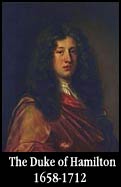
From the English perspective only an incorporating union with Scotland would do, where there was one king and one parliament, and where the Scots accepted the Hanoverian succession, as this alone would guarantee England’s future security. The Scots favoured a federal union, where the Scottish Parliament was retained. Their hopes were dashed, however, especially after the Duke of Hamilton, the leader of the Scots opposition, had remarkably agreed to allow Queen Anne to select the Scottish commissioners who would negotiate the Union.
 In return for accepting the loss of their sovereign parliament and adopting the Hanoverian dynasty the Scots were offered short term commercial advantages for landowners, and free trade with England and her colonial empire. Scotland’s distinctive national identity was guaranteed, and her own laws, education system and Presbyterian Kirk assured. In return for accepting the loss of their sovereign parliament and adopting the Hanoverian dynasty the Scots were offered short term commercial advantages for landowners, and free trade with England and her colonial empire. Scotland’s distinctive national identity was guaranteed, and her own laws, education system and Presbyterian Kirk assured. English troop-manoeuvres were conducted, raising the prospect of invasion and reinforcing English superiority in the Union. Furthermore, the wheels of politics were oiled with English money, secretly distributed to key sections of the nobility in the Scottish Parliament. The Scots who had invested in the Darien venture were to be reimbursed out of money the Scots were given for taking on their share of England’s national debt - this financial sweetener was known as The Equivalent. In the end the realpolitik of the situation and the fractured nature of the opposition was enough to secure a majority in the noble-dominated Scottish Parliament. Outside the Parliament the venture was hugely unpopular. Petitions from Scottish burghs against the Union failed, the mob rioted in Glasgow, Edinburgh and Dumfries, but again to no avail. Contemporaries estimated that 9 out of 10 Scots opposed Union but without aristocratic leadership their was no hope of a spontaneous rising. The Chancellor of Scotland, the Earl of Seafield, signed away Scotland’s sovereign independence saying, ‘There’s ane end of ane auld sang’. On the 1st of May, 1707 the Union came into effect and the bells of St Giles Cathedral in Edinburgh rang out to the tune ‘Why am I so sad on this my wedding day?’ For the English Government it was a diplomatic triumph. For the Scots it created as many problems as it solved. Jacobitism was kick-started and the economic impact of free trade with England was disastrous for over 30 years. Nobody expected the short-term political fix of 1707 to endure, but in one of the ironies of history it became the foundation of the Great British Empire. 
 | |  | The BBC is not responsible for the content of external Web sites. |
|







