|
Stirling Castle Factsheet
| | |
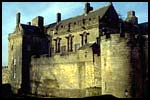 Where Wallace and Bruce had won the kingdom’s freedom, the Stewart’s built their monument to independence. Stirling was the symbolic location the Stewart monarchs chose to make one of their grandest gestures: on top of the castle rock they built a brightly coloured palace that could be seen for miles around. Where Wallace and Bruce had won the kingdom’s freedom, the Stewart’s built their monument to independence. Stirling was the symbolic location the Stewart monarchs chose to make one of their grandest gestures: on top of the castle rock they built a brightly coloured palace that could be seen for miles around.
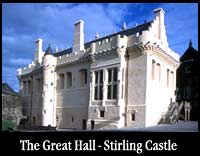
Around the castle’s central courtyard are arranged some of the most splendid buildings to survive from Scotland’s Renaissance. On the one side is the Great Hall built by James IV, and on the other side of the courtyard the magnificent Palace of James V- one of the earliest Renaissance buildings in Britain.
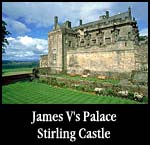 James V’s Palace & The Stirling Heads James V’s Palace & The Stirling Heads
Inside the palace, the King’s presence chamber was richly decorated with 56 oak-carved heads, representing many of his courtiers, along with gods and heroes from Classical antiquity. Known as ‘The Stirling Heads’, and carved in the 1540s, they are perhaps the supreme example of renaissance iconography in Scotland. The courtiers are depicted in the style of classical gods at some sort of celestial court, and this reflects the Renaissance hankering for the cultural glories of classical Rome and Greece.
- 38 of the original 56 heads survive today, and they would have fitted into an oak framework on the ceiling of the king's chamber- a fairly common feature in many palaces on the continent at the time.
The courtiers depicted in the carvings are the most fashionable and creative people of the day, who came to the court of the Stewarts to win fame and 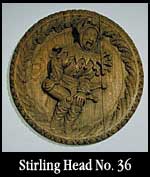 fortune. All kinds of people met at the Palace and the court was extremely cosmopolitan: communicating in up to six different languages, and always abreast of the latest technologies in the Europe of the day.
- The Palace itself dates from about 1538 to 1542 and is noticeable for its wealth of exterior sculptures, as well as the famous interior decor. Masons from France worked on the palace and undoubtedly had an influence on its design and style.
- The Great Hall of James IV
The Great Hall was built around 1500 for James IV and housed one of the most cosmopolitan and talented courts Scotland ever saw.
- The alchemist John Damian was one such courtier, who promised the King that he would produce gold from base metals, and who attempted to fly from the castle walls in 1508.
- The great Makar, William Dunbar, was also a prominent member of the court and we know many of the palace intrigues today from his poetry.
- The hall measures 42.2m by 14.3m, and has five huge fireplaces to warm the court through the winter months.
 | |  | The BBC is not responsible for the content of external Web sites. |
|
|