|
| Bannockburn Factsheet |  | |
 And when it comes to the fight
Let each man set his heart will and strength
To humble our foes’ great pride.
They will come arrayed on horse
And advance on you at no small speed;
Meet them with spears boldly,
And think then of the great ill
That they and theirs have done to us
And are still determined to do.
Bruce’s advice to his troops before Bannockburn
in John Barbour’s epic poem ‘The Bruce’ c.1377.
From modern translation by A.A.M.Duncan.
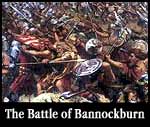
Bannockburn. If there is a fact every Scot knows, it is who won the Battle of Bannockburn in 1314; although it did not bring outright victory in the war, which lay 14 years in the future and would only be won at the negotiating table. The victory was a combination of Bruce’s demand of 1313: that all of the remaining Balliol supporters acknowledge his kingship or forfeit their estates, and the imminent surrender of the English garrison encircled in Stirling castle - which spurred Edward II to invade Scotland. He mobilised a massive military machine: summoning 2,000 horse and 25,000 infantry from England, Ireland and Wales. Although probably only half the infantry turned up, it was by far the largest English army ever to invade Scotland. The Scots common army numbered around 6000, with a small contingent on horseback. It was divided into three ‘divisions’ or schiltroms (massive spear formations), led by King Robert Bruce, his brother, Edward, and his nephew, Sir Thomas Randolph, Earl of Moray. After eight years of successful guerrilla warfare and plundering the north of England for booty, the Scots had created an experienced battle-hardened army. In June 1314, Edward II crossed the border only to find the road to Stirling blocked by the Scots army. Bruce had carefully chosen his ground to the south of the castle, where the road ran through the New Park, a royal hunting park. To his east lay the natural obstacles of the Bannock and Pelstream burns, along with soft, boggy ground. It seems Bruce planned only to risk a defensive encounter, digging pots (small hidden pits designed to break up a cavalry charge) along the roadway, and keeping the Torwood behind him for easier withdrawal. 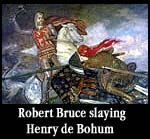 The First Day, Sunday 23rd June, 1314 The First Day, Sunday 23rd June, 1314
The battle opened with one of the most celebrated individual contests in Scottish history. Sighting a group of Scots withdrawing into the wood, the English vanguard, made up of heavy cavalry, charged. As they clashed with the Scots, an English knight, Sir Henry de Bohun, spotted Robert Bruce. If de Bohun had killed or captured Bruce, he would have become a chivalric hero. So, spurring his warhorse to the charge, he lowered his lance and bared down on the king. Bruce, an experienced warrior, didn’t panic, but mounted ‘ane palfray, litil and joly’ and met the charge. Dodging the lance, he brought his battle axe down on de Bohun’s helmet, striking him dead. Elated, the Scots forced the English cavalry to withdraw.
Two of Edward’s experienced commanders, Sir Henry Beaumont and Sir Robert Clifford, attempted to outflank the Scots and cut off their escape route - very nearly surprising the Scots. At the last moment, however, Thomas Randolph’s schiltrom dashed out of the wood and caught the English cavalry by surprise. A ferocious melee ensued. Without archers the cavalry found they were unable to get through the dense thicket of Scots spearmen, even resorting to throwing their swords and maces at them, until the Scots pushed them back and forced them into flight.

 | |  | The BBC is not responsible for the content of external Web sites. |
|
|