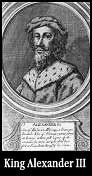
 Scotland and England are two nations divided by their experience of history. That divide was never wider than during the Wars of Independence in the 13th and 14th centuries when a chance event brought an era of relative friendship to an end in violent conflict. The crisis began in 1286 when Alexander III fell from his horse on the sands of Kinghorn and broke his neck. After Alexander’s death, Scotland was governed by the premier nobles and bishops of Scotland, known collectively as the Guardians of Scotland. In 1286 Alexander’s heir to the throne was Margaret, the Maid of Norway, but her death in 1290 brought Scotland to the brink of civil war as two claimants emerged for the vacant throne, John Balliol and Robert Bruce (grandfather of the more famous Robert Bruce who fought at Bannockburn). John Balliol had the most lawful claim, since he was descended from a male ancestor of Alexander III. He headed the powerful Balliol/Comyn faction that controlled much of the north and Galloway.
The claim of Robert Bruce was closer by degree, but through a female ancestor. His powerbase was in the south, in Ayrshire and Annandale, and was backed by the powerful Stewarts.
To avoid civil war someone would have to mediate and make a decision, and soon the Guardians turned to Edward I of England as a respected king and neighbour to adjudicate the contest. 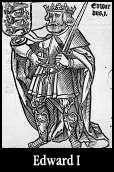 Edward and the Diplomacy Game Edward and the Diplomacy Game
Edward soon realised he could exploit the situation to his advantage. He invited the Scots to Norham Castle, just on the English side of the border. However, the Scots declined, fearing this would give Edward symbolic authority over them. He then asked the Scots to acknowledge his overlordship. The Scots declined, stating they could find no historical evidence for Edward’s claims.
The task then fell to Bishop Wishart of Glasgow to tell Edward, to his face, that since there was no King of Scots, the Guardians of Scotland could not surrender any Scottish sovereignty to England, since only the rightful Scottish King could do so.
Thus far Edward's plans had been foiled, but, being an expert in legal matters, he cunningly exploited medieval law to achieve his end. Edward was to adjudicate between the two claimants, but if there were three or more, he would have to judge, and a judge had to have authority. Edward procured a veritable avalanche of claimants, with Bruce and Balliol under the immediate pressure of others seeking Edward’s favour. Of the two original claimants, Bruce was the first to pay Edward homage; Balliol, seeing his kingship slipping away, followed suit later. 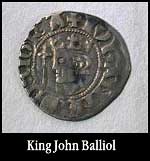 Edward had what he wanted: whoever the king was to be, he had already recognised English overlordship. In 1292 John Balliol was judged to be the winner and was proclaimed King of Scots at Berwick. Edward had what he wanted: whoever the king was to be, he had already recognised English overlordship. In 1292 John Balliol was judged to be the winner and was proclaimed King of Scots at Berwick.
No sooner was Balliol crowned than Edward began active interference in Scottish affairs, intervening in legal cases, keeping taxes and demanding Scottish troops to fight in France. Rapidly the Scots realised they would have to fight Edward - not a task undertaken lightly as Edward had one of the most formidable military machines in Europe at the time.

 | |  | The BBC is not responsible for the content of external Web sites. |
|