Edinburgh New Town
 |  | |
Symbol of the Scottish Enlightenment
 Scotland’s new imperial vision can be seen in the practical, physical improvements of Edinburgh’s New Town. Its combination of Gothic and Greek architectural styles reflected the roots of European civilisation and aimed to establish Edinburgh as the Athens of the North. The initiative was a symbol of Scotland’s involvement in European culture of the time and demonstarated the North Britons’ desire to play a central role in the British Empire. Scotland’s new imperial vision can be seen in the practical, physical improvements of Edinburgh’s New Town. Its combination of Gothic and Greek architectural styles reflected the roots of European civilisation and aimed to establish Edinburgh as the Athens of the North. The initiative was a symbol of Scotland’s involvement in European culture of the time and demonstarated the North Britons’ desire to play a central role in the British Empire. North Britons
The idea for a New Town in Edinburgh emerged after the defeat of the 1745 Jacobite Rising. Architect James Craig initially envisaged a ‘patriotic’ street plan in the shape of a Union Jack, but this was soon abandoned. The imposition of Scotland’s new British identity is, however, reflected in the New Town’s very British street names: Cumberland Street, after the Duke of Cumberland (the ‘butcher’ of the Battle of Culloden); Hanover Street, after the House of Hanover; Frederick Street, after George III’s father; with Thistle Street and Rose Street symbolising the Union of 1707. Scotland’s own distinctive religious identity was recognised in St Andrew Square.
Factsheet
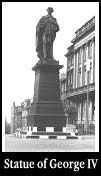
- George Street was named after the Hanoverian King George III; it was intended to be the grandest street (and widest, at 115 ft) in the New Town linking two identical squares: St Andrew, patron saint of Scotland, in the east, with St George, patron saint of England, in the west (although this was renamed Charlotte Square). George IV's visit in 1822 prompted a commemorative statue, which can be seen at the junction with Hanover Street, and which portrays him in ceremonial robes worn over a kilt (reportedly he wore silk stockings under his kilt). Also, there are statues of Dr Thomas Chalmers,
 who was instrumental in the formation of the Free Church of Scotland, and William Pitt, who was Prime Minister when the New Town was under construction. who was instrumental in the formation of the Free Church of Scotland, and William Pitt, who was Prime Minister when the New Town was under construction.
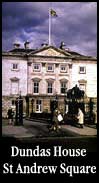
- St Andrew Square. In the centre is the statue of Henry Dundas, the colossus of late 18th century Scottish politics. He wielded considerable power in Scotland, earning himself the nickname ‘Harry the Ninth, uncrowned King of Scotland’. Dundas was the Government’s political manager in Scotland, distributing offices to the nobility and representing the interests of the landed class. He also created overseas posts for favoured Scots. His lasting achievement was to convince Scotland’s nobility into a new form of patriotism founded on improving schemes, self-interest, Scots sentiment, and a firm commitment to the British Empire. Dundas House, built for Lawrence Dundas in 1774, is on the east side of the square and has been the HQ of The Royal Bank of Scotland since 1825. The house was modelled on a Roman villa, showing the fashions and aspirations of the Edinburgh gentry and aristocracy of the time.
- Charlotte Square: named after Queen Charlotte, wife of George III. The square was designed as an integral unit by Robert Adam in 1791, with the exception of St George’s Church on the west side which was designed by Robert Reid to replace a more costly Adam design.
- Princes Street. Not really thought of as part of the New Town by locals, the street was originally to be named St Giles Street after the patron saint of Edinburgh, and was renamed Princes Street after King George III’s sons (Prince George, the future George IV, and the Duke of York). Construction began at its east end and reached Hanover Street by 1786, Frederick Street by 1795, and its west end by 1805. Designed to have one of the finest panoramas in Europe, commercial considerations bedevilled the plan to fill it with fine residences right from the start. Tradesmens' booths had to be demolished on its south side as they spoilt the view, but, nevertheless, Princes Street became increasingly commercial, eventually becoming the busy shopping street which we see today.
- Princes Street Gardens. The idea of an ornamental park between Edinburgh’s Old and New Towns was incorporated in James Craig’s original plan to replace the Nor’ Loch, which for centuries had formed a crucial defensive barrier on Edinburgh’s north side. Craig’s idea was for an ornamental canal but plans for its construction were abandoned after the Mound was built to connect the New Town and the Old in 1790- the mound itself was formed from millions of
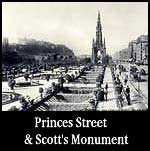 cartloads of earth created by the excavation of foundations for houses in Princes Street. The gardens’ construction blocked up a culvert running between St Cuthbert’s Church and the North Bridge, resulting in a kind of swamp, which became ‘the receptacle for many sewers and seemingly all the worried cats, drowned dogs and blackguardism of the city.’ From 1816 the Gardens began to replace the swamp although the East Garden succumbed in 1845 to the North British Railway’s plans for Waverley Station. cartloads of earth created by the excavation of foundations for houses in Princes Street. The gardens’ construction blocked up a culvert running between St Cuthbert’s Church and the North Bridge, resulting in a kind of swamp, which became ‘the receptacle for many sewers and seemingly all the worried cats, drowned dogs and blackguardism of the city.’ From 1816 the Gardens began to replace the swamp although the East Garden succumbed in 1845 to the North British Railway’s plans for Waverley Station.
 | |  | The BBC is not responsible for the content of external Web sites. |
|