Radicalism
 A Man’s a Man for a’ that’.
Ye see yon birkie ca’d ‘a lord’,
Wha struts an’ stares, an’ a’ that?
Tho’ hundreds worship at his word,
He’s but a cuif for a’ that.
For a’ that, an’ a’ that,
His riband, star, an’ a’ that,
The man o’ independent mind,
He looks an’ laughs at a’ that.
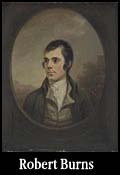
Robert Burns - ‘A Man’s A Man For A' ThatThe term ‘radical’ literally means ‘from the root’, and describes exactly the kind of political reform that the Radical movement was seeking towards the end of the 18th century. One of the most famous radical sympathisers in Scottish history was the poet Robert Burns. This is shown in what is considered by many to be Burns' most famous song, A man’s a man for a’ that, which encapsulates in song the radical ideas of Tom Paine, the author of The Rights of Man. Burns’ notion of the independent mind, like many others, was influenced by two very important international events at the time: The American and French Revolutions.The American Revolution
The progress of the American Revolution, 1776-83, was closely followed by a Scottish public with a growing interest in international events. Newspaper circulation boomed as news-hungry readers followed the disastrous progress of the war and the British Government’s increasing incompetence. Many Scots, whose livelihoods depended on the Atlantic trade, patriotically desired the revolution crushed, but with defeat in 1783 they became increasingly critical of their noble leaders. With the establishment of the United States reformers now had a concrete example of how a more socially progressive society could be constructed.
The French Revolution
The advent of the French Revolution in 1789 seemed to herald a new age of Enlightenment across Europe. As the French embraced an enlightened constitution, Radicals in Scotland began to demand the same. The Revolution was an inspiring example for Scotland’s developing middle and working classes; it demonstrated that they too could participate in the governance of the country, that the status quo could be changed, and that constitutions weren’t handed down from God but were made by men.
Radical Scotland
Liberty trees, a French revolutionary symbol, were planted around Scotland on market crosses, and ideas of political reform were being publicly debated. At Edinburgh, in what became known as the King’s Birthday Riots, thousands protested for three days from the 4th of June, 1792. They burnt effigies of the Home Secretary, Robert Dundas, and attempted to burn down the Lord Advocate‘s house. Only an army-command to open fire on the mob managed to suppress the riot eventually, and the authorities worried that riot might turn to revolution.
In December 1792 a democratic organisation called the Friends of the People was created out of numerous Reform Societies which had emerged across Scotland. They demanded moderate change, to bring the mercantile middle classes into the governance of the country; however, change was not forthcoming, and as Henry Dundas said: ‘It would be easier to reform Hell’. When events in France turned into ‘The Terror’ of 1793, with the widespread public execution of nobles and priests, the British Government set out to quash the Radicalism in no uncertain terms.