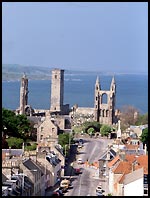
St. Andrews
 |  | |
Having St Andrew as your patron saint was no bad thing in the Christian world: he was actually in the Bible and one of the first followers of Jesus. Only St Peter in Rome and St James at Santiago de Compostella had equivalent kudos. To the dark age and medieval mind, he was as close to Jesus as you could get.
The town of St Andrews on the east coast of Scotland, now a centre of pilgrimmage for golfers, was a magnet for religious pilgrims during the medieval period, and has been pivitol in the swings and roundabouts of political and religious history in Scotland since it was a Pictish settlement.
St. Andrews Factsheet
- Early St Andrews (or Kinrymont)- A Pictish Monastery
St Andrews has been a Christian burial ground since perhaps the 5th century, making it one of the oldest Christian sites in Scotland. It was a Pictish royal centre until the reign of the warrior King Unust and the arrival of St Andrew's relics.
Sometime after the reputed arrival of the saint's relics, the Pictish King Unust (729-761), the man who founded the town, built a church dedicated to St Andrew - perhaps within an existing Pictish monastic enclosure. Nearby lay the Pictish royal residence - located, probably, at the end of North Street and spreading into what later became the Cathedral precincts.
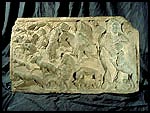 King Unust is believed by many to lie in the famous St Andrews Sacrophagus, which can still be seen in the Cathedral's museum. A treasure of Dark Age Pictish art, the Sarcophagus may have lain before the high altar of the original 8th or 9th century church dedicated to the saint. Covered in old testament iconography, it depicts the biblical King David - the icon of medieval kingship. King Unust is believed by many to lie in the famous St Andrews Sacrophagus, which can still be seen in the Cathedral's museum. A treasure of Dark Age Pictish art, the Sarcophagus may have lain before the high altar of the original 8th or 9th century church dedicated to the saint. Covered in old testament iconography, it depicts the biblical King David - the icon of medieval kingship.
Others believe it was designed to hold a later Pictish King, Constantín (789-820), who re-founded the Church at St Andrews and may have been regarded as a saint.
Despite St Andrew's biblical fame, he didn’t gain immediate, widespread recognition across Scotland, whose peoples already had many local saints to worship. The cult remained essentially Pictish in its early years.
- Constantine II and St Andrews
In the chaos of the Viking onslaught, Kinrymont, as St Andrews was then known, probably suffered devastating raids, although there is no written record of it. However, with the birth of the Kingdom of Alba at the start of the 10th century, the town and the cult flourished.
In 906 AD, King Constantine II reorganised the Pictish Church along Gaelic lines, giving St Andrews a new role as the Episcopal centre of the Kingdom of Alba. When he retired from the kingship in 943, Constantine became a monk and later The Abbot of St Andrews.
According to legend, Constantine's monastic habit didn’t prevent him from raiding Northumbria one more time. But it seems more likely Constantine was sincere in his monastic piety. When he died in 952, he was buried at St Andrews - a sign of changing times - for he was the first Gaelic king not to be buried at the home of St Columba's cult on the island of Iona.

 | |  | The BBC is not responsible for the content of external Web sites. |
|