Iona - A Beacon of Light Through the Dark Ages
 |  | |
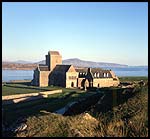 Discover the spiritual heart of Scottish Christianity on the Hebridean island of Iona. For over 1,400 years the fame of its monastic founder, St Columba, has made it one of the most popular pilgrimage sites in Scotland, and for centuries it was the burial ground of her Dark Age kings. Discover the spiritual heart of Scottish Christianity on the Hebridean island of Iona. For over 1,400 years the fame of its monastic founder, St Columba, has made it one of the most popular pilgrimage sites in Scotland, and for centuries it was the burial ground of her Dark Age kings.
Iona - Factsheet
- The island of Iona, off the west coast of Scotland, is the symbolic centre of Scottish Christianity. Through 1400 years of history its fortunes have fluctuated, from its heights as one of the greatest centres of learning in Dark Age Europe, to its lows as a crumbling ruin. However, thanks to the fame of its monastic founder, St Columba, the island has always been revered as a holy place, and, over the centuries, Iona has continually been re-invented and reconstructed as a centre for pilgrimage.
- Iona’s fame began in 563 AD when Columba, with thirteen followers, landed at the south end of the island, at St Columba’s Bay, to establish a monastery.
- The great abbey we see today belongs to a later era. Columba’s Iona was a very different affair, and he wasn’t very interested in grand buildings, rather he was seeking seclusion among the ‘desert’ of the Atlantic ocean. Almost nothing remains of his original monastery. Traces of the vallum, or ditch, that surrounded the monastic enclosure, can still be seen. Inside would have been a settlement that resembled a small village - a modest, timber church, surrounded by huts for the monks to live and work in, and small cells to provide the solitude necessary for prayer. These cells, or chambers, used for prayer, are also found on the nearby islands of Canna and Eileach Naoimh, and certain islands off the coast of Ireland such as Skellig Michael.
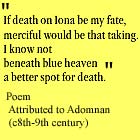
- From Adomnan, who wrote Columba's biography 100 years after his death, we know a great deal about the early monastery’s daily life. Withdrawn, contemplative and austere, its primary purpose was the contemplation of God through prayer and learning. Holy texts from around Europe were copied, poetry flourished and Adomnan himself wrote a guide to the Holy land - a fact which illustrates that the monastery's intellectual horizons stretched right across Christendom. As a consequenceIona amassed one of the greatest libraries in Western Europe and became a powerhouse of Dark Age learning.
 - Columba died on the 9th June 597 AD. Adomnan writes that his final day was spent copying a psalter, on the Torr An Alba (the Hill of Scotland): the rock which stands in front of the Abbey today. He urged his successor as abbot to take up his work, then went to the church, dying in prayer before the altar with a final gesture of blessing on his monks. He is believed to have been buried below the small, stone chapel shrine, which is attached to the front of the abbey. It was around this building, or an earlier version of it, that the cult of Columba developed.

 | |  | The BBC is not responsible for the content of external Web sites. |
|