Dunnottar Castle
 |  | |
Dunnottar Castle has played an important role during many crucial episodes of Scottish History, however, it was originally known as a Pictish fortress, and its greatest hour came during Æthelstan 's invasion of Alba 934AD.
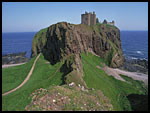
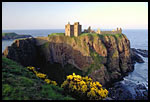
The castle is probably the most dramatic historical site in Scotland: a formidable castle rock, surrounded on three sides by the North Sea and accessed only by a narrow isthmus of land with a steep, stone-cut path leading to the top of the rock. For over 1000 years it played a crucial role in Scottish history, occasionally as Scotland’s last bastion, and has housed some of the nation's greatest historical figures: Constantine mac Aed, Sigurd the Mighty, William Wallace, Mary Queen of Scots, and the Marquis of Montrose. Dunnottar Castle Factsheet - We know Dunnottar was a Pictish fortress of strategic importance, set on the frontier between north and south Pictland where the Grampian mountains come close to the North Sea.
- Its early appearances in history are some what mysterious. In 681 and 694 AD the Annals of Ulster simply record ‘Obesessio duin Foither’ - a siege at Dunnottar.
- The 681 AD siege happened in the reign of King Bridei, son of Bili, who was attempting to unite the Picts by force against the overlordship of the Angles. Bridei attacked Orkney in 682 AD from his bases north of the River Tay. Either he attacked Dunnottar as the opening move in his northern campaign or his later attack on Orkney was in reprisal for the Orcadian Picts' siege of Dunnottar.
- After Bridei’s death in 693 AD a power struggle, unsurprisingly, ensued in Pictland. His successor, Taran, was expelled only three years later, suggesting he wasn’t very popular. So, the second siege of Dunnottar, may have been part of a bitter Pictish civil war.
- Over thirty years later Dunnottar was the scene of one of the most important battles of the Dark Ages - one which could be looked upon as the first ever big battle between the Scots and the English, as the British Isles started to split into two major power blocks. In this episode Constantine II (Constantín mac Áed) defied the conquest of Æthelstan, King of Wessex, by surviving a month-long seige at Dunnottar. Read the story of Constantine's defiance of Æthelstan
- In the late 13th century the oldest part of the present castle, a stone church, was constructed and dedicated to St Ninian, who was believed to have converted the Picts to Christianity - this seems unlikely however, as when St Columba visited Pictland at a later date the Picts were still pagans.
- During the Wars of Independence the castle was garrisoned by Edward I, King of England, after his crushing defeat of John Balliol, King of Scots. A year later, in 1297 AD, none other than William Wallace, laid siege to Dunnottar, burning down its wooden walls with an English garrison inside. The Scots makar, or poet, Blind Harry, wrote an chilling account of the struggle for the rock in his epic poem ‘Wallace’:
Therefore a fire was brought speedily:
Which burnt the church, and all those South’ron boys:
Out o’er the rock the rest rush’d great noise;
Some hung on craigs, and loath were to die.
Some lap, some fell, some flutter’d in the sea;
And perish’d all, not one remain’d alive.
Extract of Blind Harry ‘Wallace’ c1470’s Harry, seems to be familiar with Dunnottar, and may have visited what had become the Renaissance home of the Earls Marischal.
- In 1651, Oliver Cromwell’s army laid siege to the castle for eight months attempting to steal the Scottish Crown Jewels, however the jewels were saved, smuggled out by Mrs Grainger, wife of the minister at Kinnef Kirk - a village a few miles south of Dunnottar. Here they were hidden at the old Parish Church.
- The castle never recovered from the damage inflicted on it by Cromwell’s cannons. In the late 17th century it lay mostly derelict but was used on one infamous occasion as a prison for radical Presbyterians, or Covenanters, who refused to accept the king as their overlord in matters of religion. In 1685 in the midst of what is known as ‘the Killing Times’, 167 Covenanters were imprisoned in what is known as the Whig’s Vault at the far end of the castle.
- Dunnottar Castle was the home of the Earls Marischal of Scotland, who oversaw all ceremonial activities in the Scottish Court, including the coronations. They were also responsible for the security of the Scottish Crown Jewels, known as the 'Honours of Scotland'.
- The castle’s active history came to a close when the last Earl Marischal was executed for his part in the 1715 Jacobite Rising and the castle was confiscated by the government. It remained neglected until 1925 when the 1st Viscountess Cowdray started its restoration. It remains in private ownership today, but is open to the public.
 Back to Aberlemno Castle Back to Aberlemno Castle
Back to the Kingdom of the Picts
 | |  | The BBC is not responsible for the content of external Web sites. |
|