The Kingdom of the Gaels -
Dál Riata
 |  | |
The Royal Centre of Dunadd
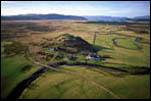
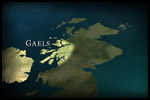
Discover the Gaelic Kingdom of Dál Riata and the royal centre of Dunadd - a stunningly beautiful hill fort in modern day Argyll, where a footprint in the rock marks the inaugural spot where the Gaelic kings were symbolically married to the land they were to rule - a consort to the female nature spirit which the Gaels worshipped from pagan times.Dunadd hill fort, in Argyll, can lay claim to being the foundation stone of the Kingdom of the Scots. It was the royal centre of the kingdom of Dál Riata, whose kings became the Kings of Scotland and whose people, the Gaels, gave Scotland its name and Gaelic culture. Dunadd is a spectacular site to visit and traces of its Dark Age splendour can still be found. It lay at the centre of the Dark Age Kingdom of Dál Riata, which stretched northwards to Ardnamurchen, west to northern Ireland and south to Arran and the Mull of Kintyre. In its heyday Dunadd would have been an impressive sight, a single rock outcrop set in the flat bottom of the Kilmartin Valley. On its upper slopes Dunadd was surrounded by stone ramparts, the remains of which can still be seen, and entry was through a natural cleft in the rock sealed by wooden gates. Beyond the gate were houses and workshops for smelting iron and gold. An important trading centre, many goods flowed through it: gold from Ireland, wine from southern Europe, even rare minerals from the far east used by scribes to colour manuscripts.
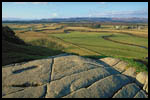
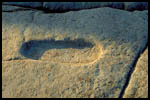
Through a second set of ramparts lay Dunadd’s summit, possibly the site of the king’s mead house. Just below the summit, on an outcrop of rock, lies the inauguration stone of the Kings of Dál Riata. A footprint carved into the rock is the most striking and evocative symbol of Scottish Kingship. Here the king’s of Dál Riata, from Aedan to Kenneth MacAlpine, were inaugurated, their followers gathered below. The inauguration stone of The Kings of Dal Riata (left and above).
The King would place his foot in the hole, symbolising his union with the land.
Kingship brought expectations: that a new king would bring fertility, bountiful seasons and success in war. The ceremony was partly pagan: a symbolic marriage to the land, with the king’s bard reciting his genealogy back to his mythic ancestors; and part Christian: as the kings were blessed by the abbot of Iona.
 Click for Dal Riata Factsheet Click for Dal Riata Factsheet
 | |  | The BBC is not responsible for the content of external Web sites. |
|