Constantine mac Aed, King of Alba 900-943 (page 2) The power of the pagan Vikings began to wane in the early 10th century as Christian kings like Constantine and the Kings of Wessex allied against them. In 928 AD, Athelstan, the Anglo-Saxon King of Wessex, conquered the Viking Kingdom of York. Not content to stop there, he aimed for nothing less than subduing the whole of Britain to his will. Dunnottar Castle
The rock fortress where Constantine II is thought to have been besieged by Athelstan, King of Wessex. | 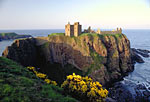 |
In 934 AD Athelstan marched north, forcing the Earls of Northumbria and the Kings of Strathclyde to acknowledge him as overlord. Alba had never seen so vast an army: Athelstan had brought with him 3 Welsh kings and 6 Viking chieftains. Constantine was forced into retreat and was besieged, it is thought, at the rock fortress of Dunnottar. The fortress was too strong for Athelstan to take, however Constantine must have been forced into some form of recognition of Athelstan's claims.
Constantine’s response to Athelstan came in the form of cunning diplomacy. He married his daughter to Olaf Guthfrithsson, the pagan king of Viking Dublin and persuaded Owein of Strathclyde, his relative, to support his cause. In 937 AD they invaded Athelstan’s England. At the Battle of Brunanburh, at an unknown location deep in England, they fought one of the largest and bloodiest battles of the Dark Ages. Athelstan was victorious, Owein of Strathclyde was killed and the Anglo Saxon Chronicle revelled in Constantine’s defeat. ‘The hoary man of war had no cause to exult
in the clash of blades; he was shorn of his kinsmen,
deprived of friends, on the meeting place of peoples,
cut off in strife, and left his son
on the place of slaughter, mangled by wounds,
young in battle. The grey-haired warrior,
old crafty one, had no cause to boast’ Despite defeat, Athelstan was weakened and Constantine’s diplomacy and network of allies had freed Alba and Strathclyde from the southern threat. Olaf Guthfrithsson restored Viking rule to York and Athelstan’s grand schemes lay in ruins. In 943 AD, after reigning for 43 years, Constantine retired from the kingship and for the final nine years of his life became a monk at St Andrews. He was Scotland’s most successful Dark Age king, a success won through a combination of strength in battle and diplomacy. His combined forces approximated something very close to a northern powerblock, one which pitted itself against another powerblock to the south - a story which was to repeat itself many times throughout the next millennium.
  | |  | The BBC is not responsible for the content of external Web sites. |
|









