|
Stone Circles - Ring of Brodgar
Factsheet
|  | |
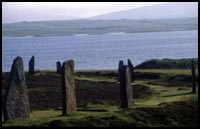
- The original circle contained 60 standing stones, of which 36 survive with 27 still standing. The stones are set in a perfect circle 103.6m/340ft. in diameter. Probably created by putting a post in the ground and using a cord pulled taught to mark out their positions around the circumference. Some archaeologists would go further. Professor Thom believed the circle builders understood certain Pythagorean mathematical theories - 2,500 years before the Pythagoreans deduced such theories. He also thought that the Neolithic builders used a standard unit of measurement called the megalithic yard (0.829m/2.72ft). The Ring of brodgar is a perfect example of this theory: measuring exactly 125 megalithic yards in diameter.
- Was it a Neolithic Astronomical Observatory?
brodgar does not have any clear alignments to the stars or the moon. But it is part of a wider complex of ritual monuments and standing stones. A standing stone at Deepdale, across Loch Stenness and in line of sight from brodgar, seems to be associated with the setting sun.
- brodgar is closely related to other nearby, Neolithic sites. It was linked to the Stones of Stenness by a causeway guarded by a pair of standing stones; and another standing stone nearby, the Barnhouse Stone, seems in alignment with the winter sunset at the Maes Howe chambered tomb.
- How long did it take to build?
Theories abound. Some archaeologists believe that they were put up over a long time period: built by small communities or by individuals who gained prestige by organising a stone to be erected to the memory of the ancestors - a process that would have taken generations to complete and required a sense of long-term planning.
- Others see Orkney as developing powerful chiefdoms that were capable of mobilising the Neolithic farming people into this massive effort.
- The ditch that surrounds the stones was itself a huge undertaking and is still visible today. Carved out of bedrock, it was 10m/33ft across and 3.4m/11ft deep. 4700 cubic metres or 165,978 cubic ft of rock were hacked out of the ground using stone tools - a job that would have taken, it has been calculated, 80, 000 man hours, or 100 men 100 days to complete, even before the stone circle was begun.
 |
|