|
| Skara Brae |  | |
Visit the best preserved Stone Age settlement in Western Europe. Set amidst a landscape littered with the relics of our neolithic ancestors, on the sandy beaches of the Bay of Skaill on Orkney's west coast, Skara Brae is a gift from the past - a true trip into the stone age.
Skara Brae Factsheet
- Right is Male - Left is Female?
Each of the eight dwellings of Skara Brae have the same basic layout - a large room, with a fireplace in the middle, a bed on either side and a dresser facing the entrance.
The visitor to Skara Brae may notice that the right hand bed is always larger that than the left hand bed; this has led some archaeologists, including one of the site's main excavators, Gordon Childe, to speculate that the layout of the village is gendered - right being male and left being female. Beads and paintpots were also found on some of the smaller beds - lending weight to the gendered theory.
- This theory is also supported by the fact that, in most of the later houses, an object on the left hand side of the entrance, usually a stone box, forced a person to turn into the right hand half of the house. This suggested that the right hand side of the dwelling may have been an area where guests were received and the less domestic business of the day was delt with, while the left hand side was reserved for the more domestic chores which were delt with by the women.
Was this part of a greater structure of belief held by the neolithic inhabitants of Skara Brae - that their universe was ordered by gender?
 House 7 - An Apparently Darker History House 7 - An Apparently Darker History
House 7 in Skara Brae may appear very much like the other houses in the community, however, several distinctive features have led archaeologists and historians to theorise that it played a unique, and perhaps darker, part in village life.
- The house is isolated from the main part of the village: access being gained down a side-passage.
- It is the only house in the village in which the door was barred from the outside, not the inside.
- The bodies of two females, interred in stone-built graves, were discovered beneath the right hand bed and wall. It was apparent that the females had been buried there before the house was constructed and their presence could have signified some sort of foundation ritual.
- Most theories on the subject invlove confinement or separation from the rest of the community - they range from childbirth and menstruation to initiation through ritual and imprisonment.
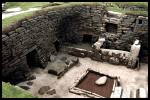
- Stone Age Lavatories?
Off the main room, cells were set into the wall for storage. One of these has a drain and may be the first indoor toilet - long before the Romans amazed Britannia with the wonders of Latin latrines.
 | |  | The BBC is not responsible for the content of external Web sites. |
|
|