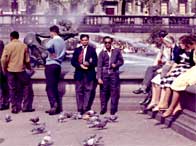
Asian arrivals in Britain
To understand your Asian history, it is helpful to know how your ancestors may have arrived in Britain. The following groups below will all have left documents and records which will help in tracing your family tree:
- Britain’s colonies on the Indian subcontinent allowed many South Asians to travel and work in the UK
- Indian royal families, (for example, Nawabs and Rajas) and diplomats made visits for pleasure or to submit petitions to the Crown on legal matters
- Politicians visited to make arguments for Indian independence, while many merchants travelled to London for business
- Nannies (known as 'ayahs') found themselves employed by the East India Company elite and British officials
- Scholars came to Britain to teach Persian and Hindustani languages
- Students came to study and took the Indian Civil Service exam
- Indian seamen (known as Lascars) worked for the British Merchant Navy
The vast majority of the South Asian population who arrived in Britain from India came after the 1947 partition of India, and there were many later arrivals from Pakistan, Sri Lanka, Nepal and Bangladesh.
Post-war arrivals also included Indian indentured labourers who had migrated to sugar-producing colonies during the colonial period and Indian workers who had gone to work in East Africa.
After the independence of Uganda in 1962, Kenya in 1963 and Tanzania in 1964, there were many upheavals. In 1966, Kenya terminated settlement rights for British passport holders of South Asian descent, creating the first exodus of East African Asian migrants to Britain. This was followed by the expulsion of Asian citizens from Uganda in 1972.
Post-war Asian migrants were skilled workers such as artisans, teachers, medical doctors, and ex-Indian and British Armed Forces personnel. Their spouses and relatives came to join their families who were now living in Britain.
Most of the Asian migrants were Hindu, Muslim, Sikh, Buddhist Zoroastrian (Parsis or Parsees) and Christian (particularly Anglo Indians).
In the 19th century, Asians encountered challenges when they tried to integrate, as their religions were different from the mainstream community.
Many converted to Christianity and some did not change their religion but took anglicized names, as they wanted to fit in and be accepted by the host community. The vast majority did not change their names legally.
[an error occurred while processing this directive]