
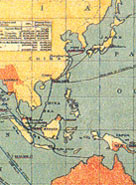
The British Empire forged trading links across the world, particularly in the Far East. How can you explore your relatives' roots if they hailed from this region?
By Dr Nick Barratt
Last updated 2011-02-17
The British Empire forged trading links across the world, particularly in the Far East. How can you explore your relatives' roots if they hailed from this region?
When we think of migration from Asia, the traditional route is via Britain's role in India. However, during the height of the British Empire, trading and commercial links stretched to the Far East, often under the control of the East India Company but enforced by naval and military force. Consequently, the opportunity to move to parts of the UK presented themselves to a large number of people who were either under direct British rule or closely associated with its merchants and traders. Many, for example, joined up with the British Merchant Navy and ended up starting a new life at the end of their journey across the world.
As with most lines of family history, you should start by asking your family what they know. It may be the case that their parents were first generation settlers in the UK, which should result in detailed information about where your ancestral roots lie. Furthermore, if your family have maintained ties with their relatives abroad, you should be able to make direct contact with them and therefore learn more about your roots.
If you don't have this immediate link available, you should use traditional sources such as birth, marriage and death certificates, and depending on when your ancestors arrived in Britain, census returns prior to 1901, to look for clues as to where they originated from. Many people who arrived from overseas territories that were not part of the British Empire or Commonwealth applied for citizenship by a process known as naturalization.
The rules and regulations concerning citizenship have changed over the years - there was a recent debate about the status of the citizens of Hong Kong on the eve of the colony's handover to China - but in general, applicants had to undergo various checks on their suitability to attain British status. Successful applicants were granted a certificate of naturalization - a full list of names can be searched at The National Archives via The Catalogue - and in most cases, background paperwork can be ordered from the archive. These documents can often reveal a great deal of biographical data such as parental names, date of birth, and - most importantly - place of origin, with the length of residency in Britain also noted. It is then a case of taking your research overseas, where relevant archives are likely to be located.
There are a number of research institutions in the UK that are particularly good for either specific record collections, or background information about the archives and resources back in the country of origin. The Oriental and India Office Library, part of the British Library in London, has a wide-ranging collection of documents relating to the parts of the Far East that were under British control, mainly as a result of the activities of the East India Company. You should also consider approaching the Commonwealth Institute and also the School of Oriental and African Studies - both of which have important libraries and research facilities.
Of course, it is also a case of following the clues where they lead you. In the case of merchant seamen who enlisted aboard British registered vessels in the 20th century, there may be records amongst the 5th Register of Seamen, held at The National Archives. Many others joined branches of the British armed forces, particularly during World War Two, and so there are likely to be military service records available. Thereafter, it is a case of heading overseas and continuing your research at the relevant state or provincial archive. The British institutions listed above can help you to find and approach the most applicable source.
If your ancestors moved back and forth between the UK and the Far East, it is worth searching for them on UK outbound passenger lists, which can be found at www.ancestorsonboard.com.
Dr Nick Barratt worked at the Public Record Office (now The National Archives, or TNA) from 1996 to 2000, with the family history team. He has given many talks on family history, and has written frequently for the TNA's genealogy journal, Ancestors. He has worked for the BBC as a specialist researcher on programmes such as 'One Foot in the Past','The People Detective' and 'Who Do You Think you Are?'.

BBC © 2014The BBC is not responsible for the content of external sites. Read more.
This page is best viewed in an up-to-date web browser with style sheets (CSS) enabled. While you will be able to view the content of this page in your current browser, you will not be able to get the full visual experience. Please consider upgrading your browser software or enabling style sheets (CSS) if you are able to do so.

