
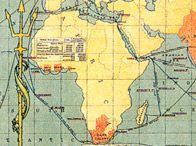
Independence, civil wars or economic migration are just some of the reasons why your ancestors left Africa. Dr Nick Barratt explains how to start researching their history.
By Dr Nick Barratt
Last updated 2011-02-17
Independence, civil wars or economic migration are just some of the reasons why your ancestors left Africa. Dr Nick Barratt explains how to start researching their history.
There has been a long connection between Britain and Africa, much of which is recorded in written record. Early images of black musicians in the medieval English court are captured in illuminated manuscripts, whilst correspondence concerning merchants and traders coming from North Africa are frequently recorded in official State Papers in the 16th and 17th centuries. Yet the most infamous connection between Britain and Africa comes from the exploitation of the slave trade to populate the plantations of Britain's possessions in the Caribbean.
Over the centuries, thousands of individuals were brought in chains from the slave markets of west Africa to the sweltering plantations of the Caribbean, in exchange for goods. Gradually, the 'scramble for Africa' in the 19th century led to the conquest of large parts of the continent, mainly in opposition to other European powers such as France, Belgium and Germany. Whilst not on the same scale as migration from India during the same period, there was still a considerable number of people moving from Africa into parts of Britain, though the bulk of immigration has taken place in the 20th century as a result of independence, partly to escape civil war or persecution in Africa.
As with most lines of family history, you should start by asking your family what they know. It may be the case that their parents were first generation settlers in the UK, which should result in detailed information about where your ancestral roots lie. Furthermore, if your family has maintained ties with their relatives abroad, you should be able to make direct contact with them and therefore learn more about your roots.
If you don't have this immediate link available, you should use traditional sources such as birth, marriage and death certificates, and depending on when your ancestors arrived in Britain, census returns prior to 1901, to look for clues as to where they originated from. Many people who arrived from overseas territories that were not part of the British Empire or Commonwealth applied for citizenship by a process known as 'naturalization'.
The rules and regulations concerning citizenship have changed over the years - during the various independence movements that affected many of Britain's former colonies in Africa, decisions were made about eligibility for entry into the UK - but in general, applicants had to undergo various checks on their suitability to attain British status. Successful applicants were granted a certificate of naturalization - a full list of names can be searched at The National Archives via The Catalogue - and in most cases, background paperwork can be ordered from the archive. These documents can often reveal a great deal of biographical data such as parental names, date of birth, and - most importantly - place of origin, with the length of residency in Britain also noted. It is then a case of taking your research overseas, where relevant archives are likely to be located.
There are a number of research institutions in the UK that are particularly good for either specific record collections, or background information about the archives and resources back in the country of origin. You should also consider approaching the Commonwealth Institute and also the School of Oriental and African Studies - both of which have important libraries and research facilities. Of course, it is also a case of following the clues where they lead you; for example, many men of African descent signed up to fight for the Armed Forces during the two World Wars; surviving World War One service records are held at The National Archives, whilst the papers for anyone who was discharged after 1923 should be with the Army Personnel Centre, Glasgow and details can be obtained from their website, www.army.mod.uk. Thereafter, it is a case of heading overseas and continuing your research at the relevant state or provincial archive. The British institutions listed above can help you to find and approach the most applicable source.
Dr Nick Barratt worked at the Public Record Office (now The National Archives, or TNA) from 1996 to 2000, with the family history team. He has given many talks on family history, and has written frequently for the TNA's genealogy journal, Ancestors. He has worked for the BBC as a specialist researcher on programmes such as 'One Foot in the Past','The People Detective' and 'Who Do You Think you Are?'.

BBC © 2014The BBC is not responsible for the content of external sites. Read more.
This page is best viewed in an up-to-date web browser with style sheets (CSS) enabled. While you will be able to view the content of this page in your current browser, you will not be able to get the full visual experience. Please consider upgrading your browser software or enabling style sheets (CSS) if you are able to do so.

