
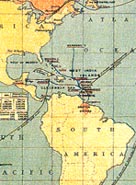
The last few decades has seen Britain become a popular destination for those arriving from the Caribbean. If your family made that trip, how can you uncover their origins?
By Dr Nick Barratt
Last updated 2011-02-17
The last few decades has seen Britain become a popular destination for those arriving from the Caribbean. If your family made that trip, how can you uncover their origins?
The vast majority of migration from the Caribbean to Britain took place after World War Two, particularly from 1948 when families were encouraged to move to Britain to help with the post-war reconstruction work. Ex-servicemen were particularly targeted by the government campaign, leading to ships such as the SS Windrush disembarking hundreds of people from the Caribbean into London. Many found the contrast in climate difficult to adjust to, and many moving accounts are to be found on websites such as www.rootsweb.com where you can also view the passenger list for the Windrush.
As with all pieces of research, you need to start with the basics before heading back into official records in archives. The best thing to do is to ask your family what they know about their relatives and experiences, both in Britain and back in the Caribbean. This will probably lead you to cousins, uncles and aunts who probably still reside overseas, and who will be able to tell you about their own roots. However, herein lies the challenge of researching ancestors who came to Britain. A certain amount of travel, and therefore time and expense, is involved. Whilst there are some record sets you will need to examine in the UK, they tend to be much further back in time and so you should be prepared to spend some time out in the Caribbean.
Civil registration was introduced in the Caribbean in the mid-nineteenth century, but actual dates vary from place to place ...
The first thing to realise is that each island has its own local archives and record office, covering civil registration, ecclesiastical records of baptism, marriage and burial, and local administration records. The second point that needs to be raised is that you are highly likely to uncover slave roots, unless you are related to one of the British or European plantation owners who used slaves to work in the fields. This is where your research can become really tricky, and in many case going further back in time - or indeed even reaching this stage - can be impossible.
Civil registration was introduced in the Caribbean in the mid-nineteenth century, but actual dates vary from place to place amongst the 20 or so Anglo-Caribbean islands. Records should be located at the relevant registry office. Similarly, different sets of church record, according to religious denomination, can be used to work further back in time or complement the official sources, and are to be found either deposited in the local archive, or retained by the church. In addition, you will also find census returns to be of enormous help - again, stored in local archives - whilst some valuable information can be gleaned from probate records, where they survive. Your first task, therefore, is to construct a family tree from these records, working as far back as possible, focusing as always on names, dates and places. Your goal is to ensure that you've found ancestors living at the time when slavery was abolished in 1834.
From 1812 to 1834, slave registers were kept by the authorities in the Caribbean to monitor the number of legally-owned slaves held by each plantation owner. The records of these local island registries are held at the appropriate record office. The Treasury established a central registry in London in 1819, and its records are now at The National Archives. In general, registers were updated every three years, and contain more detail about the slave owners than the slaves themselves. However, it is possible to track ancestors over time through these records.
... going further back in time can be very hard indeed, although not impossible ...
In general, the more detailed records were created at the start of the period. The name of the slave owner is provided first, followed by the name of the slave. In many cases this would simply be a single name, though slaves who were baptised may have a Christian name recorded as well as their former slave name. An approximate age was recorded, as well as their colour. Many terms used to describe slave colour reflected European biological influence, as slave owners often had children with their slaves. The country of the slave's birth was noted, as was their occupation on the plantation. A column for general remarks was also provided, which could be used on occasion to note any distinctive tribal marks.
Given that the records were predominantly for the benefit of the slave owner, family relationships can be hard to discern, particularly as there were few surnames noted in the records - these tended to appear post-emancipation, and many former slaves took the name of the plantation where they worked, or the estate owner that they worked for. Consequently, going further back in time can be very hard indeed, although not impossible; if you are lucky, you can use ethnic data combined with the country of birth to continue your research in Africa.
Dr Nick Barratt worked at the Public Record Office (now The National Archives, or TNA) from 1996 to 2000, with the family history team. He has given many talks on family history, and has written frequently for the TNA's genealogy journal, Ancestors. He has worked for the BBC as a specialist researcher on programmes such as 'One Foot in the Past','The People Detective' and 'Who Do You Think you Are?'.

BBC © 2014The BBC is not responsible for the content of external sites. Read more.
This page is best viewed in an up-to-date web browser with style sheets (CSS) enabled. While you will be able to view the content of this page in your current browser, you will not be able to get the full visual experience. Please consider upgrading your browser software or enabling style sheets (CSS) if you are able to do so.

