
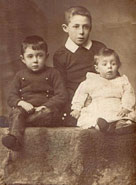
If the facts don't add up, you may be about to uncover a family mystery. Prepare yourself for a surprise or two!
By Dr Nick Barratt
Last updated 2011-06-09
If the facts don't add up, you may be about to uncover a family mystery. Prepare yourself for a surprise or two!
When researching your family history, be aware that you might uncover unexpected secrets. Many of them could come as quite a shock, particularly if they involve people that are either still alive, or were well known by your parents or grandparents.
What may be an interesting story to us could be a potential source of shame, sadness or distaste to others, so you need to think quite carefully before investigating certain areas. Once the material is in the public domain, there's no going back.
Until the introduction of the civil Court for Divorce and Matrimonial Causes in 1858, church courts heard any disputes between husband and wife, and a legal separation was the best outcome.
Divorce as such could only be achieved through private bill in the House of Lords, a prohibitively expensive procedure, and although some couples came to a private agreement, the reality was that legal divorce was out of the reach of most people.
The new court from 1858 did at least offer a route for civil divorce, but the proceedings took place in London and still proved too costly for most people to use. Although the system underwent several changes, particularly in the 20th century, it was only the extension of legal aid and the spread of local divorce registries that opened the floodgates, particularly after World War Two.
Consequently, many couples who separated but did not divorce underwent subsequent, bigamous second marriages. Tell-tale signs include stating on the marriage certificate that they were a bachelor or spinster when you know they had been married, or that they were widowed, when you can find no evidence of the death of their spouse. Alternatively, they may have moved quietly to another part of the country and reappeared on census returns with a new family.
Of course, bigamy was a felony and prosecutions did occur, and many cases are reported in local and national newspapers. If you suspect that your ancestor was involved in more than one marriage, you can first check for a divorce among surviving material at the National Archives, or by contacting the Principal Registry of the Family Division, Decree Absolute section, where a complete list of granted divorces is stored.
It is then a case of checking the facts through certificates, such as whether both parties are alive at the time of a second marriage.
Another area you may delve into is that of illegitimacy. Again, there are several clues you can spot. The most obvious is the lack of a father's name on the birth or marriage certificate, but equally the lack of a marriage between the parents is another clue to a birth outside wedlock.
Informal adoption within families also occurred, with the daughter disappearing to spend time with relatives elsewhere so the child could be born, and then passing the baby off as a sibling rather than a son or daughter. This is often reflected in census returns, where actual grandparents are described as parents, despite an unconvincing age gap between their youngest and second youngest child.
Yet where no support could be found, officialdom would step in. Because the duty of care for mothers and illegitimate children fell upon the local parish, paid for by rates of poor law assessments, then a real attempt would be made to find the father and either ensure he married the mother of his child, or made adequate financial provision. Failure to comply might result in the issuing of a 'bastardy order'.
More intriguing are the cases where suspicion of fatherhood falls upon someone from a higher social position. In cases where illegitimate offspring of aristocrats, wealthy families and estate owners are informally recognised, you can often find payments made for schooling, gifts or presents at a baptism, or a military commission that would have provided a lucrative career and social status.
Linked to illegitimacy was the need to establish a national system for adoption, because prior to the 20th century any arrangement was essentially a private, informal agreement between parties.
Various organisations existed to cater for foundling children and orphans, such as the charity Dr Barnardos and Thomas Coram's Foundling Hospital, while the church also provided some infrastructure. For example, the Catholic Church was responsible for organising countless adoptions, though few records survive.
It was only in 1927 that official certification for adoptions was first introduced in England and Wales, and thereafter in other parts of the UK, with certificates showing the date of adoption, the name of the child adopted and the name and address of the adoptive parents.
Yet searching for records of adoption can be a traumatic process for all parties concerned, and it is strongly recommended that if this is a route that you wish to pursue, you should contact a professional councillor who can give you advice about some of the emotional issues you will have to deal with.
Dr Nick Barratt worked at the Public Record Office (now The National Archives, or TNA) from 1996 to 2000, with the family history team. He has given many talks on family history, and has written frequently for the TNA's genealogy journal, Ancestors. He has worked for the BBC as a specialist researcher on programmes such as 'One Foot in the Past','The People Detective' and 'Who Do You Think you Are?'.

BBC © 2014The BBC is not responsible for the content of external sites. Read more.
This page is best viewed in an up-to-date web browser with style sheets (CSS) enabled. While you will be able to view the content of this page in your current browser, you will not be able to get the full visual experience. Please consider upgrading your browser software or enabling style sheets (CSS) if you are able to do so.

