
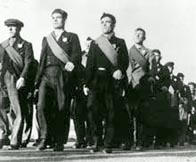
The struggle for representation has run through history. How can you find out if your ancestors were involved in the fight for votes, union power or political parties?
By Dr Nick Barratt
Last updated 2011-02-17
The struggle for representation has run through history. How can you find out if your ancestors were involved in the fight for votes, union power or political parties?
Today, we live in an established democracy, with political parties and representation across a series of levels - local councils, trade unions, regional assemblies and of course Parliament. Yet it has not always been so easy to make one's voice heard, either in the workplace or the wider world of politics, and the following topics are areas in which our ancestors might have left their mark.
With the move towards an industrial nation came the growth of towns and cities, with large proportions of their population reliant on employment in factories. Yet this new urban working class of manual workers served largely to line the pockets of the owners of the factories, whilst working long hours in conditions that were often very dangerous. The same was true for workers in mines, foundries and on the emerging railways. At first, groups such as cooperative societies and friendly societies emerged to provide food, shelter and medical assistance for workers' families who were left impoverished by unemployment or injury - surviving membership books and payments can be found at both local and national archives - but out of these 'social' movements rose more political organisations such as trade unions, designed to provide a voice for the working classes in negotiating better terms and conditions. As the Tolpuddle Martyrs found to their cost, the establishment attempted to ban such unions, but the outcry caused by the trial and transportation of the Tolpuddle group led to a relaxation of the law. Consequently, trade unions flourished in every occupation, though with particular emphasis in the industrial North and Midlands.
There are several specialist archives that hold relevant papers and books, such as the Modern Records Centre, University of Warwick and the John Rylands Library, Manchester, as well as local archives and museums. Individual trade unions are also worth approaching direct. Of particular importance are moments when the unions flexed their muscles, most notably during the General Strike in 1926 but also more recently with the miners' strike in 1984. Names of those who broke the strike were often recorded, as were those who received help during the hard times without work. Many records can be viewed to gain an understanding of what life was like during these hard times, held at places such as The People's History Museum, Manchester.
Hand in hand with the rise of the trade unions came the birth of the Labour party, designed to give the working classes political representation. Once again, there are a range of archives that will reveal details of party membership, such as the aforementioned Modern Records Centre, Warwick, as well as the Labour Party's own archives. Similar archives exist for the other political parties, in particular the Conservatives (formerly known as the Tory party) and the Social Liberal Democrats, (formerly the Liberal party or Whigs). In addition, members of Parliament representing these and other parties are fairly easy to trace - the History of Parliament project provides biographies of every MP, and volumes can be found in most libraries.
Of course, national representation was only one aspect of government. A large amount of work, as today, went on at a local level and you may find your ancestors popping up on parish or local councils, amongst churchwardens or poor rate assessors and collectors, and as representatives on the urban and rural district councils that emerged following changes to local government in the mid nineteenth century. Local newspapers, council minute books and election results will all provide information about their careers in politics.
Today, we take the right to vote for granted, but for centuries many of our ancestors were excluded from the democratic process. As a result of numerous protests and political movements - Chartists, National Land Societies and Suffragettes to name but a few - the electoral franchise was gradually extended to include most of the population, with particular progress made in the late 19th and early 20th centuries. However, previously only landholders were entitled to vote in local and national elections. Consequently, poll books were compiled to show who was entitled to vote, and from the mid-eighteenth century to 1832, land tax returns were enrolled in quarter session returns to provide evidence of eligibility amongst the freeholders in each county. As the vote continued to be extended, more electoral lists were compiled, showing the various levels at which people were entitled to vote. It is possible to view these electoral lists at most main branch libraries or local study centres, whilst the British Library has an extensive collection. Modern lists can be found online via a number of commercial websites such as www.192.com
Dr Nick Barratt worked at the Public Record Office (now The National Archives, or TNA) from 1996 to 2000, with the family history team. He has given many talks on family history, and has written frequently for the TNA's genealogy journal, Ancestors. He has worked for the BBC as a specialist researcher on programmes such as 'One Foot in the Past','The People Detective' and 'Who Do You Think you Are?'.

BBC © 2014The BBC is not responsible for the content of external sites. Read more.
This page is best viewed in an up-to-date web browser with style sheets (CSS) enabled. While you will be able to view the content of this page in your current browser, you will not be able to get the full visual experience. Please consider upgrading your browser software or enabling style sheets (CSS) if you are able to do so.

