
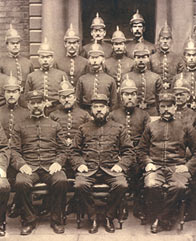
There are plenty of places to find out more about the black sheep - and criminal offenders - in your family's past.
By Dr Nick Barratt
Last updated 2011-06-09
There are plenty of places to find out more about the black sheep - and criminal offenders - in your family's past.
Many people talk of the excitement of discovering a 'colourful character' in the family, or of stories handed down the generations that a distant ancestor was a highwayman.
The reality is that we all probably have criminal ancestors hiding in our family trees, and that there are plenty of avenues to research if you want to find out more about their misdemeanours.
One of the earliest forms of court that sprang up was that of the local manor, where the lord would preside over offences committed by any of his tenants according to the custom and jurisdiction of the manor.
Most of the offences were against property - the illegal encroachment on common land, failure to undertake specific work, lack of maintenance of houses - but there was scope of punishments for crimes against individuals.
Surviving records are likely to be in Latin before 1733, so are not that accessible, but can be found among manorial and estate collections in local archives.
Later, a separate system evolved to replace these semi-private courts - 'quarter sessions', presided over by 'justices of the peace'. The system was a forerunner to the modern magistrate system, and was arranged on a regular, local basis to hear what usually amounted to petty crime, but could also include more serious offences.
Every three months, justices of the peace would gather to try cases brought before them, as well as dealing with a whole range of other routine matters concerning the effective administration of the local area.
The quarter session records that were generated by this process can be found in county archives, though you are most likely to find out about a criminal ancestor through a report in a local newspaper - either online, via the county archives, or the British Newspaper Library, Colindale.
More serious offences were heard by groups of itinerant assize justices, who would tour a circuit of specific counties twice or, in exceptional circumstances, three times a year, and hear cases brought before them.
The usual jurisdiction for these royal justices was to hear more serious offences passed up to them from the quarter sessions, and so the crimes were usually felonies against property or people, such as theft, murder, assault, highway robbery, bigamy and rape.
Several sets of records survive, now held at the National Archives. Indictments provide an indication of the nature of the crime, and a plea and verdict can be recorded on the indictment statement alongside details of the accused and their victims or accusers.
Where they exist, depositions and witness statements give a far better picture of what is likely to have happened during the incident in question, although not every case will have surviving material. Thereafter, crown and gaol books will record the date of the trial and the verdict, and other miscellaneous material such as calendars of prisoners can fill in some of the gaps.
As with quarter session records, local or national newspapers can provide the most detailed accounts, along with contemporary pamphlets. In terms of punishment, there are also avenues you can explore.
Prison records do exist, though they are scattered across a range of local and national archives, although in contrast anyone transported to a penal colony is likely to have left a trail in the official sources that survive - prison hulks, medical journals and disembarkation records. Some of the relevant records are now available online at www.ancestry.co.uk.
The ultimate sanction - execution - was designed to act as a deterrent and so often became a public event, with associated media coverage in the press. Many cases went to appeal, and correspondence between law lords and the assize judges survive as well.
Of course, these records can be used to research not just criminal ancestors, but those who served as justices and indeed even the names of the jurors, whose decisions often condemned our ancestors to hard labour in prison.
Remember that an increasing amount of material is becoming available online. One of the most popular websites used by genealogists researching their criminal ancestry is www.oldbaileyonline.org, which includes the full, indexed proceedings of the Old Bailey 1674-1913.
Police records can also provide a great deal of information about criminality, though they are usually to be found with the relevant police authority's archives or museum - the main exception being those of the Metropolitan Police, which can be found at the National Archives.
Along with service histories of policemen and officers, you can find files about notorious criminals, prevention of crime, investigations and general reports about activities associated with dealing with a criminal section of the population. The records of the Home Office are worth investigating as well, stored at the National Archives.
Dr Nick Barratt worked at the Public Record Office (now The National Archives, or TNA) from 1996 to 2000, with the family history team. He has given many talks on family history, and has written frequently for the TNA's genealogy journal, Ancestors. He has worked for the BBC as a specialist researcher on programmes such as 'One Foot in the Past','The People Detective' and 'Who Do You Think you Are?'.

BBC © 2014The BBC is not responsible for the content of external sites. Read more.
This page is best viewed in an up-to-date web browser with style sheets (CSS) enabled. While you will be able to view the content of this page in your current browser, you will not be able to get the full visual experience. Please consider upgrading your browser software or enabling style sheets (CSS) if you are able to do so.

