
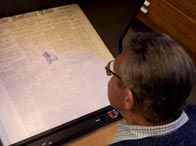
Obituaries, articles, gossip and adverts - newspaper archives hold a wealth of information for the family historian.
By Else Churchill
Last updated 2011-06-08
Obituaries, articles, gossip and adverts - newspaper archives hold a wealth of information for the family historian.
Most family historians are keen to find out what happened during their ancestors' lives and in the communities in which they lived. Local newspapers give an insight into the daily lives and activities of our ancestors and their neighbours. They can reveal what our ancestors were gossiping about, as well as what concerned them most.
A glance at the huge numbers of advertisements crowded into newspapers for quack medicines and surgical trusses illustrates well that our ancestors lived in medically challenging times before the introduction of the National Health Service.
Newspapers are vital for finding reports of major and minor events – from an industrial accident to a local tragedy. If you have a family story to substantiate or evidence on a death certificate that there may have been a coroner’s inquest relating to the death then you should turn first to a newspaper of the period.
If you want to read more about the history and development of the press, the growth of literacy and the mass circulation of papers (as influential as the internet today), then try the small booklet An Introduction to Using Newspapers and Periodicals by Colin Chapman (Federation of Family History Societies, 1993) or Newspapers and Local History the Local Historian at Work no 5 by Michael Murphy (Phillimore & Co, 1991).
In addition, the British Library publishes an interesting history called Newspapers by John Westmancoat (British Library, 1997)
Newspapers can be found in some local libraries. It is possible that a local library may have made some attempt at indexing or extracting their local collections. Sometimes a local library and archive service may have digitised or provided online indexes to their local collections of newspapers. The British Library has also digitised two million pages of 19th century newspapers, which can be accessed from within the library or remotely with a subscription. Some library cards allow free access to this database from home.
You may also want to consult the British Library's offline national and international collection at the Newspaper Library in Colindale, London. It is a good idea to look at their website to prepare yourself before you visit.
Newspapers often include information on births, marriages and deaths which can supplement more usual sources. For example, the family of Samuel Kersey placed a notice of his death in the Lynn Advertiser on 25 March 1882. The death actually took place on 1 February at Jones Lake, New Westminster in British Columbia, Canada. The notice tells us that Samuel, aged 45 years, was the only son of the late Samuel Kersey of West Harling in Norfolk. This would not be recorded in his death certificate had it been found in England!
The Hereford Times for October 1892 tells us that Sarah Bray was charged with stealing a table cloth, the property of Charlotte Garness, from her clothes line. Sarah received 14 days of hard labour as punishment.
Thomas Izod summoned Richard Smith of Much Marle for £2 11 10d wages due to him. He settled for £1. Remember that local events may give way to matters of national interest even in local papers. You would be unlucky to be looking for something at the time the Titanic sank, as this would have taken precedence over local matters.
Gory deaths
The newspaper should be your first source if you find a death certificate which mentions a coroner's inquest. Coroners' records are not easily available, although there is a useful guide to them in Coroners' Records in England and Wales by Jeremy Gibson and Colin Rodgers (Federation of Family History Societies, 1997).
Coroners' inquests are regularly reported in newspapers, especially if the events are gory. The death certificate of Thomas Stephens reports that he died on 29 April 1891 at Proctor's manure factory in Bristol. Thomas was a 61-year-old labourer who was accidentally killed by the fall of a large mass from a mountain of manure.
The informant of the death was the Coroner for Bristol, who held an inquest on 30 April. Unsurprisingly, both the event itself and the subsequent inquest are recorded in the Bristol Evening News. Frederick, the son of the deceased, identified his father and his address is given. Both of these details are extra to the death certificate.
The Times Digital Archive can be accessed via a subscription, although many library cards allow users free access to Archive both on-site and from home. The Times Digital Archive can also be accessed at Colindale.
The Times may have obituaries for prominent people as well as mentioning provincial places. For example, there are hundreds of entries for Whitstable in Kent in the Times from 1800, ranging from reports of smuggling and fires, to the interminable arguments with the Oyster Fishery Company about access to the beach, which continue to this day.
Directories such as those published by Kelly for the Post Office, or other publishers such as Piggot or White are invaluable listings of people. Local studies libraries will have collections for their area, but there are few collections as comprehensive as those at the Guildhall Library, which holds the Kelly archive on film, or the Society of Genealogists.
Urban city directories such as the Post Office Directory of London will have distinct sections including what are known as the Court, Commercial, Street and Trades directories.
The Court directory lists the gentry and upper middle class householders by name alphabetically. The Commercial section will be an alphabetical list of the artisans, professionals and tradesmen who paid to be listed.
The Trades section will group similar tradesmen together, so all butchers, bakers and candlestick makers will be listed as distinct groups. The Street directory lists all streets and those who paid to be listed and are by no means a comprehensive listing of all inhabitants.
County directories will be arranged place by place, usually by town, with the parishes in its environs. These will present the same hierarchy or society as mentioned above with the gentry, clergy and professional persons of rank coming before the shopkeepers and traders.
The pub and its landlord will often be given separate and quite prominent mention as the local inn might be the seat of the local sessions or perhaps the excise office. The county and provincial directories are rarely comprehensively indexed and need often to be searched place by place.
However there is a great interest in publishing facsimiles of local directories on CD-ROM, and often the publishers have enabled them to be searched by name. The University of Leicester has a project to digitise and index many historical directories and this is a good place to start looking for names in local directories. Some collections are also available on commercial genealogical websites.
Nineteenth century directories are invaluable for confirming an address of an individual and thus enabling them to be found in a census return of that address (if you have been let down by the online name indexes).
Remember that it could take quite some time for the agents to compile the directories and a directory entitled 1871 may well have been compiled anything up to a year before. Also employees of tradesmen or the poorer sort are unlikely to have paid money to be listed.
Else Churchill has been the Genealogy Officer of the Society of Genealogist since 1998. Formerly the Librarian of the Institute of Heraldic and Genealogical Studies, Else has worked for the SOG since 1994. Her main interests lie in the 17th century and sources for people who lived through the English Civil Wars but she also specialises in using the records of the Victorian censuses.

BBC © 2014The BBC is not responsible for the content of external sites. Read more.
This page is best viewed in an up-to-date web browser with style sheets (CSS) enabled. While you will be able to view the content of this page in your current browser, you will not be able to get the full visual experience. Please consider upgrading your browser software or enabling style sheets (CSS) if you are able to do so.

