
The 19th century saw waves of European migrants entering the United Kingdom. Find out how to trace their origins.
By Else Churchill
Last updated 2011-06-07
The 19th century saw waves of European migrants entering the United Kingdom. Find out how to trace their origins.
During the 19th century, European migrants came to the United Kingdom for a variety of reasons.Often it was with the intention of continuing on to the United States, but many settled in urban areas, particularly London and other industrial towns.
They came from the Prussian (German) and Austrian-Hungarian empires, from Russia and from Eastern Europe. They were Jewish, Catholic and Protestant. No matter where they came from, they all produce common problems in tracing their origins. There are, however, some important sources in this country that can set you on your way.
In order to discover more about your immigrant ancestor it will be important to have a clear idea of where they came from. This will need to be precise information, as rarely does the country of origin have a centralised system of recording births, marriages and deaths as exists in the United Kingdom.
At best, the records may be held in the state or province within a particular country. More likely, the records will be kept locally in towns and villages. It is not enough just to know the country where migrants came from - terms such as 'Germany' or 'Austria' are just too vague. They could mean the country or the whole of the 'empire' of the period.
Germany extended east to include parts of what is now Poland. Austria-Hungary extended far south into what we would now recognise as the Czech Republic and the former Yugoslavian states.
Remember of course that throughout history place names as well as boundaries have changed. For example, Dubrovnik in Croatia was more commonly known as Ragusa. If you are lucky enough to find a source that gives an exact place, but you don't recognise that name, then try to examine a contemporary gazetteer.
For example you may be able to find Lippincott's Gazetteer of the World which is a complete pronouncing gazetteer, or geographical dictionary of the world, containing notices of over 125,000 places, with recent and authentic information respecting the countries, islands, rivers, mountains, cities and towns (two volumes, new revised edition with supplement published by JB Lippincott and Co; Philadelphia (USA); 1901).
Try to examine maps of the period rather than present day atlases.
Due to the vagaries of record keeping in England there are relatively few records that give detailed information about the origins of immigrants in this period. The sources that do help are largely to be found at the National Archives at Kew.
TNA has published a very useful book by Roger Kershaw and Mark Pearsall called Immigrants and Aliens: A Guide to Sources on UK Immigration and Citizenship (The National Archives, 2004).
You might find the Moving Here website a good place to start, which looks at immigration in England over the last 200 years and currently focuses on Caribbean, Irish, South Asian and Jewish communities.
Census returns from 1851 onwards record the birthplace of an individual, but all too frequently the place is a very vague term (for example 'Germany' or 'Prussia') or is the nearest large town rather than the village itself. For example, the 1881 census entry for the Engels family shows the following:
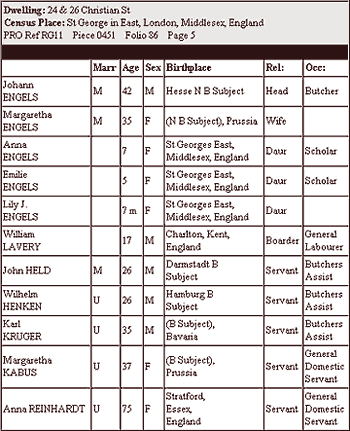 1881 census entry for the Engels family ©
As you can see, the migrants here have given the birth places as the state or large towns within Germany which are often good clues but may not be precise enough. However, we know that Johann and Margaretha and their servants were 'naturalised British subjects'.
'Naturalisation' gives the recipient rights similar to a 'natural born' citizen, while 'denization' endowed only limited privileges, such as the right to buy land.
These records are held at The National Archives mostly in the series HO 1, HO 45 and HO 144. Generally these records contain correspondence, petitions and memorials amongst the denizations and naturalisations papers. Naturalisations granted by the Home Office from 1844 to 1935 can now be searched for on TNA's online catalogue.
Later surviving papers, from 1934 to 1948, are also indexed in the catalogue. The correspondence and related papers about the naturalisation and denization application can be found in HO 45 and HO 144. These can include many details about the petitioner's origins such as affidavits and statements to support the application, and references from friends.
Naturalisation certificates issued from 1844-1873 are enrolled in the Chancery Close Rolls (C 54). From 1870, duplicate certificates were kept by the Home Office (HO 334). Indexes to naturalisations and denization prior to 1800 have been published by the Huguenot Society.
Class HO 2 at The National Archives contains bound-up certificates of arrivals of individual aliens in England and Scotland. These records are now available online at www.ancestry.co.uk. They record the name, nationality, profession and date of arrival, along with the last country visited. The Anglo-German Family History Society has extracted certificates relating to German, Polish and Prussian Persons (1847-52) and these indexes, along with an index to some earlier certificates (1826-49 HO 5/25-32), are in the search room at Kew.
Class HO 3, also available on Ancestry, contains returns of alien passengers made by the masters of ships in July 1836-December 1869 (with a gap from 1861 to 1866). These returns are by no means comprehensive. Despite penalties on both the aliens and masters, it is obvious that far more aliens entered the country than were registered.
Board of Trade records include the Passenger Lists Inwards (BT 26) from 1878-1888 and from 1890 onwards. These contain the names of all persons arriving in the UK from places outside Europe and not within the Mediterranean Sea, unless the vessels originally sailed from outside Europe and picked up passengers from a European or Mediterranean port en route. These records too are online at www.ancestry.co.uk. The lists include age and occupation, but rarely give a place of birth.
Else Churchill has been the Genealogy Officer of the Society of Genealogist since 1998. Formerly the Librarian of the Institute of Heraldic and Genealogical Studies, Else has worked for the SOG since 1994. Her main interests lie in the 17th century and sources for people who lived through the English Civil Wars but she also specialises in using the records of the Victorian censuses.

BBC © 2014The BBC is not responsible for the content of external sites. Read more.
This page is best viewed in an up-to-date web browser with style sheets (CSS) enabled. While you will be able to view the content of this page in your current browser, you will not be able to get the full visual experience. Please consider upgrading your browser software or enabling style sheets (CSS) if you are able to do so.

