
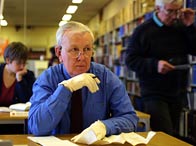
From obscure trade directories to emigration indexes - you'll be surprised at how much your local library has to offer the family historian.
By Else Churchill
Last updated 2011-06-07
From obscure trade directories to emigration indexes - you'll be surprised at how much your local library has to offer the family historian.
Huge amounts of printed source material and unpublished findings are available to family historians within local or special libraries. Many libraries are underused but have so much useful information squirrelled away within. Local studies libraries contain local history information on the communities where our ancestors lived. There are several printed local history guides that will tell you where the local studies collections within a county can be found.
Stuart Raymond edits a useful series of county Genealogical Bibliographies (also known as British Genealogical Library Guides), published by the Federation of Family History Societies. These bibliographies list the different types of printed information published in the journals and periodicals of local record or archaeological societies found in the local studies library. Researchers can find information on records that might be very hard to read in the original, such as records of medieval inquisitions post mortem or eighteenth century manor court documents. Stuart Raymond expressly lists printed transcripts and indexes of such sources, arranged by subject and then place.
As we saw in Localising Your Ancestor it is often possible to trace information relating to an ancestor's trade or occupation. A useful work found in libraries is Genealogy for Librarians by Richard Harvey (Library Association Publishing, 1992). This lists printed sources containing biographical information for people in professions. The Society of Genealogists has published guides such as My Ancestor was a Lawyer by Mark Herber and Brian Brookes (2006) and My Ancestor was an Anglican Clergyman by Peter Towey (2006)
A special library or association may deal with a particular activity. Information about such organisations might be found in The Aslib Directory of Information Sources in the United Kingdom by Keith Reynard and ME Jeremy (Association for Information Management, London 2000) or in British Archives: A Guide to Archive Resources in the United Kingdom by Janet Foster and Julia Sheppard ( Palgrave Macmillan, 1984). These include details of a variety of organisations such as the following:
Many, but by no means all of the libraries of special interests are in London.
Often university and other academic libraries have collections that family historians might not have considered using. The HELPERS website (Higher Education Libraries in your PERSonal research) is the first attempt by the academic community to introduce family historians to the wealth of special archive collections that various colleges and institutions within the University of London and Senate House have collected. For example the London School of Hygiene and Tropical Medicine has a collection of medical records detailing people who emigrated to the colonies between 1898 and 1919. The records also hold a small amount of information about the interviewee’s immediate relatives.
Guides to using collections
Whatever local, special or academic library you use, do check to see whether it publishes a guide to using its collections and read it before your visit. Most will have a website. For example, you could use the Society of Genealogist's library to prepare yourself for trips to the Colindale Newspaper Library or the British Library Oriental and India Office Collections, as guides to both of these are held. Alternatively, each has comprehensive guides on their websites. There are also guides to museums related to various activities and trades, including regimental museums (if your ancestors served in the army). Remember the local museum will often have a library or archive attached.
Else Churchill has been the Genealogy Officer of the Society of Genealogist since 1998. Formerly the Librarian of the Institute of Heraldic and Genealogical Studies, Else has worked for the SOG since 1994. Her main interests lie in the 17th century and sources for people who lived through the English Civil Wars but she also specialises in using the records of the Victorian censuses.

BBC © 2014The BBC is not responsible for the content of external sites. Read more.
This page is best viewed in an up-to-date web browser with style sheets (CSS) enabled. While you will be able to view the content of this page in your current browser, you will not be able to get the full visual experience. Please consider upgrading your browser software or enabling style sheets (CSS) if you are able to do so.

