
How do you go about reconstituting a lost World War One memorial when all you have is the number of those who fell and no names?
By Richard Cable
Last updated 2011-04-27
How do you go about reconstituting a lost World War One memorial when all you have is the number of those who fell and no names?
For a rugby club with a long and venerable history dating back to the 19th century, it has always struck me as odd that Rosslyn Park's clubhouse has a memorial to players lost during World War Two, but no mention anywhere of those lost in the Great War.
It was agreed that the public school holiday matches should be revived as a morale booster.
I asked the older members of the club why this was. Nobody was entirely sure, but a consensus slowly formed that we'd 'lost' it when the club moved in 1956 from its former ground at the Old Deer Park, Richmond to its current home in Roehampton.
(Quite how someone loses a sizeable chunk of inscribed marble remains a mystery.)
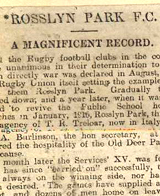
A speculative check of a scrapbook, dating from 1917 - 1921 and held by the club archivist, turned up an interesting clipping from a 1918 edition of the Richmond and Twickenham Times.
Entitled 'A Magnificent Record', it stated that Park had lost 66 men during the conflict and that a further six were missing. More than 80 had been wounded and four were still prisoners of war. Very few names were mentioned.
It went on to list, very much in the manner of a breathless match report, the various decorations won by Park's serving members, both surviving and killed in action, ranging from the Victoria Cross down to 'mentioned in despatches'.
The article also described Rosslyn Park's war record, which was unique among English clubs. Most teams quickly closed down on the outbreak of war in August 1914, Park included, but by late 1915 it was agreed that the public school holiday matches, normally held in January, should be revived as a morale booster for players and spectators alike.
The matches were hosted by Rosslyn Park in January 1916 (and survive to this day as the National Schools Sevens, the world's largest junior rugby tournament). They were a success, and a month later the Services XV was formed. Games continued to be played until the end of the war.
It seemed to me a terrible shame that a club whose members had given so much had no record of those who had made the ultimate sacrifice, and thought I ought to do something about it.
Rosslyn Park was founded in 1879, the year of the Zulu Wars and the famous stand by heavily-outnumbered British soldiers at Rorke's Drift. Many of the senior British officers who blundered so badly on the Somme in 1916 would have gained their first experience of war in colonial conflicts of this type.
These were the young lieutenants and captains who fought and died leading their men.
Fortunately, meticulous minutes of the club's committee meetings were kept right from the outset, mostly inscribed in the laborious, long-hand Victorian script of the stalwart HA Burlinson.
The minutes record, amongst other things, the first 'tour' to Europe by a British club (to Stade Francais in Paris) and the cancellation of matches during the mourning period following the death of Queen Victoria.
It also held the surname, initials and address of every member who joined the club pre-August 1914, as well as recording the final toll of 72 killed, 86 wounded - but again hardly naming any of those who fell.
I carefully transcribed all the names of members who joined the club between 1900 and 1914 - more than 700 in total - working on the assumption that most of those at the right age for active service would probably have joined post-1900.
I then cross-referenced all 700-plus names against the Commonwealth War Graves Commission database, which holds the names of all British and Commonwealth servicemen and women who died during the world wars.
Here I made another broad assumption - that I would only cross-reference against the names of officers.
In the early years of the 20th century, rugby football was an almost exclusively public school sport. When they joined the armed forces, ex-public schoolboys would generally be expected to seek a commission as an officer. Some joined as other ranks, but they were in a tiny minority.
Rosslyn Park was a club where new members were proposed and seconded (rather than the 'open' club it is now). It seemed reasonable, given the social strictures of the day, that public schoolboys would only nominate other public schoolboys.
(It is important to note that these were not officers of the more senior, and latterly vilified, 'donkey' kind, but the young lieutenants and captains who fought and died in great numbers leading their men.)
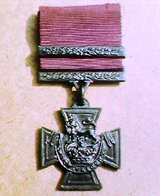 The Victoria Cross, which bears the inscription 'For Valour' © The initial Commonwealth War Graves Commission sweep produced 110 'possibles'. But how would I know if the individual in the Park minutes was the same as the individual in the CWGC records?
The process was further complicated by the fact that the Park minutes only recorded surnames and initials, rather than full first names. All very well when the member's name was the incredibly rare 'HHH De La Cour', of which there is only one in the CWGC database, but problematic for the much more numerous 'F Atkinson'.
'...though already severely wounded and undoubtedly in great pain, he displayed indomitable resolution...'
(Even then, who's to say that there weren't two HHH De La Cours - one who played rugby and the other who died of wounds in 1919?)
One of the most valuable pieces of information gleaned from the club minutes, apart from the names, was the addresses of the members. If I could match the 'minutes address' for a member with the same address for the same name in a second source, such as the CWGC or 1901 census, then that would constitute a 100% positive match.
The CWGC entries vary greatly in the quantity and quality of information about a serviceman or woman. Some entries simply list name, rank, regiment and date of casualty. Even the individual's age is frequently omitted.
Others, like RBG Glover, contained fuller information. For example:
'GLOVER, RICHARD BOWIE GASKELL: Son of the late Richard Thomas Glover and of Agnes Glover, of 68, Dartmouth Park Rd., Kentish Town, London.'
This provided an exact match on the address for the RBG Glover in Rosslyn Park's club minutes. He was one of the very first confirmations. Ralph Kirton, Arthur Kerr and a number of others followed.
Also relatively easy to confirm was England rugby international Lieutenant Commander Arthur Leyland Harrison, who led the storming parties during the famous raid on German U-boat pens at Zeebrugge on the night of the 22-23 April 1918.
His Victoria Cross citation in the London Gazette read:
'...in a position fully exposed to the enemy's machine-gun fire Lieut-Commander Harrison gathered his men together and led them to the attack. He was killed at the head of his men ... though already severely wounded and undoubtedly in great pain, [he] displayed indomitable resolution and courage of the highest order in pressing his attack...'
He is in the Rosslyn Park 1st XV photo for the 1913-1914 season and is clearly the same AL Harrison in the picture that accompanies his VC at Dartmouth Museum.
Having exhausted possible matches via the CWGC database, I tried typing each individual name into a search engine to see what results it threw up. There was an awful lot of junk, but also some gems.
Major Savory was the first British pilot to bomb a battleship, for which he received the Distinguished Service Order.
The 'Roll of Honour' website is a volunteer-run record of the names and inscriptions on British war memorials. It is an incomplete work-in-progress, but a valuable resource nonetheless and helped identify Second Lieutenant Guy Pinfield as one of Park's fallen.
Killed aged just twenty-one during the Easter Rising in Dublin, April 1916, he was buried in Ireland but commemorated on the war memorial in his home town of Bishop's Stortford. The Roll of Honour site saved me an unlikely trip to deepest Hertfordshire.
This search also helped eliminate some of the names from the list. Major Kenneth S Savory of the Royal Naval Air Service - the first British pilot to bomb a battleship, for which he received the Distinguished Service Order and the French Croix de Guerre - was revealed to have survived the war.
(This was despite a 1918 press report describing him as the 'late' KS Savory. He also attended a Rosslyn Park dinner in 1921, according to the list of 'notable' attendees.)
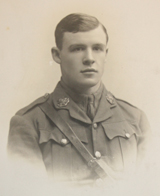 Captain Arthur 'Mud' Dingle, 1910 © At this point, my search diversified quite significantly. In addition to addresses, the minutes occasionally noted which school the members had attended, or the university they had gone to afterwards.
A closer reading of the minutes revealed that Rosslyn Park drew many of its players from two main public schools, Uppingham and Marlborough, with smaller contingents from Bedford and Haileybury.
The 'Old Boys' club secretaries and school archivists were incredibly helpful in sifting through my lists of names for matches. Many revealed exact address matches or vital biographical data that helped pursue confirmations by other routes.
Fischel was killed less than two months before the end of the war, in September 1918.
School rolls held by the British Library were also immensely helpful. Humphrey Dowson, Percival Corban-Lucas and Robert Dale were among those confirmed.
Oxford and Cambridge Universities both had strong ties with the club and, again, the archivists at various colleges were extremely helpful in confirming details of students who had played for Rosslyn Park and died in the Great War.
Among those identified at this stage was Captain Arthur 'Mud' Dingle, listed by Scrum.com as an England rugby international who won three caps in 1913-1914. He was confirmed by the archivist at Keble College, Oxford.
Hospitals also provided a remarkable series of confirmations, with members who studied or worked at Middlesex, Guy's, University College, St George's and St Bartholomew's Hospitals.
Roy Fazan and Claude Fischel appear to have joined Middlesex Hospital as students at the same time, but Fazan abandoned his studies and joined up immediately. He was killed in France in 1915.
Fischel stayed on and qualified, then joined up, serving with the Royal Army Medical Corps. He was killed near Etricourt, also in France, less than two months before the end of the war, in September 1918.
Once again, I received invaluable help from archivists and curators at each institution.
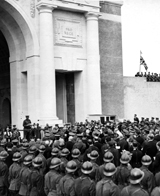 Dedication of the Menin Gate memorial to the 55,000 British war dead with no known grave, 1927 © The censuses for 1901 and 1891 proved excellent sources for identifying parents, siblings and grandparents of club members, and crucially pinpointed where these close relatives lived. This generated yet another raft of address matches, this time 'by proxy'.
For example, the 1901 census revealed that Second Lieutenant Francis Ormsby - killed in action at Becourt on the Somme 3 September 1916 - was the son of Colonel John Becher Ormsby, whose address was a match for the one given by his son in the Rosslyn Park minutes.
Charles Scholey was killed in action, aged 22, and his body was never recovered.
The problem was that at the time of the investigation there could be as many as 13 years between the last publicly available census (1901) and the time an individual joined the club, so a source was required that provided address data much closer to the time of joining. Since finishing the investigation, the 1911 census has become available, which would have made the task rather easier.
The British Telecom series of telephone books provided a useful interim source. The CWGC database revealed that Captain Charles Scholey, for example, was the son of Harry Scholey, whose address found in the 1910 phone book matched the one his son had given when he joined the rugby club in 1912.
(Charles Scholey was killed in action, aged 22, and his body was never recovered. He is commemorated on the Ypres (Menin Gate) Memorial in France.)
Having exhausted the more traditional means of identifying names and addresses, I reviewed the original 'long list' in light of what I had learned during my research.
Fairbairn was a talented rower who won silver in the double sculls at the 1908 London Olympics.
I started by challenging my original assumption that all members were likely to be officers, and discovered I had missed Rifleman John Bodenham, confirmed by his father's address in the census of 1891. He was killed on the first day of the Battle of the Somme, 1 July 1916.
I also reinstated individuals who seemed 'geographically unlikely' - men who, according to the CWGC database, appeared to have come from India, South America or Australia to fight and therefore seemed certain not to be members of a rugby club in south west London.
Second Lieutenant George Eric Fairbairn was just such a case. A native of Victoria, Australia, he joined the Durham Light Infantry and died in Bailleul, France in June 1915. Fairbairn was a talented rower who won silver in the double sculls at the 1908 London Olympics.
I then branched out into new territory, emailing the still-operating hotels and guest houses given by members as their 'transitory' addresses, to see if any further records existed.
The Langham Hotel in London politely responded that since World War One it had been closed down during the Depression, bombed by the Luftwaffe, occupied by the army and used by the BBC as offices before finally being restored as a hotel in 1991. Unsurprisingly, in light of this no guest-list records survive.
I even tried websites dedicated to the genealogy of specific families and family names. This confirmed Basil Ash, a career soldier who was killed at the very onset of the war in September 1914, and produced many interesting leads besides.
The review helped me organise my research into four lists: the original 'long list'; those confirmed with 100% certainty; 'probables' of which I was about 75% certain; and 'possibles' which were fifty-fifty.
Apart from searching the 1911 census, the next job, and one that I have to confess to not looking forward to, is to go through the local papers of the day and look for individual obituaries, or further articles like the 'A Magnificent Record' one that got me started.
This requires sitting in an attic room at Richmond Library and spooling through hundreds of 'microfiche' editions of the Richmond and Twickenham Times. It is time-consuming and eye-wearying work.
To focus my search, I have actually created a graph that shows 'peaks' in Rosslyn Park casualties, both suspected and confirmed, so I can target specific editions. (In the vernacular of the 21st century historian, this is referred to properly as 'geeking out'.)
This has already produced one result - Captain Robert Keith McDermott, a 33-year-old barrister who died in Jerusalem in September 1918. His obit specifically mentions Rosslyn Park. I had originally missed him due to a mistake in transcribing his initials from the minutes.
Of the 74 or 75 players who will probably make up the complete memorial, I now have 41 confirmed.
It is rare to be able to discover something of the human being that each name represents.
This exceeds the starting figure of 72 recorded in the minutes of 1918. This is because the servicemen and women of World War One continued to die into the 1920s of wounds and disease, in accidents and during the operations to reclaim the dead and clear the battlefields. They are as much victims of the conflict and as deserving of remembrance as those who died during the fighting.
It seems inevitable that Rosslyn Park's war dead, who already reflect the scale and many dimensions of the fighting, will be no exception to the losses suffered after the Armistice.
From here on, the research gets harder and more laborious as the more obvious avenues of enquiry dry up. It is highly likely that it will be impossible to recover every name of every player, but it feels right to at least be trying.
It could be that one day the original stone memorial is recovered (although I've had a good look for that as well, scouring the outfield of what is now the London Welsh rugby ground at Old Deer Park) but I suspect that, in any case, it probably bore an inscription honouring, rather than naming, the dead.
It is tantalising to think that someone must have kept a list of names at some point, and that one day the list might be found. This would neatly complete the (admittedly intermittent) work of the last two years, but I would argue that it wouldn't make it redundant. Whatever the eventuality, this has been a persistently moving and fascinating journey.
We are all familiar with the war memorials to be found in nearly every town and village in Britain, and with the rows of mute names that they bear. But it is rare to be able to discover something of the human being that each name represents. That in itself is a privilege and a call to action, and something worth trying for yourself.

BBC © 2014The BBC is not responsible for the content of external sites. Read more.
This page is best viewed in an up-to-date web browser with style sheets (CSS) enabled. While you will be able to view the content of this page in your current browser, you will not be able to get the full visual experience. Please consider upgrading your browser software or enabling style sheets (CSS) if you are able to do so.

