
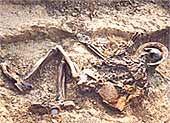
In the late 1990s, a group of amateur archaeologists discovered the remains of a forgotten World War One battlefield at Boesinghe in Belgium. Paul Reed tells the story of a battle that was left out of the history books.
By Paul Reed
Last updated 2011-04-27
In the late 1990s, a group of amateur archaeologists discovered the remains of a forgotten World War One battlefield at Boesinghe in Belgium. Paul Reed tells the story of a battle that was left out of the history books.
During World War One nearly 750,000 soldiers from Britain and the Commonwealth were killed in the trenches surrounding the Belgian city of Ypres. Out of the conflict came names that are forever associated with these huge losses: Hill 60, Messines and Passchendaele among them. One place that never appears in the history books is the small Flanders village of Boesinghe (now Boezinge).
...a desolate crater zone of shell holes, mud, muck and slime...
Situated north of Ypres along the Yser canal, fighting came to the area during the gas attack of April 1915. French forces, thrown back across the Pilckem Ridge, dug in just short of the canal and village, and here the front lines were stabilised for the next two years. The British arrived in June, and regiment after regiment passed through this sector of the battlefield until the ground was cleared in the opening phase of Third Ypres in July 1917. By this time little remained of Boesinghe, and the ground east of the canal had been turned into a desolate crater zone of shell holes, mud, muck and slime.
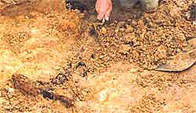 One of the Belgian archaeologists starts to recover the remains of a German soldier (you can see his boot) © The troops who initially served in the trenches at Boesinghe were regular soldiers from the British 4th Division. This unit had been in France since August 1914, and had fought in all the previous battles, suffering grievous losses during the fighting at Ypres in April and May 1915. When they took over the canal area from the French in June, it was a relatively 'quiet' sector; despite the daily bombardments, snipers, rifle grenades and machine-guns.
...it was a relatively 'quiet' sector despite the daily bombardments, snipers, rifle grenades and machine-guns...
However, chaos reigned on the battlefield itself, and these regulars, normally young soldiers in their late teens, or older soldiers in their 30s and 40s, veterans of the Boer War (1899-1902), spent much of their time repairing and working on their trenches. Slowly dugouts were added, along with machine gun and mortar positions.
With much of the ground below sea level, there was a constant problem with the water table filling trenches and dugouts with water. The British began to develop a system of 'A-Frame' trenches, where the boards were placed on inverted wooden A-Frames, suspending them above a drainage ditch which allowed the water to flow away. While primitive, and susceptible to damage from shell-fire, it made life a little bit more bearable for soldiers in the forward trenches.
Opposite the Germans were doing the same, building a strong front line across to a redoubt which was named Fortin 17 on British trench maps. Their trenches were lined with wooden revetments, and they also used a system of A-Frames to cope with flooding. Their approach differed in the use of concrete; many dugouts and strongpoints were reinforced with concrete blocks, pre-cast behind the lines and taken up by working parties.
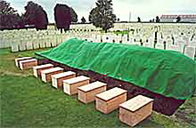 The coffins of nine unidentified British soldiers recovered from the Boezinge site, about to be buried in Cement House Cemetery © The first major action at Boesinghe for the British was when 4th Division attacked the German lines around Fortin 17 on 6 July 1915. In several places they were able to penetrate into the German positions, but some attack waves were cut down in No Man's Land suffering heavy losses. A few trenches were captured, and the shape of the front lines changed slightly - in most cases it moved both sets of trenches closer together, so that by the close of the battle some British soldiers were only tens of metres away from the enemy.
...by the close of the battle some British soldiers were only tens of metres away from the enemy...
General Sir Herbert Plumer, who had been the overall commander during this engagement, later said that 'the attack will go down in history as one of the great battles of the campaign'. However, events elsewhere on the Western Front, and the fighting in Gallipoli, soon conspired to send the events of July 1915 into historical oblivion, remembered only by the veterans who survived the battle, and the families of those who fell.
The regulars were relieved in the front line at Boesinghe not long after this battle, and sent south to the Somme front. The unit that took over from them was the 49th (West Riding) Division. These Territorial soldiers were recruited from a large number of industrial towns in the West Riding of Yorkshire such as Halifax, Leeds and Sheffield. They differed from the regulars in respect of their age and social background; while the Territorials attracted large numbers of working class men, the ranks also contained the sons of many aspiring middle-class Yorkshire families, men who would end the war as officers.
The West Riding Territorials remained at Boesinghe until the spring of 1916, and during this time they vastly improved the trench system east of the canal. Indeed, they also named many of the trenches, a common practice during the war, after places they had known back home in Yorkshire. Communication trenches, which took the soldier from behind the front to the forward positions, were added and improved upon. Extra dugouts were constructed, often to some depth and lined with timber, some of it brought especially from Canada because of its hard-wearing abilities.
...there were the usual periods of 'daily hate' when each side bombarded the other's trenches.
While no major battles were fought during this period, there were the usual periods of 'daily hate' when each side bombarded the other's trenches. Raids and patrols were made in No Man's Land, the ground between the two lines, and into the German trenches themselves. Occasionally the Germans did the same. Gas was by now used almost daily, and in December 1915 a large gas bombardment of the Boesinghe sector resulted in heavy casualties among the West Riding Territorials.
British soldiers killed in the front line area were not buried in the trenches, as further shell-fire would normally unearth them and therefore increase the possibility of disease and sickness spreading. Soldiers were therefore instructed to remove casualties to a battlefield cemetery, somewhere close to the line. At Boesinghe there were a number of these. Essex Farm was the site of an Advanced Dressing Station (ADS), a medical post where wounded soldiers were treated for their wounds.
A large cemetery was created as a result, and added to with soldiers killed in the front line. Just to the north, Bard Cottage and Talana Farm were also used, and whole plots of these burial grounds were used by specific regiments. Eighty-five years later, there are permanent cemeteries on the sites that once bore these names, and following the rows of graves it is possible to follow the front line history of the battalions and regiments that served at Boesinghe.
The Battle of the Somme took place in 1916 in northern France, and there were no major offensives at Ypres. However, daily life at the front continued, and casualties mounted; dozens of soldiers from both sides would be killed and wounded every day. Many units passed through Boesinghe during this year, including the first wartime volunteers, men from Kitchener's Army, in the form of 14th (Light) Division. Among them were many young soldiers, including Private Valentine Joe Strudwick of the Rifle Brigade, who was killed in January 1916, aged 15. He was among the youngest soldiers to die in the war, and is buried in Essex Farm Cemetery.
...Private Valentine Joe Strudwick of the Rifle Brigade, who was killed in January 1916, aged fifteen.
One unit that came here in 1916, and would return for the battles of 1917, was the elite Guards Division. Comprised of all the different regiments of foot guards, its soldiers were tall, smart and well disciplined. The officers were drawn from some of the leading families of the day, and one of those who was here in May 1916 was Lieutenant Raymond Asquith, son of the Prime Minister, HH Asquith. He recalled in a letter to his family that:
'...in this part of the line we are surrounded and overlooked by the Germans on almost every side and they have a great number of guns in good positions which they loose off pretty continuously.'
He survived Boesinghe, to be killed on the Somme in September 1916.
During the winter of 1916-17, the harshest winter of the war when temperatures dropped to -22°C, many different units passed through here. The war poet Edmund Blunden was at Boesinghe for a while, and then in the final months leading up to the Battle of Passchendaele, the 38th (Welsh) Division occupied the trenches here.
Battle of Passchendaele
At 3.50am on 31 July 1917 the attack commenced. In the north the Guards advanced across the Pilckem Ridge, and the Welsh came through the hamlet of Pilckem, across the ridge and onwards to the outskirts of Langemarck. Over 5,000 men were killed and wounded here on that day, the most murderous of the entire war in the Ypres Salient when along the entire front in Flanders more than 6,000 died.
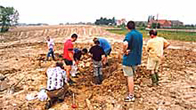 The Belgian archaeologists (who call themselves 'The Diggers') working on ground soon to be covered by an industrial site © After the last shell had fallen in 1918, the ground at Boesinghe soon became forgotten and abandoned. No houses were built on the area of the front lines east of the canal, and the fields were used for pasture. In the late 1990s the ground passed into the hands of developers, factory sites were planned and construction began. A group of local historians and archaeologists, called The Diggers, realised what might lie just below the surface and obtained a licence to work on the site. The result was an amazing survey of a section of the Western Front battlefields, which had never been attempted before.
The result was an amazing survey of a section of the Western Front battlefields, which had never been attempted before.
During the course of their work whole trench systems were unearthed, dugouts entered and every artefact connected with life at the front was uncovered. In the process the remains of more than 120 World War One soldiers were also found; British, French and German. None were ever identified, which is hardly surprising given the nature of the battlefield at Boesinghe and the fact that many were found in No Man's Land itself.
Soon the battlefield at Boesinghe will be completely covered in new buildings, and the trenches just below the surface lost forever. However, the work of The Diggers has given an insight into a part of the line that was typical of the British sector of the Western Front, and the life experienced by the average soldier in the front line.
Books
Before Endeavours Fade by Rose Coombes (After the Battle, 2001)
Ypres Then and Now by John Giles (After The Battle, 1990)
Walking The Salient by Paul Reed (Pen & Sword 1999)
Soldiers Died in the Great War (CD-Rom) (Naval & Military Press, 2002)
The Western Front Association The site is a great source of information about the Western Front
Paul Reed spent his teenage years interviewing veterans of World War One and has been active in the Western Front Association. He has published five books in the 'Battleground Europe' series. He is working on a book about the Normandy battles of 1944.

BBC © 2014The BBC is not responsible for the content of external sites. Read more.
This page is best viewed in an up-to-date web browser with style sheets (CSS) enabled. While you will be able to view the content of this page in your current browser, you will not be able to get the full visual experience. Please consider upgrading your browser software or enabling style sheets (CSS) if you are able to do so.

