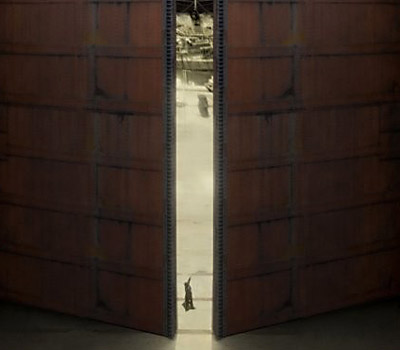
Computer image of reconstruction of the testing of the Gatun Locks
During the second week of June 1913, the testing of the guard gates at Gatun went perfectly. On 27 June, the last of the Gatun Dam spillway gates were closed, allowing the lake to rise to its full height.
At the Gatun Locks, ships are raised or lowered 26m (85ft) in a continuous flight of three steps. These lock gates, or mitre gates as they are known, because they close in a wide 'V', are the Canal's most dramatic feature.
The gates swing open and shut like double doors. Their lower halves are hollow, and their watertight construction makes them buoyant in the water - thus reducing the strain on their hinges. All the gates are 19.5m (64ft) wide by 2m (7ft) thick, but they vary in height from 14m (47ft) to 25m (82ft), depending on their location.
The original strut arm system to operate the lock gates, designed in the early 1900s, employed a 40-horsepower motor to mobilise a bull wheel. When the bull wheel rotated, the attached metal arm pulled the lock's mitre gate open or pushed it closed.
The new hydraulic system uses two motors, each with 25-horsepower capacity, which power a hydraulic arm to push and pull the lock's mitre gate. The advantage of this dual motor system is that, in the event of motor failure, one motor is sufficient to operate the system on a temporary basis.
No pumps are used at the Panama Canal, as the water does its work by force of gravity alone. Water is admitted or released through giant tunnels, or culverts, 5.5m (18ft) in diameter, running lengthwise within the centre and side walls of the locks. There are a total of 100 holes in each chamber for the water to enter into or drain from, depending on which valves are opened or closed.