
As cut-throat commerce helped shape London in the 17th and 18th centuries, the talented, vain and venal flocked to join in its growth. Explore the city's twists and turns on its way to becoming what Disraeli called a 'modern Babylon'.
By Bruce Robinson
Last updated 2011-02-17
As cut-throat commerce helped shape London in the 17th and 18th centuries, the talented, vain and venal flocked to join in its growth. Explore the city's twists and turns on its way to becoming what Disraeli called a 'modern Babylon'.
In the two centuries that followed 1700, London was utterly transformed, ditching medieval housing and habits to become the centre of the world - and the hungry metropolis that we know today.
By 1700, the city was already growing in population and in size, chewing up surrounding countryside and spitting bricks in its place.
By 1700, the city was already growing in population and in size, chewing up surrounding countryside and spitting bricks in its place. With large areas necessarily rebuilt after the Great Fire of 1666, London was looking more modern.
Its thriving port was the basis for flourishing finance and cut-throat commerce. The sharp-suited city boys were already marking out their turf, and the wealth this generated reinforced the power and patronage of the Royal court, to make London a magnet for the talented, the ambitious, the vain and the venal.
As a result, the city was expanding in all directions. To the east, Spitalfields was already growing rapidly by 1700, helped by the influx of French Protestant refugees. In 1743, Bethnal Green had a population of 15,000; by 1801, 22,000 people lived there, making it as large as Oxford and Cambridge combined.
To the north, London crept out towards Sadler's Wells, Finsbury Fields and Hoxton in the first half of the 18th century, colonising the turnpike roads with terraced houses.
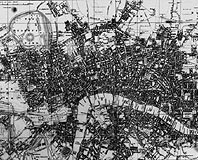 Leigh's Map of London in 1818 © To the south, however, was the River Thames. It had formed a natural barrier between north and south for centuries and the south bank, although populated, had always been a place apart.
In 1700, it was the location for those industries banished from the city proper - tanneries, timber yards and factories making vinegar, dyes, soap and tallow. As a result, south London was smelly and - with its prisons, asylums and dodgy taverns - it had a bit of a reputation. It was also difficult to get to. How things change.
Turning up its nose at the south bank was a luxury London could no longer afford.
Turning up its nose at the south bank was a luxury London could no longer afford. The building of Westminster Bridge in 1750 and Blackfriars Bridge in 1769 opened it up, and roads were soon laid to Kennington and Elephant and Castle. The first inhabitant was heavy industry, with potteries, lime kilns and blacking factories springing up in the later 18th century.
The building of three toll-bridges, at Southwark, Waterloo and Vauxhall, also laid the ground for extensive house-building in places like Camberwell, Brixton, Clapham and Dulwich. Even so, large patches remained rough and dirty: George Gissing wrote of Southwark's 'evil smell... alcoholic fumes... [and] a miasma that caught the breath', and many Londoners (not just taxi-drivers) still viewed south of the river as somewhere to be avoided.
By contrast, areas to the west were scrubbing up quite nicely. Fuelled by demand from rich and powerful individuals, development of west London was rapid, extensive and relatively well planned. Aristocratic families developed lands they had snagged after the Dissolution of the Monasteries almost two centuries earlier.
Aristocratic families developed lands they had snagged after the Dissolution of the Monasteries almost two centuries earlier.
Hanover Square was built by the Earl of Scarborough; Savile Row and Burlington Street by the Earl of Burlington, and the Duke of Devonshire created Berkeley Square, which immediately became one of the best addresses in London.
Yet London's prosperity brought its own headaches. Trade had underpinned the city's economy for centuries, and the 18th century saw it grow enormously. As the volumes of goods traded increased, however, the Thames became seriously overcrowded, causing delays and damage to merchandise.
After the West Indies merchants - who imported perishables like sugar, rum and coffee - threatened to move elsewhere, the West India docks were built at the Isle of Dogs in 1800. The 20,000 jobs they provided gave the east of London a major boost. Initially, at least, the East End (as it would eventually become known) was a respectable centre of the working poor.
All this change meant that the 19th century saw London explode into the modern age, its population rocketing seven-fold to over 6,500,000. By 1901, one in five people in England and Wales lived in London. The West End was completely overhauled by the Prince Regent and his architect, John Nash, who designed Regent's Park, Regent Street and Piccadilly Circus, and continued to redesign most of what is now tourist London.
Wider roads were also required, prompting the first phase of slum clearance. Around 120,000 people ultimately lost their homes between 1840 and 1900, and the City lost 100,000 inhabitants as it became a shrine to capitalism, dominated by banks, insurance offices and warehouses.
But it was the railways that ensured London's complete transformation. After all, this was the age of industrial revolution and the great city was never going to miss out. Euston station was built in 1837; Waterloo, Paddington, Victoria and the rest all followed shortly afterwards. In the 25 years from 1852 to 1877 the railways took over, as networks were laid that remain to this day. London would never look or feel the same again.
Railways meant they could move to the suburbs.
The biggest impact of the railways was the way they revolutionised working life. The big, national railway networks were accompanied by local, commuter lines. These were ideal for the clerks and other lower-middle-class professionals who could not afford to live in the safer areas of central London - and who chose not to live in the cheaper areas, where crime was booming. Railways meant they could move to the suburbs.
London Bridge and Fenchurch Street stations began running commuter services in the 1840s, servicing once far-off places like Deptford, Croydon and even Brighton. In 1859, work began on the Metropolitan Railway, running underground from Paddington to Farringdon. It was an instant success when it opened four years later and, in its first year, carried almost ten million passengers. The 'Tube', as it came to be known, was born.
The first electric line opened in 1890 and ran from King William Street to Stockwell, a distance of three miles; the Waterloo and City line ('the Drain') opened in 1898. On the surface, horse-drawn omnibuses first appeared in 1829; by the middle of the century there were 3,000 of them, carrying 900,000 passengers each day. Along with cabs, carts, carriages and trams, they filled London's roads. With gasoline-powered omnibuses arriving in 1897, London in 1900 would have been a far noisier place than it had been even 50 years earlier.
All the while, building continued apace: Chelsea, Pimlico, Bayswater, St John's Wood and Notting Hill were all developed between the 1820s and 1850s. In 1873, one reporter complained that 'the London of our youth... is becoming obliterated by another city which seems rising up through it.'
The Cheap Trains Act of 1883 helped the working class move from grim tenement blocks to 'railway suburbs' like West Ham and Walthamstow.
But London was spreading as well as rising. By the 1860s it had swallowed Hammersmith, Wood Green and Blackheath. Areas like Hackney, Balham and Islington were now favoured locations for office clerks and, increasingly, prosperous working class families. The Cheap Trains Act of 1883 helped the working class move from grim tenement blocks to 'railway suburbs' like West Ham and Walthamstow. This migration left only the poorest in the East End and, by 1880, it had become a hellish slum, notorious for its poverty, vice and violence (Jack the Ripper didn't help matters much).
The grinding poverty of Dickensian London was real and vicious, yet in many ways the city was improving. The tailor Francis Place claimed that, 'notwithstanding the vice, the misery and the disease which still abounds in London, its general prevalence has been greatly diminished.'
For once, London's expansion was accompanied by an evolving governance and infrastructure; London could look after itself better than ever before; it was maturing. Health scares and cholera epidemics in the 1850s paved the way for cleaner water; the Metropolis Management Act of 1855 shook up local government; and major works, such as drainage and slum clearance, were put in the hands of the Metropolitan Board of Works.
This progress, combined with the work of reformers such as Sir Robert Peel, Sir Edwin Chadwick and the Earl of Shaftesbury, resulted in new churches and schools and better law and order. Charities like the Sutton and Lewis trusts were building houses for the working class and, by the end of the century, London was dragging itself towards the introduction of municipal housing.
Public money was establishing and maintaining parks, and the success of the British Museum, coupled with the popularity and profitability of the Great Exhibition of 1851, paved the way for the national museums in South Kensington, free to all. Theatres and music halls were booming and department stores, like Harrods and Whiteleys, were separating Victorian gentility from its hard-earned cash.
By the end of the 19th century, London was a city without equal. Its role as headquarters of the British Empire gave it power and prestige; its population of millions gave it unparalleled diversity. To Disraeli, it was 'a modern Babylon', teeming with a myriad people, languages and cultures.
In this respect, it was the first global city, instantly recognisable to any Londoner today. Almost seven million people; wide streets crammed with buses and cabs; mainline and underground stations disgorging bustling commuters; weekends spent in pubs, parks, theatres and museums. In 1900, it must have appeared as if its growth, prosperity and progress would last forever. However, the planes and bombs of two world wars were soon to provide the great city with its greatest challenge yet.
Books
London, the Biography by Peter Ackroyd (Vintage, 2001)
A History of London by Stephen Inwood (Macmillan, 2000)
London, a Social History by Roy Porter (Penguin, 2000)
1700: Scenes from London Life by Maureen Waller (Sceptre, 2001)
Dr Johnson's London: Everyday Life in London in the Mid 18th Century by Liza Picard (Weidenfeld and Nicolson, 2001)
Bruce Robinson is a professional journalist who graduated with a first class degree in History from Cambridge University, specialising in English Social, Political and Economic History from 1300 to 1600.





BBC © 2014The BBC is not responsible for the content of external sites. Read more.
This page is best viewed in an up-to-date web browser with style sheets (CSS) enabled. While you will be able to view the content of this page in your current browser, you will not be able to get the full visual experience. Please consider upgrading your browser software or enabling style sheets (CSS) if you are able to do so.

