
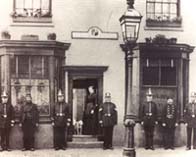
The Victorian zeal for rules and reform led to the establishment of the 'new police'. David Cross explores the role of the British bobby in Victorian Birmingham.
By David Cross
Last updated 2011-02-17
The Victorian zeal for rules and reform led to the establishment of the 'new police'. David Cross explores the role of the British bobby in Victorian Birmingham.
As the Industrial Revolution took off, employees flocking to work in the new industries were housed in densely populated residential areas for the first time. Crime, of course, was not a new problem, but rocketing crime levels and a fervour for regulation led to the formation of town and borough police forces in 1832 after the Charter of Incorporation. This charter allowed towns and boroughs to levy a rate on householders in order to pay for street lighting and cleaning, pavements and for the provision of police on the model of Robert Peel's highly successful 'new police' in London, formed two years previously.
Crime, of course, was not a new problem...
Most towns and boroughs adopted the Charter, but the town of Birmingham did not. However, following the Chartist riots in 1839, the councillors and magistrates requested permission from Lord John Russell, the Home Secretary, to establish a police force. Permission was granted under special terms as Birmingham had not signed up to the Charter. Thus the Birmingham Police force was formed in August 1839; the chief officer was Francis Burgess, a barrister at Warwick, who also happened to be a friend of Lord John Russell.
The rank structure of the force was very simple. At the top was the Superintendent. According to instructions issued for the running of the Birmingham force, 'It will be incumbent on him to direct the officers and men in their respective duties and to make such regulations with regard to the performance of them as he may find conducive to the interests of the service - subject to the approval of the Watch Committee.'
The constables were the backbone of the force...
Plain-clothes detectives were introduced a few years later. Their main job was to circulate lists of stolen property and to check pawnshops as well as dealing with more serious crime - all under the guidance of the Detective Inspector. The DI was often responsible for the attendance of police officers at court, and was therefore able to meet most regular criminals; he needed a good memory for names and events.
The constables were the backbone of the force and, not surprisingly, the lowest paid. In 1839 a constable in Birmingham earned between 16 and 18 shillings (80-90p) a week.
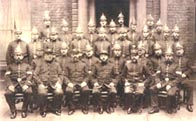 The City of Birmingham police force, 1880s © Appropriate conduct for constables was laid down in a detailed book of instructions published in 1840 and issued to all new constables. On discovering a fire, for example, the constable, who doubled as a fireman, could consult his book for the suggested response, '...the constable will spring his rattle and cry fire there for raising an immediate alarm. He will also raise the inmates of any house or dwelling.' The instructions didn't just cover operational matters, '...night duty officers will grow a beard that will cover his throat to keep his air tubes warm...'.
...night duty officers will grow a beard that will cover his throat to keep his air tubes warm...
The constable's uniform consisted of a top hat representing authority and a tailed jacket for servitude, because although the police were considered public servants they were also the public's masters. The officer would also have carried a truncheon, handcuffs (which were issued on a semi-regular basis from 1832 and by 1839 were commonplace), an oil lamp and - in some of the more dangerous areas - a cutlass. Police whistles came much later; the early Victorian constable would have carried a small wooden rattle.
Constables lived either in the police station or a few doors away. On parading for duty at 6am the day constables were marched to their beats. Only at this stage was the night constable they were relieving allowed to join the officers going on duty so he could march back to the police station to sign off. Had any incidents occurred on his beat then he would have to write up the report after he had finished his tour of duty.
The day constable would have to patrol at the pace of two and a half miles per hour, keeping the streets free from hawkers selling goods from suitcases, moving on persons causing an obstruction, and looking out for children playing in the street. He was not allowed to leave his beat or consume alcohol when on duty. Traffic duty consisted of ensuring the roads were not obstructed by horses and carts, hansom cabs and making sure that persons being carried in sedan chairs were transported on the road not on the pavement. He was not allowed to gossip with anyone or even pass the time of day with another constable if it was not in the line of duty. The policeman was clearly dissuaded from taking advantage of his smart new uniform - '...a constable will not enter into conversation with women especially female servants...'.
The policeman was clearly dissuaded from taking advantage of his smart new uniform...
The Victorian policeman was lucky enough to receive sick pay (with a deduction of one shilling). However, if he had a hangover or injury caused by drinking, he received nothing - all at the discretion of his Superintendent. After his first year of duty, the constable received ten days leave a year, but he worked seven days a week!
Clearly though a thick rulebook was not enough to keep the constables on the straight and narrow. The Birmingham Police force 'Default book' for 1839-40 lists examples of where constables slipped up. The hapless PC George Leach joined the force in July 1840. On 3rd September he was found to be, 'Absent from duty beat at 9pm and found drinking in the White Lion Beer shop in the company of prostitutes and thieves - fined two days' pay'. Four days later a slightly ambiguous entry reads 'Highly disgraceful behaviour in Church yesterday - dismissed from the service.'
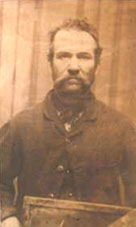 Mugshot of a criminal, imprisoned for 14 days for thieving from a washing line © During the second half of the 19th century the policeman's role was complemented by the development of forensic science and the invention of the camera, which led to the creation of the infamous rogues' gallery. In Birmingham this pictorial record began in 1858 and the earliest photographs were taken in a studio next to the station in Moor Street. Once the police had a camera, the number of photographs increased to become an archive of mugshots. Details of the alleged crime, the court case and sentence are listed with each photograph forming a comprehensive record. (Police photographs are distinguishable from prison photographs since prisoners usually wore a uniform.)
Once the police had a camera, the number of photographs increased to become an archive of mugshots.
Thus the days when criminals had only to change their locations and identities to slip the bobby's grasp were over. With the advent of forensic science came the more sophisticated image of the police force as a band of men equipped with a combination of cunning, science and logical deduction.
Scientific and technological advances aside; the foundations of the modern police force were laid in towns like Birmingham during the early Victorian period (the town became a city officially in 1889). The uniforms, division of uniformed and plain-clothes officers, the hierarchy and the role of the superintendent have not changed dramatically in the century and a half since PC George Leach found himself on the wrong side of the law. However, the drunken law-enforcer is doubtless not an invention the Victorians can claim credit for.
Books
The English Police: A Political and Social History by Clive Emsley, 2nd edition (Longman, 1996)
The Emergence of Penal Policy in Victorian and Edwardian England by Leon Radzinowicz and Roger Hood (Clarendon Press, 1990 )
White-Collar Crime in Modern England: Financial Fraud and Business Morality 1845-1929 by George Robb (Cambridge University Press)
Artful Dodgers: Youth and Crime in Early Nineteenth-Century London by Heather Shore, Woodbridge (Boydell Press/Royal Historical Society, 1999)
Street Violence in the Nineteenth Century: Media Panic or Real Danger? by Rob Sindall (Leicester University Press, 1990)
The New Police in Nineteenth-Century England: Crime, conflict and control by David Taylor (Manchester University Press, 1997)
Crime, policing and punishment in England 1750-1914 by David Taylor (Macmillan, 1998)
Reconstructing the Criminal: Culture, Law, and Policy in England 1830-1914 by Martin J Wiener (Cambridge University Press)
Women, Crime and Custody in Victorian England by Lucia Zedner (Clarendon Press, 1991)
West Midlands Police Museum - Sparkhill Police Station, 607 Stratford Road, Sparkhill, Birmingham. Tel: 0121 626 7181. The West Midlands Police Museum houses a wide range of pictures, information and items to show the development of policing in and around Birmingham.
The London Dungeons - 28-34 Tooley Street, London, Tel: 020 7403 0606. Detailing the darker side of London life for the last 1500 years, the London Dungeons include a section on Jack the Ripper and Victorian crime.
The Sherlock Holmes Museum - 221B Baker Street, London. The home of the greatest Victorian sleuth, faithfully preserved as it would have been in the 19th century.





BBC © 2014The BBC is not responsible for the content of external sites. Read more.
This page is best viewed in an up-to-date web browser with style sheets (CSS) enabled. While you will be able to view the content of this page in your current browser, you will not be able to get the full visual experience. Please consider upgrading your browser software or enabling style sheets (CSS) if you are able to do so.

