
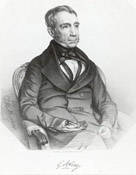
The Victorians brought order to everything - scientific research included. Emily Winterburn introduces George Airy, Astronomer Royal and chief rulemaker at the Royal Observatory.
By Emily Winterburn
Last updated 2011-02-17
The Victorians brought order to everything - scientific research included. Emily Winterburn introduces George Airy, Astronomer Royal and chief rulemaker at the Royal Observatory.
George Biddell Airy was Astronomer Royal at the Royal Observatory in Greenwich from 1835 to 1881. In his time, Airy transformed the observatory, installing some of the most advanced astronomical apparatus of his day and expanding both staff numbers and their workload. Staff had to clock-in and clock-out - common practice in Victorian factories and he also introduced new methods for dealing with the larger scale of the organisation. Further steps to automate systems and the production of strict step-by-step guidelines, all helped to reduce human error and increase efficiency.
The Airy Transit Circle, installed in 1850 and first used on 4th January 1851 is emblematic of the revolution in working practice introduced by Airy at the Royal Observatory. It sits on the north-south line, which today marks longitude 0°. This Prime Meridian, signals the start of the Universal day for the entire world. At the time of its installation, the Airy Transit Circle marked a huge advance on existing technology.
A transit instrument is always lined up with a north-south line, or meridian. When a star passes over the meridian, the transit instrument can be used to measure the angle at which this happens. Whilst this happens, an extremely accurate clock, called a regulator, is used to measure the time it occurs. These two measurements give the co-ordinates of that star, which can be used to make a star chart - and star position tables to aid navigation. The production of these tables, published annually to this day in the Nautical Almanac, was fundamental to the founding duty of the Observatory, which was to improve navigation.
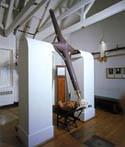 Instrument made by Troughton © A new telescope was needed, Airy argued, because improvements in telescope design more generally meant discoveries were being made that the Observatory had no way of using or checking. Between 1801, when the first asteroid was discovered, and 1845, when Airy first proposed the new instrument, three new minor planets, or asteroids had been discovered. This figure continued to climb throughout the 19th century. The existing Troughton transit telescope was not powerful enough to see these. Yet, Airy argued, it was the duty of the Observatory to chart the position of all stars and planets so they might be used by navigators.
The transit instrument that Airy's transit circle replaced was made by Edward Troughton of London, a famous instrument maker of the 18th century. He worked independently, on commission, from his workshop-cum-showroom, with the help of one or two assistants and apprentices and using an object glass from the optician, Peter Dollond.
The construction of the Airy Transit Circle was completely different. For a start, Airy was in control, rather than the instrument makers involved. He drew up the designs, with advice from Charles May on engineering and William Simms on optics, to incorporate all the improvements he thought necessary to keep the Observatory at the forefront of positional astronomy. He then contracted out different parts of the overall construction to different companies. To that end, Ransomes and May of Ipswich were employed to carry out the engineering work on the telescope, such as the construction of the telescope tube and the mountings, while the optical work, and fine, detailed work of micrometer manufacture, was carried out by Troughton and Simms.
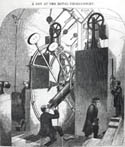 The Airy Transit Circle in use © The Troughton telescope had used an object glass of 5 inches diameter, which, at the time of its manufacture, in 1793, was the largest ever made by the optician Peter Dollond. Airy's new telescope had an object glass of 8.1-inch diameter. It had a magnification of 195, and most importantly, incorporated a number of measures to reduce the overall errors incurred in observations. There are, for example six micrometers for reading the scale, which gives the angle above the horizon of the star. Each is read, and an average of the six is taken, so even if one is slightly out, the reading is still very accurate.
When making a transit observation, one major source of error was the reaction time of the observer between when he (and it was always a he) observed the star, and when he noted the time. To reduce this error Airy came up with a way of linking both. With this chronograph, instead of observing the star, listening to or glancing at the regulator, and then mentally registering the time before noting it down, all the observer had to do was observe the star and simultaneously tap a key.
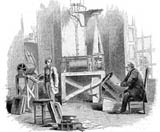 The barrel chronograph, from Dunkin's The Midnight Sky © The task of reading the chronograph sheets to extract the time for each observation was then passed down the production line to the computers, as the clerks who did the calculations were called. The observers' role was therefore reduced to just making the observations, while interpretation of these observations was left to the computers. As it happens, there was a certain amount of cross over, with many of the observers having some of their time assigned to computing duty, while some computers spent a portion of their time being trained up as observers.
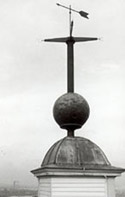 The Greenwich timeball © It was not only the observers and the instruments that introduced errors to the measurements made. Once the observations had been made, the measurements would be handed over to the computers or clerks, who in Airy's day, worked at the Observatory from 8 in the morning until 8 at night. Their job was to turn the raw data into useful tables. To ensure that as few errors were made as possible, Airy devised a form to fill out, taking the computer through every step of the calculation. This production line method meant that errors might be reduced or at least be easily traceable. It also meant that someone relatively inexperienced could carry out quite complex calculations.
In the hierarchical structure of Airy's Observatory, the computers were at the very bottom of the heap. Above them came the observers, the chief assistant and at the very top, the Astronomer Royal.
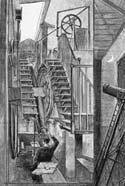 The Observatory, from The Graphic, 1885 © Airy's drive to make the Observatory carry out its job of aiding navigation more efficiently led to other innovations besides the Airy transit circle. One aid to navigation, which had been installed by Airy's predecessor, John Pond, in 1833 was the timeball. To this day it falls at 1pm every day to signal to navigators on the Thames the time at Greenwich, that they might set their clocks accordingly. This had originally been activated by hand - Airy made this automatic.
When Airy first arrived, the work of the Observatory was still very much focused on positional astronomy and although the Observatory was expanding, it was still very small. When Airy finally retired in 1881 there were several new departments, including a heliographic department (for observing the Sun and in particular for making daily observations of sunspots), a spectroscopic department (making use of the latest technology to investigate what stars are made of), and a Double-star department. Certain existing departments such as the magnetic and meteorological department had changed beyond recognition. This department in Pond's day consisted only of some magnetic needles and barometers. But now it had its own buildings and a team of staff tasked with taking daily readings of the direction and intensity of the Earth's magnetic field both in the vertical and horizontal plane, of temperature, humidity and atmospheric pressure, and of wind speed and direction, rainfall and hours of sunshine.
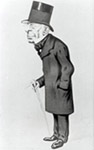 Caricature of George Airy, from Vanity Fair, 1875 © A quote often used when describing Airy, comes from an ex-employee, Maunder, writing in 1900, who in turn quoted De Morgan who 'jocularly said that if Airy wiped his pen on a piece of blotting paper he would duly endorse the blotting paper with the date and particulars of its use, and file it away amongst his papers'. There is another anecdote, also from Maunder, where he describes Airy as having spent an entire afternoon labelling empty boxes 'empty'.
While there is undoubtedly some truth in these descriptions of his rather fastidious behaviour, it is also fair to say that it was this obsessive attention to detail that made him an extremely good at his job. It allowed him to break down each project the Observatory was involved in into a series of steps. These he could then delegate accordingly so that each employee could specialise in one particular stage of the process.
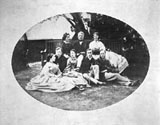 George Airy and family © For the years 1835 to 1881 Airy lived at the Observatory with his wife and children. Of his nine children, six were born while the family lived at the Observatory.
Greenwich Observatory, vol 1, by Eric G. Forbes (London, 1975)
Greenwich Observatory, vol 2, by A. J. Meadows (London, 1975)
Greenwich Observatory, vol 3, by Derek Howse (London, 1975)
The History of the Airy Transit Circle by Gilbert Satterthwaite (MSc Dissertation at University of London, 1995)
The Royal Observatory, Greenwich by E Walter Maunder (London, 1900)
Autobiography of Sir George Biddell Airy edited by Wilfrid Airy (Cambridge University Press, 1896)
The Victorian Amateur Astronomer, Wiley-Paxis by Allan Chapman (Chichester, 1998)
The Midnight Sky by Edwin Dunkin
'John and Edward Troughton, Mathematical Instrument Makers,' Note & Records of the Royal Society, vol 27, no 2, by AW Skempton & Joyce Brown (Feb 1973)
Eyes Right: The Story of Dollond & Aitchison, 1750-1985 by Hugh Barty-King (Quiller Press, London, 1986)
Transit Circle: The Story of William Simms, 1793-1860 by Eleanor Mennim (William Sessions Ltd, York, 1992)
Ransomes of Ipswich by DR Grace & DC Phillips (University of Reading, 1975)
Directory of British Scientific Instrument Makers, 1550-1851 by Gloria Clifton (National Maritime Museum, London, 1995)
Emily Winterburnn is Curator of Astronomy at the Royal Observatory, Greenwich, and is also working on her PhD looking at the life of another 19th century scientist, John Frederick William Herschel.




BBC © 2014The BBC is not responsible for the content of external sites. Read more.
This page is best viewed in an up-to-date web browser with style sheets (CSS) enabled. While you will be able to view the content of this page in your current browser, you will not be able to get the full visual experience. Please consider upgrading your browser software or enabling style sheets (CSS) if you are able to do so.

