Early Victorian
The Christmas tree
The image of a glittering fir tree, with its lush dark-green branches illuminated by twinkling lights, at the centre of a happy domestic scene is today one of the most powerful and recognisable images of a 'traditional' Christmas. For many, the Christmas tree is also firmly associated with the Victorians, and indeed with those great advocates of Christmas, Queen Victoria and her husband Prince Albert.
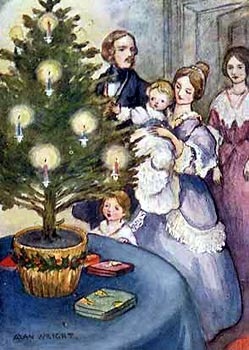
The custom, which originated in Germany, was introduced into England during the Georgian period. Queen Charlotte, German wife of George III, is known to have had a decorated tree for her family as early as the 1790s, and there is also a record of a tree at a children's party given by a member of Queen Caroline's court in 1821. Queen Victoria herself remembered such trees in the 1830s, happily describing potted trees placed on round tables 'hung with lights and sugar ornaments'.
So, although Prince Albert is generally given credit for introducing the Christmas tree to England, he in fact simply popularised and made fashionable an already existing custom. Victoria and Albert shared a heart-felt enthusiasm for Christmas and each year of their marriage, decorated trees provided a focal point for their domestic celebrations.
In 1848, a print showing the Royal couple with their children was published in the Illustrated London News. From this time onwards, the popularity of decorated fir trees spread beyond Royal circles and throughout society. Charles Dickens referred to the Christmas tree as that 'new German toy'.
Trees were generally displayed on tables in pots, with gifts placed unwrapped underneath. The tree was decorated with wax candles, baskets of sweets, flags and little ornaments and gifts. The imported German Springelbaum was the tree of choice until the 1880s, at which time the home-grown Norway Spruce became available. This made a larger tree more affordable, and people began placing trees on the floor.