
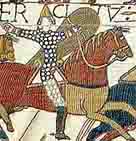
The Conquest of 1066 is considered the last invasion of the British Isles. But how did Britain defend her shores from subsequent foreign attackers such as Spain and France?
By Dr Niall Barr
Last updated 2011-02-17
The Conquest of 1066 is considered the last invasion of the British Isles. But how did Britain defend her shores from subsequent foreign attackers such as Spain and France?
The invasion of England in 1066 by a moderate force of Norman, Breton and Flemish knights marked a decisive turning point in the nation's history. The destruction of the old Anglo-Danish hierarchy at Hastings effectively severed England's traditional ties with the Scandinavian world that had existed since the 9th century. Nevertheless the Normans were still forced to repel invasions from large Norwegian and Danish forces in the late 1060s that found native support in the north-east of England. To prevent future raids and crush internal resistance, William I adopted a 'scorched earth' policy known as the 'harrowing of the north', and castles appeared throughout England to garrison a resident military force.
To prevent future raids and crush internal resistance, William I adopted a 'scorched earth' policy...
In consequence, for the next 150 years England enjoyed an unprecedented level of security from external enemies as part of an Anglo-Norman 'super-state'. Friendly Norman ports protected England's southern coasts, whilst the Channel was viewed as an inconvenient break in the lines of communication between the two territories rather than a defensive ditch. Only family conflict compromised this security. England slipped into anarchy when King Stephen lost Normandy to Henry, Duke of Anjou, who repeatedly invaded until he won the throne in 1154.
England and Normandy were thus absorbed into an 'Angevin Empire' that stretched from the Scottish border in the north to the Pyranees in the south, and incorporated about two-thirds of modern France. Naturally the French monarchy felt threatened by such an over-mighty neighbour, and wars sporadically broke out; however the fighting took place across the Channel in a disputed territory known as the Norman Vexin. From 1154, this was effectively England's eastern frontier, and invasion was a distant threat.
By the dawn of the 12th century, Normandy's protection from French invasion relied heavily on English silver, expended in vast quantities by Richard I on defensive fortifications. However, the French swept through the Duchy in 1204, and castle after castle fell with bewildering rapidity. King John was unceremoniously evicted from his continental lands back to England; only Gascony was retained. For the first time since the Conquest, the Channel became England's first line of defence.
To his credit, John realised that dominance of the Channel was crucial if England was to be saved, and expended vast sums building a navy. Planned French invasions in 1205 and 1213 were thwarted at sea, but during the crisis of 1215 the rebellious barons invited French troops under Prince Louis to land unopposed to assist with their struggle over Magna Carta. Dover Castle, a vital communications centre on England's south coast, was besieged in 1216. The defenders held out - just - and after John's timely death. the French were soon driven from England's shores.
An uneasy peace held for most of the 13th century; but tension grew as England's important naval links with Gascony were threatened.
Thereafter the Channel was the key to English security. An uneasy peace held for most of the 13th century; but tension grew as England's important naval links with Gascony were threatened. War erupted in 1337, and its course over the next century was shaped by the struggle for naval supremacy. The French fleet initially held the upper hand, allowing their land troops to occupy and burn Southampton in 1338. Buoyed by this success, a full-scale invasion was planned in 1339. Edward III's spectacular naval victory at Sluys in 1340 at a stroke destroyed the French fleet, removed the threat of invasion and secured English dominance of the Channel. Furthermore the capture of Calais in 1347 gave the English a foothold on the Continent - the equivalent of the French holding Dover castle - and permitted large-scale invasions of France.
For the remainder of the 14th century and the first half of the 15th, the Hundred Years War was fought on French soil. Although most of England was safe from invasion, the southern coastline was terrorised by swift yet damaging French raids, exemplified by the destruction of Winchelsea in 1360. Fears of more serious incursions were raised in 1385, and in 1400 French troops assisted the revolt of Owen Glendower in the Welsh marches. However Henry V's conquest of Normandy brought renewed security to England that had not been enjoyed since 1204.
 St Benet's Abbey in Norfolk fell into decay after the English Reformation © The expulsion of the English from France in 1451-53 ultimately plunged England into horrific civil war, only ended by the invasion of Henry Tudor and his victory at the Battle of Bosworth in 1485. Mindful of his own success as a usurper, Henry VII's embryonic regime was preoccupied by fear of invasion by pretenders backed by either the French or the Holy Roman Empire. A new weapon was therefore deployed to provide security - international diplomacy.
Years of civil war had relegated England to a virtual observer in the international arena as France fought against the Holy Roman Empire for control of Italy. The age of military 'leagues' had arrived, when the exorbitant cost of warfare prohibited any country from fighting alone. Henry VII brought a measure of security to England by acting as Europe's 'honest broker', whilst arranging marriage alliances with key states to strengthen his dynasty.
However, his son Henry VIII had very different ideas, and was determined to restore England to its former glory. His costly invasion of France in 1513 achieved little beyond exposing England's Achilles heel - in his absence a Scottish army invaded from the north, mindful of the Auld Alliance between France and Scotland. Thereafter continental adventures could only take place once the northern border had been secured.
Henry's break with Rome in 1534 radically changed England's relationship with the major European powers. By placing England outside the community of Christian (Catholic) kingdoms, Henry laid himself open to excommunication and deposition, whilst the Pope could legitimise any invasion of England as a religious crusade. This was precisely what happened in 1539 and 1545, when enemies threatened on three fronts. In response, defensive barricades and earthworks were hastily thrown up; and a series of gun forts were constructed along the south coast to protect key harbours such as Portsmouth. The importance of naval superiority was reflected by huge investments in refitting and expanding the navy. Leading exponents in cartography, a relatively new science, were employed by Henry to produce maps that would assist with the defence of his realm.
...defensive barricades and earthworks were hastily thrown up...
Despite these preparations, the French launched an invasion in 1545 that culminated in the capture (for 24 hours) of the Isle of Wight. Despite the sinking of the flagship 'The Mary Rose' in Portsmouth harbour, the English navy were able to chase the French fleet away before they could disembark an army on the mainland. Although the threat had receded, the remainder of Henry's reign was spent wondering who to fear the most - France, or the growing might of the Habsburgs in Spain and the Holy Roman Empire.
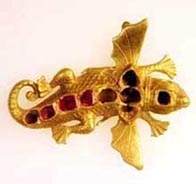 A gold pendant in the shape of a lizard salvaged from an Armada vessel wrecked off the coast of Ireland © When Mary I died in 1558, the majority of England's political élite had rejected a return to Catholicism, and stood in direct opposition to her erstwhile husband Philip II of Spain, the champion of Catholic Europe. Yet national security had been seriously compromised when Calais fell to the French in 1558, leaving the eastern coasts stripped of protection for the first time in two centuries; and a survey undertaken in 1559 showed the navy to be in a perilous state of disrepair.
Unease deepened in 1566 when Spanish troops were despatched to the Netherlands to crush a Protestant revolt, raising the unappetising prospect of the entire coast opposite England falling under Spanish control. With France rendered impotent by internal religious war, Elizabeth I reluctantly sent cash to the beleaguered Dutch rebels; by sending troops in 1585, England had effectively declared war against Spain.
...national security had been seriously compromised when Calais fell to the French in 1558...
The fear of 'an enemy within' had already been raised by the discovery of plots amongst England's Catholic community, encouraged by Spanish agents, to assassinate Elizabeth and place her cousin Mary Queen of Scots on the throne. Lord Burghley established a sophisticated intelligence network under the direction of Sir Francis Walsingham to gain information on England's enemies at home and abroad. Armed with sufficient information to convict and execute Mary in 1587, Walsingham then extended his network of spies to obtain detailed plans of a massive Spanish invasion, long feared since 1582.
Once more, naval dominance was the key to England's survival. Yet the discovery of the New World meant that much of the struggle took place on the high seas thousands of miles away. English raids on Spanish bases in the West Indies and attacks on treasure ships carrying bullion to Europe cut off a vital supply of resources, and helped to delay Spain's invasion plans and buy England some time to prepare.
England's only realistic chance of salvation lay in stopping a battle-hardened Spanish army from crossing the Channel. Consequently the English navy had to prevent the Armada making its rendezvous at Calais, and despite a fearsome battle from 19th July the majority of the Armada reached its intended destination. In desperation, English fireships were launched into the harbour at night, flushing the Armada back into open waters before the land troops had time to embark. At the Battle of Gravelines (29th July 1588) the armada was driven further around Britain's shores, and only 34 of 128 ships returned to Spain.
Despite renewed fears of Spanish attacks, particularly in 1595, no invasion ever materialised. By 1605 peace had been signed, and the next threat to English security materialised from erstwhile allies. Within 50 years, the Dutch had become commercial and maritime rivals in the New World. Three wars were fought in quick succession, and a Dutch raiding party that sailed into the Medway in June 1667 quickly jolted the nation out of its complacent attitude towards its closest neighbours.
The successful invasion of England provoked a reaction in Scotland and Ireland...
The Dutch returned in 1688, and the unthinkable finally happened: 14,000 troops landed in Devon at the invitation of disgruntled opponents of James II, and their leader William of Orange marched unopposed to 'seize' the throne. All the contemporary rhetoric portraying the coup as a 'Glorious Revolution' cannot disguise the fact that England had been invaded by a rival nation - a fact underlined by one of William's first moves as king, when he persuaded Parliament to pay the Dutch for the expenses incurred in the expedition.
The successful invasion of England provoked a reaction in Scotland and Ireland in support of the exiled Stuarts, who had taken refuge in France. William's harsh repression of the first Jacobite uprisings failed to solve the problem, and the union of Scotland and England in 1707 sparked a new wave of protest the following year. The Hanoverian succession in 1714 inspired a wider coalition of disgruntled forces, from disaffected Scottish Highlanders to English Tories opposed to the Whig-Hanoverian government. The '15 was eventually defeated, and the failure of the Stuarts to provide support from abroad was crucial.
To prevent repetition, massive expenditure was outlaid on a network of roads in the Highlands to ensure rapid movement of troops. These measures were put to the test in 1745 when Bonnie Prince Charlie set out on an abortive raid to the Islands, which snowballed into a full-scale invasion. Once again, the failure to secure foreign support spelled the doom of the expedition, and reprisals were swift and brutal. A series of strategic forts were constructed to hold the Highlands as though they were conquered territory. Effectively, Britain's back gate had been slammed shut.
Britain assumed it was safe from invasion, even when the North American colonies were slipping away.
Britain assumed it was safe from invasion, even when the North American colonies were slipping away. The incursion of John Paul Jones at Whitehaven in 1778 therefore came as a huge shock. Although his raid was no more than a self-interested revenge attack by an American privateer, the vulnerability of English ports provoked a hysterical reaction. A hasty programme of repair and reconstruction to coastal forts failed to calm fears that America's allies, Spain and France, would also strike. However by 1789 the revolution across the Atlantic was to have a far deeper impact on English security.
Books
R.A. Brown, The Norman Conquest by Edward Arnold (1984)
Britain after the Glorious Revolution 1689-1714 by G. Holmes (ed.) (Macmillan, 1965)
The Hundred Years' War by R. Neillands (Routledge, 1990)
The English and the Norman Conquest by A. Williams (Boydell, 1995)
The Jacobites: Britain and Europe 1688-1788 by D. Szechi (Manchester University Press, 1994)
Domesday: A Search for the Roots of England by Michael Wood (BBC Books, 1999)
battle1066 has a lot of useful context on the Battle of Hastings and links to a site displaying the Tapestry in its entirety.
Dr Niall Barr is a senior lecturer in Defence Studies, Kings College London, at the Joint Services Command and Staff College.





BBC © 2014The BBC is not responsible for the content of external sites. Read more.
This page is best viewed in an up-to-date web browser with style sheets (CSS) enabled. While you will be able to view the content of this page in your current browser, you will not be able to get the full visual experience. Please consider upgrading your browser software or enabling style sheets (CSS) if you are able to do so.

