
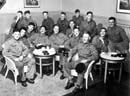
David Prest discovers the impact that National Service had on the young men who trod the drill ground in the 1940s, 50s and 60s - for better, for worse.
By David Prest
Last updated 2011-03-03
David Prest discovers the impact that National Service had on the young men who trod the drill ground in the 1940s, 50s and 60s - for better, for worse.
The years of National Service cover almost two decades - from World War Two to the birth of the Beatles. In all, between 1945 and 1963, 2.5 million young men were compelled to do their time in National Service - with 6,000 being called up every fortnight.
Some went willingly, while others were reluctant but resigned.
Some went willingly, while others were reluctant but resigned. A few were downright bloody-minded, seeing little difference between their call up and the press gangs of Britain's distant past.
At first public opinion was behind the idea of peacetime conscription, or national service. It was clear in the immediate post war political landscape that Britain had considerable obligations, and only a limited number of men still in service.
There was Germany to be occupied with 100,000 troops; and Austria too. In the Middle East there was Palestine to be policed, Aden to be protected, the Suez Canal Zone to be held down - as well as Cyprus, Singapore, Hong Kong and a chain of lesser military bases.
However, in the milk bars and Lyon's tea shops of those days, no amount of government propaganda could stop youngsters of both sexes grousing about the disruption to their lives caused by national service. It would have an effect on education plans, young boys starting apprenticeships, and on girlfriends faced with the prospect of their partners disappearing with only occasional leave. The only escape, so it seemed, was failing the medical.
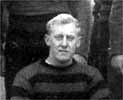 Inventor Trevor Baylis became an army physical training instructor © The inventor Trevor Baylis managed to become an army physical training instructor. Like every ex-conscript, the medical is etched into his memory - it was a comic ritual performed like everything the military did, strictly according to king's regulations. And it ended with the dreaded moment when a lady doctor asked the young lads to drop their trousers and cough.
The summons came a few weeks after the medical, delivered by the postman in a plain brown envelope, with the instruction that the prospective recruit had to report to barracks for the start of ten weeks of basic training. For reasons no one can now remember, the first day of soldiering was always on a Thursday.
The arena for the breaking in of these young men was the parade ground.
Bruce Kent, many years later a leader of the Campaign for Nuclear Disarmament, was a happy and willing warrior in 1947, but quickly came to consider his sergeant majors as demented psychopaths, who positively enjoyed shouting at and insulting the new recruits.
Overnight, the national servicemen had to learn a new language. 'Blanco', 'spit n polish', 'rifle oil', 'pull throughs', and the dreaded 'bull' and 'jankers'. Once they had been shaved and kitted out - all within a few hours of arrival - the rookie national servicemen all looked identical, even if, back in the barrack room, every man was still an individual.
The arena for the breaking in of these young men was the parade ground. In squads they learnt how to obey orders instinctively, and to react to a single word of command, by coping with a torrent of abuse from the drill sergeants.
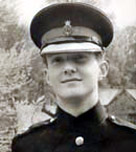 Auberon Waugh pictured as a young national serviceman © After basic training, the raw recruits would be turned into soldiers , sailors and airmen, and they would be posted to join regiments at home or abroad. Nearly 400 national servicemen would die for their country in war zones like Korea and Malaya. Others took part in atomic tests on Christmas Island, or were even used as human guinea pigs for germ warfare tests.
There are tragic stories too, of young men who simply couldn't cope with military life, or the pain of separation from their families and for whom suicide was the only way out.
Nearly 400 national servicemen would die for their country in war zones like Korea and Malaya.
But what of the longer term impact on these men? Among the more independent young soldiers, they learnt a contempt for the army, which damaged morale and affected the image of the army to the outside world. As news of the absurdities of army life spread, this may have had its impact on the recruiting of regulars, which fell sharply during the 1950s.
In addition, as early as 1949, it had become apparent to political and military leaders that the principal of universal liability to national service was a double-edged sword: not only was it supplying more men than the services could absorb, but it was draining resources to train them, and taking fit and able young men out of the economy.
It may have started with honourable intentions of keeping Britain's post-war army viable, but nobody expected that it would last until the 1960s and have a profound effect on an entire generation.
Links
Campaign for Nuclear Disarmament
The RAF Benevolent Fund. Offers help to RAF veterans and their families.
Royal Air Force (RAF)
About the author
David Prest was the producer of 'Evacuation: The True Story', BBC Radio 4's major five-part series presented by Charles Wheeler.



BBC © 2014The BBC is not responsible for the content of external sites. Read more.
This page is best viewed in an up-to-date web browser with style sheets (CSS) enabled. While you will be able to view the content of this page in your current browser, you will not be able to get the full visual experience. Please consider upgrading your browser software or enabling style sheets (CSS) if you are able to do so.

