
Successive governments squandered billions of Marshall Plan Aid to support British world power pretensions, and so jeopardised the economic future of Britain.
By Correlli Barnett
Last updated 2011-03-03
Successive governments squandered billions of Marshall Plan Aid to support British world power pretensions, and so jeopardised the economic future of Britain.
We all know the easy British explanation for our cumulative export defeat in world markets from the 1950s onwards, especially at the hands of the Germans. This story tells us that lucky West Germany had all her industries and infrastructure bombed flat or removed as reparations, and then was able to re-equip herself from scratch with Marshall Aid dollars. Meanwhile, so this hard-luck story goes on, poor old Britain had to struggle on with worn-out and old-fashioned kit.
Britain actually received more than a third more Marshall Aid than West Germany ...
This is utter myth. Britain actually received more than a third more Marshall Aid than West Germany - $2.7 billion as against $1.7 billion. She in fact pocketed the largest share of any European nation. The truth is that the post-war Labour Government, advised by its resident economic pundits, freely chose not to make industrial modernisation the central theme in her use of Marshall Aid.
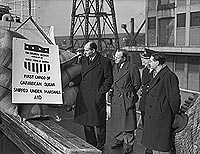 Marshall Aid sugar is unloaded at London's Royal Victoria Dock, February 1947, watched by US and UK officials © The root cause of this self-destructive British choice lies back in 1945, when Great Britain, as one of the 'Big Three' along with the United States and the Soviet Union, emerged from World War Two with the psychology of a victor but with her economic circumstances more resembling those of a defeated country. Despite the victory over Hitler, Britain was literally bankrupt, and faced the prospect of unbridgeable balance-of-payments deficits for years to come.
It was this victor's psychology that deluded both Labour and Conservative politicians into believing that Britain - at the centre of the Commonwealth and the Sterling area - could have a future that was similar to her past. British politicians saw the United Kingdom as a first-class power in the same league as the United States. And certainly Britain looked in many ways like a global power, with more than two million men in fleets, garrisons and air squadrons sprawled across the world, from their bases at home to those in Japan.
One important figure had a different view.
Nonetheless, John Maynard Keynes, the chief economic advisor to the new Labour Government, warned ministers in August 1945 that Britain's world role was a burden which '... there is no reasonable expectation of our being able to carry ...'
As he pointed out, the entire British war effort, including all her overseas military commitments, had only been made possible by American subsidies under the Lend-Lease programme. If the Americans stopped Lend-Lease, Britain would face a 'financial Dunkirk' - his words - unless Washington could be touched for a loan of $5 billion. Keynes wrote that such a 'Dunkirk' would have to be met by:
'... a sudden and humiliating withdrawal from our onerous responsibilities with great loss of prestige and the acceptance for the time being of the position of second-class Power, rather like the present position of France.'
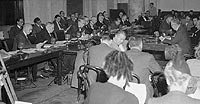 Secretary of State George Marshall (right) faces the Senate Foreign Relations Committee, 8 January 1945, to argue for aid to Europe © Well, a week after VJ-Day (Victory over Japan Day), the US Congress duly did stop Lend-Lease. What now? For the new Labour Cabinet, Keynes's 'Dunkirk' solution of packing up all our 'onerous responsibilities' and becoming a second-class power was unthinkable, certainly unthought.
So instead, the Labour Government successfully cadged a loan of nearly $4 billion from the Americans. Thanks solely to this American tick, Britain could continue to entertain the dream of being a world power at the centre of the Commonwealth. Even so, the war-bankrupted country was still desperately hard up. The Labour Cabinet therefore sought in the first place to reconcile the dream with economic reality by means of salami-slicing the armed forces. The result was worrying - as Herbert Morrison shrewdly judged in November 1949:
'We are in danger of paying more than we can afford for defences that are nevertheless inadequate, or even illusory'.
Just as true today, of course.
In the second place, the Labour Cabinet attempted to accommodate the costs of the world role and the expensive new welfare state by severely restricting capital investment at home. This of course served to handicap the much-needed modernisation of Britain's obsolete industrial system, and the country's clapped-out roads, railways and telecommunications.
The dream of Britain as a global power also included the 'invisible empire' of the Sterling Area, to which Britain chose to play the banker. This was despite the fact that her reserves of gold and dollars were well known in Whitehall to be far too scanty for this role. By the end of 1947, the American dollar loan had already been largely spent, but the gulf still remained between the cost of Britain's self-inflicted global commitments and her inadequate earnings from exports. Without another huge dollar handout, Britain would have to give up all her global strategic commitments, as well as her role as the banker to the Sterling Area, and accept that she was now only a second-class power.
... all the ... follies of post-war British policy now reached their climax in the wasting of Britain's Marshall Aid.
In that same year, the American Secretary of State, George Marshall, proposed his European Recovery Programme to rebuild a war-shattered Europe. For Britain herself, the offer of the Marshall Aid dollars presented a last chance to modernise herself as an industrial power before her old trade rivals could recover from defeat and occupation. Instead, all the illusions and follies of post-war British policy now reached their climax in the wasting of Britain's Marshall Aid.
The French and German tenders for Marshall Aid resemble today's four-year business plans, being detailed technocratic strategies which give clear priority to investment in reconstructing industry and infrastructure. However, the British tender, originally drafted by a senior Treasury civil servant, resembled an Oxbridge economist's prolix prize-essay - with a tour of the world's economic horizon and Britain's place within it.
In the words of Sir Stafford Cripps, Labour Chancellor of the Exchequer, it was a 'general statement' rather than a set of 'detailed proposals'. Certainly it amounted to nothing like an action-plan with a clearly stated strategic objective.
According to Whitehall documentation of the time, Britain's 'overriding need' in regard to the Marshall Aid was to keep up the Bank of England's reserves of gold and dollars, so that Britain could go on acting as banker to the Sterling Area. But then again, it was also stated in the documentation that the 'primary purpose' must be to keep up imports, especially of food and tobacco, to say nothing of timber for the Labour Government's ambitious programme of council-house building. As for capital investment in industrial modernisation, that was relegated in the British tender to the mere category of 'clearly of great importance'.
... gold payments in Persia, purchase of petrol for our troops ... every conceivable thing.
The plain truth is that the Labour Government in the late 1940s sought to use Marshall Aid much as the Conservatives used the rake-off from North Sea oil in the 1980s - as a general subsidy for whatever they wished to do, like clinging on to the dream of a world power role. As a Cabinet Office memorandum in 1948 put it:
'It is perfectly true that if Marshall Aid covers our dollar drain, then all our payments of gold and dollars can be regarded as financed by Marshall Aid - expenses of HM Embassy in Washington, gold payments in Persia, purchase of petrol for our troops in the Middle East, every conceivable thing.'
And so we find - surprise, surprise - that during the four-year period of Marshall Aid, Britain planned to devote to net fixed investment in industry and infrastructure a proportion of GNP that was a third less than West Germany's proportion.
In fact, far from Marshall Aid boosting British investment, planned programmes were heavily cut after the debacle of a Sterling devaluation in 1949, caused by a balance-of-payments crisis. In what had been intended as the 'decisive' Marshall Aid years of 1949 and 1950, investment was only a little higher than in 1948 - barely ahead of inflation.
What a monumental waste of a great ... opportunity.
In 1950, Britain's investment in industry and infrastructure came to only 9 per cent of GNP, as opposed to Germany's 19 per cent. Thus the actual total of the investment was a fifth less than the German total.
It followed that during the 1950s German industry would enter export markets with new plant and new machines. For instance, the Volkswagen factory at Wolfsburg was no longer the bombed-out wreck of 1945-6, but was poised to achieve sensational global success in coming decades. Then again, more autobahns had been constructed in Germany, whilst the German rail network - and the French and Italian - had been totally re-engineered, with all the main lines electrified.
In Britain, steam haulage, semaphore signalling and clapped-out track still prevailed, and were to do so until the 1960s. Moreover, the road and telecommunications network in Britain remained equally inadequate, ill-maintained and out-of-date.
The sad irony is that it had been in vain that the Labour Government had sacrificed the modernisation of Britain as an industrial country for the sake of using Marshall Aid to support a world power role - strategic and financial.
Britain's estimated defence expenditure for 1950-1 - the final year of Marshall Aid - amounted to 7.7 per cent of GNP - at a time when Germany and Japan were not spending a pfennig or a yen on defence. And in spring 1950, Hugh Gaitskell, Chancellor of the Exchequer, reported that the Sterling Area's dollar reserves were 'still at a lower level than when Marshall Aid began'.
What a monumental waste of a great and unrepeatable opportunity.
Books
Path to European Union: From the Marshall Plan to the Common Market by Hans A Schmitt (Greenwood Press, 1981)
The Lost Victory: British Dreams, British Realities, 1945-1950 by Correlli Barnett (Pan Books, 1996)
The Marshall Plan Fifty Years Later edited by Martin A Schain (Palgrave Macmillan, 2005)
The Origins of the Marshall Plan by John Gimbel (Stanford University Press, 1976)
The Second Victory: Marshall Plan and the Postwar Revival of Europe by Robert J Donovan (University Press of America, 1987)
The CIA and the Marshall Plan by Sallie Pisani (University Press of Kansas, 1991)
The Marshall Plan by Allen W Dulles, edited by Michael Wala (Berg Publishers, 1993)
The Marshall Plan: America, Britain and the Reconstruction of Western Europe, 1947-52 (Studies in Economic History and Policy: US in the 20th Century) by Michael J Hogan (Cambridge University Press, 1989)
Britain and the Marshall Plan by Henry Pelling (Palgrave Macmillan, 1988)
The Marshall Plan and the Future of US-European Relations (German Information Center, New York, 1973)
Correlli Barnett is an award winning author and historian, and Fellow of Churchill College, Cambridge. From 1977 to 1995, he was Keeper of the Churchill Archives Centre. He was appointed CBE in 1997. His many books include The Lost Victory: British Dreams, British Realities 1945-1950 (Pan, 2001), The Great War (BBC Books, 2003), The Audit of War: The Illusion and Reality of Britain as a Great Nation (Pan, 2001) and The Collapse of British Power - Pride and Fall Sequence (Pan, 2002).


BBC © 2014The BBC is not responsible for the content of external sites. Read more.
This page is best viewed in an up-to-date web browser with style sheets (CSS) enabled. While you will be able to view the content of this page in your current browser, you will not be able to get the full visual experience. Please consider upgrading your browser software or enabling style sheets (CSS) if you are able to do so.

