
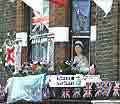
In towns and villages across the country, people came together to celebrate the Queen's Silver Jubilee in 1977. Jonathan Gili reflects on how times have changed.
By Jonathan Gili
Last updated 2011-03-03
In towns and villages across the country, people came together to celebrate the Queen's Silver Jubilee in 1977. Jonathan Gili reflects on how times have changed.
As I watched the archive film of the events celebrating Queen Elizabeth II's Silver Jubilee, after 25 years on the throne, I felt as if I was entering another world. The BBC coverage showed street parties, wheelbarrow races, egg-and-spoon races, fancy dress parades, floats - it all seemed more like a hundred years ago than a mere twenty-five. There was an ingenuousness about the festivities, an uncritical affection for the Royal Family and a strength of community, all of which have dissipated over the last quarter of a century.
Across Britain there seems to have been a consistent pattern in the break-up of communities ...
Since 1977 we've had rocketing oil prices, galloping inflation, rising unemployment, the 'winter of discontent', and Margaret Thatcher's chilling suggestion that 'there's no such thing as society'. On the royal front, the increasing accessibility of some members of the Royal Family has made people realise that they're harassed by the same problems as normal human beings. It's significant that the one person, apart from the Queen herself, who managed to keep her aura intact throughout the period was the Queen Mother, who always resolutely refused to be intimate with the media.
Across Britain there seems to have been a consistent pattern in the break-up of communities - urban as well as rural. In the country, idyllic farming villages have become commuter paradises; in the cities, ordinary families can no longer afford to live in their parents' houses as the yuppies move in.
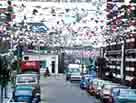 Streets were often decorated with bunting © Two places in particular encapsulate the changes: Rochford in Worcestershire and Orbain Road in Fulham, West London. Rochford, halfway between Kidderminster and Hereford, is a long village with spectacular views over low, lush green hills. 'It was only farms and farm cottages when we were brought up,' says John Wilding, who kept sheep and Shire horses there. 'There were a couple of shops in the village, and a post office that used to sell cigarettes and tea and bread. And then of course people got better off and they had cars and they went further afield, and the shops had to close. It was a great shame. Within a few years they closed the school and the post office too, and of course that does away with village life really.'
It was a friendly street: people never used to lock their doors - you just pushed the door and walked in.
John gave up his cows in October 1977, soon after the Silver Jubilee celebrations, after 28 years without a break. 'I never liked milking,' he says. 'Sheep I've always loved - ever since my parents used to give me the tiddling lambs to rear, the ones whose mother had died off. This is always recognised as the land of milk and honey really, and there used to be 12 milking farms in this village - now there's only one. The average herd size then was about 14 or 15; now of course that's no good, you've got to have 80 at least to make any living at all. The chap does a good job but he's the only one in the village now.'
You can't get his milk in the village, though - it all goes away on a tanker.
In Fulham, West London, each street used to be like a little village. Terry and Esther Connor were both brought up in Orbain Road - that's how they met. They lived on different sides of the street: Terry's family were in odd numbers, Esther's in evens. Between their families, they accounted for a dozen houses in Orbain Road. It was a friendly street: people never used to lock their doors - you just pushed the door and walked in. Now you have to make an appointment. The character of the area has changed. Houses with no gardens that used to be worth £400 are now worth £400,000. Back yards have become patios. The cars parked in the street are Porsches and Mercedes, and at weekends they disappear when the residents of Orbain Road go off to the country.
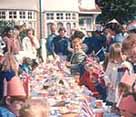 Residents celebrate at a street party © Terry has four brothers and a sister, all of whom lived in Orbain Road until rocketing rents drove them out. Terry and Esther caretake a block of flats in South Kensington; the others have moved as far as Morden, Ewell, Bognor, Bristol and Ramsgate. Esther's second cousin, Vanessa Philips, is one of the few members of the family still living in Orbain Road, though she pines for a house in the suburbs with a garden. 'I think it's a shame that my children will never see anything like the street party we had for the Jubilee,' she says, 'because we don't know the neighbours any more. I don't even know my next-door neighbour either side of me, and I think it would be hard to organise anything down here now. When I was a child, out of the 80-odd houses down the street I'd know 70 of the families that lived in them - and I'd say that 50 of them were my family or related to us by marriage.'
When Fulham was in the Cup Final, everyone dressed up in black and white ...
When Vanessa was growing up in the 60s, there was only one bath in the street. It belonged to her aunt, who lived next door; they knocked a hole in the wall between the two back yards and slipped across whenever they needed a bath without any of the neighbours seeing them in their pyjamas. 'We didn't have an inside toilet,' she says. 'I remember one particular morning when it was cold and snowing, and we couldn't open our back door. My dad had to get an axe to break the ice inside the toilet. And that was only 40 years ago. It's hard for my kids to believe that's what it was like when I was a child, but it's true.'
Orbain Road, like many in Fulham, was a street where they'd rustle up a party at the drop of a hat. Any excuse would do. When Fulham was in the Cup Final, everyone dressed up in black and white - Fulham's colours - and all the houses were decorated in black and white. Bobby Moore toured the streets in an open-topped bus. 'It wasn't a jubilee, but it was a bit like one,' says Vanessa Philips. 'My mum had a party that night and everybody we knew came in and we all had a drink. It was a good night. Unfortunately we lost to West Ham - I dread to think what it would have been like if we'd won!'
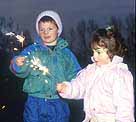 Children holding sparklers on Guy Fawkes night © 'There's no friendship any more,' says Vanessa's aunt, Hannelore Galvin, another Orbain Road resident who's been forced out of the street by rising rents. 'Hooray Henrys live there now. When I lived there we used to sit on the wall and drink in the street. Not wine, gin - until I found out I got a little bit nasty so I switched over to vodka.'
Sometimes there were punch-ups. 'But at least it was only with hands', says Hannelore's husband, Bill. 'Nobody fought with knives. When I was a kid, I watched men having a fight with blood all over the show, and the next day they're in the pub together, drinking. It was a recognised thing - you had a punch-up and the next day it was all forgotten. Not now.'
On Guy Fawkes night there was always a bonfire in the middle of the road and everyone danced round it. People accumulated any unmanageable bits of rubbish in anticipation of the blaze.
It's hard to imagine that sort of thing happening today - you'd need a licence, you'd need insurance ...
'Firework's night was brilliant', says Vanessa Philips. 'That's my favourite memory. Of course the fire brigade would come and put it out, but as soon as they'd gone the people brought out more timber and junk and old settees, and lit the fire again. They used to use petrol, and one year they even threw on part of an old car. This was right in the middle of the street! But I don't remember there ever being an accident. And the fireworks were quite well organised, I think, but I wasn't that interested in them - I'd rather have the fire than the fireworks any day.'
It's hard to imagine that sort of thing happening today - you'd need a licence, you'd need insurance, you'd need to fill in a health and safety form. And today's 24/7 lifestyle means that people are too busy to throw themselves into community activities any more. Twenty-five years on from Jubilee Day, we can look back at what seems a lost world of innocence.
Books
The Queen: A Biography of Elizabeth II by Ben Pimlott (John Wiley and Sons, 1998)
Elizabeth: A Biography of Britain's Queen by Sarah Bradford (Riverhead Books, 1997)
Queen and Country: The Fifty-Year Reign of Elizabeth II by William Shawcross (Simon and Schuster, 2002)
Jonathan Gili is the producer and director of the television film 'Jubilee Day'. His recent films for 'Timewatch' include the award-winning 'Tales from the Eiffel Tower', 'The Empire State Story' and 'Debutantes'.



BBC © 2014The BBC is not responsible for the content of external sites. Read more.
This page is best viewed in an up-to-date web browser with style sheets (CSS) enabled. While you will be able to view the content of this page in your current browser, you will not be able to get the full visual experience. Please consider upgrading your browser software or enabling style sheets (CSS) if you are able to do so.

