
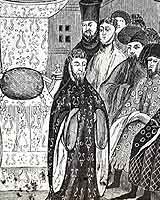
In England in the late 14th century, authority was under challenge. Richard II, however, was not in tune with this change in attitudes, and paid a high price for his lack of understanding. Professor Nigel Saul explains where the king went wrong.
By Professor Nigel Saul
Last updated 2011-02-17
In England in the late 14th century, authority was under challenge. Richard II, however, was not in tune with this change in attitudes, and paid a high price for his lack of understanding. Professor Nigel Saul explains where the king went wrong.
No longer were they prepared to endure the burdens they once had.
In England, as elsewhere in Europe in the late 14th century, authority was under challenge. The ordinary people of the land were growing restive. In June 1381, in southern England, peasant anger at their low status in society spilled over into violent rebellion, and for a few days London lay at the mercy of the mob.
Surprisingly, this discontent did not spring from poverty or hardship. As the foreign-born writer Jean Froissart observed, it was the product of affluence. No longer were the peasants of England prepared to endure the burdens they once had. In the late 1370s, when Richard II became king, living standards were rising, and rising rapidly. In 1348 the Black Death had struck England, reducing the population by between a third and a half. Labour, once plentiful, became in short supply. Wages shot up.
The wage-control laws imposed in 1351 had little effect on this, and skilled labourers drew twice or three times what they once had. At the same time, land in the fields could now be obtained cheaply. Those who had once had no land gained some for the first time, while others who already had some obtained more. Everyone moved a step or two up the economic ladder.
The effect of rapidly improving living standards was to raise people's expectations. They looked to a higher status in life. No longer were they prepared to endure the burdens they once had. In particular, they rejected villeinage - the condition of hereditary unfreedom - which bore down on them in a variety of ways. Typically, villeins were required to work on their lord's lands at harvest time and to carry his produce to the market.
These burdens were bitterly resented. Not only were they inconvenient, for they distracted the tenant from tilling his own land but they were seen as a way in which the lords provided themselves with cheap labour. To the lords, however, they represented a means of control. There is evidence that, on some manors, long defunct villein dues were brought back to counter the effects of the labour shortage. Such insensitivity provoked the withdrawal of services - strikes, in other words - by those afflicted.
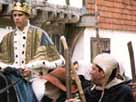 Reconstruction of Peasants' revolt © Upper class insensitivity showed itself, too, in the government's response to the collapse in its tax revenues. Until the second half of the century, the main form of public taxation had been the levy on moveable property. In the wake of the Black Death, receipts from this had fallen sharply for the obvious reason that the taxpaying population had likewise fallen.
The government could see nonetheless that people were still very well off. As a result, they conceived the idea of the poll tax - a per capita levy on everyone over the age of 15. In 1379 this tax had been 'graduated' - that is to say, it was calculated according to the taxpayer's means. But the next levy, that of 1380-1, was not. It was levied at a flat rate - and a very high one, of a shilling (5p) per head.
Such failure to take account of difference of means was deeply resented. It seemed to sum up ruling-class insensitivity, and its indifference to popular aspirations, and in June, in southern England the people of the region rose in rebellion. They attacked the tax collectors, clamouring for freedom, and the government was taken completely by surprise. Never before had such a massive popular rising been seen.
The peasant leaders acted with confidence and tactical skill - they too knew how to organise and command men. They were no longer the poor and the downtrodden of society, and they knew it was time they asserted themselves. They were drawn from the élites of their villages. They were jurors, reeves and lessees, and in demanding freedom and economic opportunity, they were simply claiming what they regarded as their own.
The government's response to the Revolt of 1381 was initially one of compromise, and later one of repression. In the short run, the king's officers offered the rebels concessions, and granted them charters of 'manumission', or freedom. They had to do this to get them out of London. But once the crisis was over, their attitude changed.
The charters were torn up. A 'bloody assize' was organised, to bring the ringleaders to book. New measures were taken to enforce public order. And, in 1388, a savage new Statute of Labourers was approved in parliament. The upper classes had taken fright; they had peered into the abyss and recoiled. Fearful of a new rebellion, they had resorted to the tools of repression.
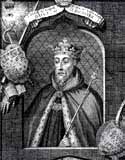 Portrait of John Gaunt, a leading noble at the court of Richard II © Their conservative outlook found echoes in the kingship of Richard II. From the mid-1380s, Richard's style became strongly authoritarian. He had come to the throne in 1377 as a boy, and in his early years the country had been ruled by his counsellors, members of the clerical élite and the nobility.
In the 1380s, as he grew to manhood, his influence on affairs gradually increased. There was a touch of haughtiness in his spirit, and he took a principled stand on the prerogative. For example, in 1386, when criticised in parliament for his choice of advisers, he said that he would not dismiss one scullion from his kitchen at their request.
To the nobility, these were actions that threatened the entire landed élite...
In 1387-8 there was a major political crisis, and a group of the nobility - called The Lords Appellant - seized control of government and prosecuted a number of Richard's advisers. In 1389, however, Richard recovered power, saying he was now old enough to rule. He appointed a new group of ministers and increasingly marginalised his critics. His exercise of kingship from now on was more skilful than before, and he chose his advisers more carefully, but his aims were always the same: the fashioning of a stronger monarchy, the reassertion of hierarchy, and the insistence on obedience by his subjects.
His kingly outlook showed itself in a number of ways. He insisted on grander forms of address ('your majesty' instead of 'my lord'). He commissioned exalted pictorial images of himself - most notably, the so called 'coronation portrait' in Westminster Abbey. And he built up a great retinue.
The interesting thing is that these policies were supported by almost the entire political class. Even Richard's former critic, Archbishop Arundel, articulated in 1395 the need for obedience in parliament. In other kingdoms the ruling élites took the same line - the reassertion of hierarchy in the face of pressure from below.
There was nothing particularly unusual about what was happening in England. So why, in 1399, was Richard overthrown? The main reason is that from 1397 his policies became increasingly arbitrary. He rejected wise counsel. Instead of guaranteeing order, he seemed to threaten it.
The final crisis was provoked by his treatment of the house of Lancaster. In 1398 Richard banished his cousin Henry Bolingbroke, John of Gaunt's son, of whom he was jealous. In the following year, on Gaunt's death, he seized the latter's estates, extending Bolingbroke's exile to life. To the nobility, these were actions that threatened the entire landed élite, for if Henry Bolingbroke was not safe, then who was?
In the summer of 1399, Richard went on an expedition to Ireland, and in his absence, Bolingbroke returned to reclaim his inheritance. As he watched popular and political support for Richard ebb away, he decided to make a bid for the crown himself. By the end of September in the same year, Henry Bolingbroke had become Henry IV of England.
 Tomb of Richard II © The change of king in 1399, though sometimes termed a 'revolution', was in reality, more a coup d'état. There was no great upheaval in society. The ruling élite remained much the same, as only the hard-line Ricardians were sidelined.
Historians in the 19th century believed that Henry IV's title was a parliamentary one: by which they meant that Henry became king only by courtesy of the Commons in parliament. The notion is as improbable as it is ill-founded. The Commons simply acquiesced in a fait accompli.
Henry had no interest in acknowledging any stakeholders in his rule, and he constantly insisted on wielding the same prerogative powers as his predecessor had done. And whatever concessions the Commons won in Henry's reign, and they were fewer than is sometimes supposed, they owed them to their control of the purse-strings - their right to give consent to taxation. Richard's deposition did, however, settle one thing. The principle was established that the strengthening of authority could never shade off onto the trampling of the law of the land.
Richard, towards the end, had pictured himself as the source of all law, and according to the deposition articles of 1399, he had said that the laws of England were 'in his mouth or in his breast'. This, however, was a Roman law adage. In the English tradition, things were seen differently. In 1215, the Magna Carta had placed English kingship firmly under the law, and a generation later, the legist Bracton had said that 'the king is under God and under the law'.
Kings could not simply dispossess their subjects as Richard had done.
Richard's deposition ensured that this principle stood firm. Kings could not simply dispossess their subjects as Richard had done. It was all very well exalting kingship; but it still had to be under the law. It is largely because of the acceptance of that principle that we live in a limited monarchy today.
Nigel Saul's books include: Knights and Esquires, The Gloucestershire Gentry in the Fourteenth Century (Oxford, 1981) and The Oxford Illustrated History of Medieval England (Oxford, 1997). His major biography Richard II (Yale, 1997) was the product of ten years' work. It was acclaimed by PD James as 'unlikely to be surpassed in scholarship, comprehensiveness, or in the biographer's insight into his subject's character.'




BBC © 2014The BBC is not responsible for the content of external sites. Read more.
This page is best viewed in an up-to-date web browser with style sheets (CSS) enabled. While you will be able to view the content of this page in your current browser, you will not be able to get the full visual experience. Please consider upgrading your browser software or enabling style sheets (CSS) if you are able to do so.

