
The Paston family rose from the peasantry to the aristocracy within just two generations. This is the story of how they did it. They are also the first record of private correspondence to survive in Britain and so offer a unique glimpse into the concerns and fears of a very upwardly mobile family at a time of huge social upheaval.
Paston Family Letters
By Dr Mike Ibeji
Last updated 2011-02-17
On this page
- The Pastons: Who were they?
- Meet the family
- Younger and elder
- Caister Castle
- Loss of the prize: Paston letters on Caister Castle
- King of the castle: Paston letters on Caister Castle
- Find out more
Page options
The Pastons: Who were they?
The story of the Pastons is a fascinating and compelling tale of a family on the make in the wake of the Black Death. They show first-hand testimony of the social benefits the plague brought to the peasantry, the chaotic effects of the Wars of the Roses on the general populace and the individual impact that the Black Death could have on a family.
There was never a Paston poor, a Heydon a coward or a Cornwallis a fool.
Their story is one of visionary gamblers willing to stake all on massive throws of the dice, and to fight for what they win with the tenaciousness of terriers, be it against the carping villagers of their home manor or the overweening power of the local lord. Many of the properties they lived in still survive, as do the institutions of which they became benefactors. In fact, from humble peasant beginnings, their impact on the county became so great that even today, there is an old Norfolk saying: 'There was never a Paston poor, a Heydon a coward or a Cornwallis a fool'.
Meet the family
Clement Paston
The great-granddaddy of them all, Clement was a yeoman who took advantage of the Black Death to build up a substantial landholding in and around Paston. Seeing which way the wind was blowing, he had the foresight to borrow enough money to send his son, William, to school, where he was educated in the law. This farsighted gamble was to establish the fortunes of his family for generations to come. It is entirely possible that he began life tied to the land, since at least one letter in the Paston collection accuses him of being a peasant bondsman. He died on 17 June 1419 and was buried at Paston.
William Paston
Born in 1378, Clement's son, William, survived the many Plagues of Children to be educated in the law. This was the making of the Paston family. It is with William that the fortunes of the Pastons really take off, for William was able to use his position as a lawyer to become a Serjeant-at-arms and eventually a Judge of Common Pleas. His position allowed him to make a very judicious marriage to Agnes Berry, which substantially increased his family's land. Their favourite residence was the beautiful manor of Oxnead, which still nestles in a little nook of the Norfolk countryside, beside a church in which many members of the Paston family are buried.
John Paston Snr and Margaret Paston
...John Snr...took the great gamble that almost destroyed his family, but which ultimately secured its position.
William's oldest son was born on 10 October 1421 and grew up to be educated in the law at Cambridge and the Inner Temple. He, too, made a very advantageous marriage to Margaret Mauteby, gaining the manors of Mauteby and East Tuddenham, which still survives. John and Margaret were major figures in the county. He was both MP and JP for Norfolk, and together they endowed benefactions to various institutions within Norwich. The great hammer-beam roof of St Andrew's Hall and the church of St Peter, Hungate are the best examples. On either side of the window dedicated to them in St Peter Hungate, the two portrait busts of John and Margaret still smile down on us today.
It was John Snr who took the great gamble that almost destroyed his family, but which ultimately secured its position and lifted it beyond the ranks of the squirearchy. This had been achieved in just two short generations after peasanthood. As a lawyer, he spent a great deal of time in London, where he made friends with the local Norfolk knight and landowner, Sir John Fastolff - a Lollard sympathiser and the real-life Falstaff of Shakespeare's plays. It is probably no coincidence that, having wormed his way into the ailing knight's confidence and become his lawyer, John Paston miraculously found himself the main beneficiary of Sir John Fastolff's will! Sir John's cheated heirs, most notably Sir William Yelverton, Thomas Howes and the de la Poles, didn't believe in coincidence either, and contested the will. When John Paston Snr died in 1466, he was buried at Bromholm Monastery (where his tomb can still be found) with the legal wrangles still unresolved.
Younger and elder
John Paston the Elder and John Paston the Younger:
John Snr's two sons, both imaginatively named John (just to make our lives easier), inherited a legal nightmare centred on the manors of Caister Castle, Coton and Hellesdon (of which the beautiful hunting lodge at Drayton still remains). It is this part of the Paston story which is so colourfully illuminated by the many letters that passed between them and their mother, Margaret. She was still living in her beloved manor at Oxnead. Not only were Sir John Fastolff's heirs still contesting the will, but they were willing to take advantage of the turbulent times to try and get what they wanted by force. On several occasions, the Pastons were constrained to fight for what they now owned, the most dramatic contest being over control of Caister Castle which was resolved only three years before John the Elder's death from plague.
John the Elder was a bit of a dilettante. He spent most of his time hanging around the King's Court in London, for which his mother constantly berated him. It was not simply that his obsession with London lost them control of Caister, but she was also concerned for his safety. On more than one occasion, she urges him to be careful in the plague-infested city. This was especially after they lost their grandmother to the plague in 1479. She was proven right as John the Elder did die of the plague. His brother, John the Younger, tells his mother of the news in November 1479.
November 1479: Margaret learns of her son's death:
November 1479:
Mother... my brother is buried in the White Friars at London. I did not think that it would have been so, for I supposed that he wished to be buried at Bromholm and that caused me to ride so soon to London to arrange his bringing home; and if it had been his will to lie at Bromholm, I would have brought home my grandmother and him together, but that purpose is now void.(John the Younger)
December 1479:
Right worshipful Mother... please it you to understand that whereas ye willed me by pains to hasten out of the foul air that I am in, I must put my faith in God, for here I must remain for a season. And in good faith, I shall never while God sends me life, dread more death than shame. But thanks be to God, the sickness is well ceased here, and also my business putteth away my fear.(John the Younger)
By this, we can be reasonably certain that John the Elder died of the same plague that took his grandmother. He left an illegitimate daughter by Anne Haute, to whom he was betrothed for years but never married.
The rise of the Paston family to the top, and the changes of medieval Society, are shown in stark relief by their decades long battle for Caister Castle.
Caister Castle
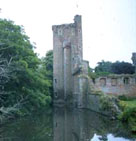 Caister Castle © The wrangle over Caister is a wonderfully dramatic incident which demonstrates how the tables were turning on the great lords who sought to use the chaos of the Wars of the Roses to feather their nests. It is a tale of David taking on Goliath with the slingshot of the law, and eventually proving through sheer legal tenacity that the pen of the gentry squire had become mightier than the noble's sword.
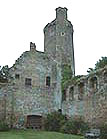
Caister Castle was the jewel in the crown of Sir John Fastolff's estates, and fell to John Paston Snr through the Fastolff will. The legal wrangles and conflict over its ownership were then to haunt the Paston family for the next 20 years, almost ruining them in legal expenses and putting the life of his sons in mortal jeopardy. For Fastolff's heirs, Yelverton and Howes, refused to accept the Paston ownership, forcing Margaret to take up residence in the castle for a while. She complained bitterly about this to her son John the Elder, as she found Oxnead to be a much more comfortable and less draughty home. Eventually, John the Younger took her place, at about the time that Yelverton and Howes sold their rights to Caister to the Duke of Norfolk, who had always coveted it. Somewhat ironically, John the Younger had once been a servant in the household of this same Duke of Norfolk.
In 1469, as warfare ripped the land, the Duke of Norfolk took advantage of this new 'tempus werre' (time of war) to try and seize Caister, besieging it with 3,000 men. The urgent letters which passed between Margaret and her two sons at this time provide graphic testimony to the violence of the attempt, and her impatience with John the Elder's lackadaisical attitude. We are left in no doubt as to whom she blames for the loss of the castle:
Loss of the prize: Paston letters on Caister Castle
 Caister Castle © Margaret Paston to John the Elder, 12 Sept. 1469:
I greet you well, letting you know that your brother and his fellowship stand in great jeopardy at Caister... Daubney and Berney are dead and others badly hurt, and gunpowder and arrows are lacking. The place is badly broken down by the guns of the other party, so that unless they have hasty help, they are likely to lose both their lives and the place, which will be the greatest rebuke to you that ever came to any gentleman. For every man in this country marvels greatly that you suffer them to be for so long in great jeopardy without help or other remedy...
John the Elder to Margaret Paston, 15 Sept 1469:
Mother, on Saturday last, both Daubney and Berney were alive and merry, and I suppose that there has come no man out of that place since who could have informed you of their deaths. And as for the fierceness of the Duke and his people... I am sure that it was agreed ... that a truce and abstinence from war should endure until Monday next, and then I think that a truce will be made for another week, by which time I hope that a good conclusion will be found... But Mother, I feel by your writing that you think I will not do my duty unless you send me heavy tidings; but if I needed a letter to wake me up at this time, I would indeed be a sluggish fellow. I assure you that I have heard ten times worse tidings since the siege began than any letter that you wrote me, and... this I can assure you, that those within have no worse rest than I have, nor fear more danger.
Margaret Paston to John the Elder, 22/30 Sept 1469:
It appears from the letter you sent me... that you think that I am writing to you fables and imaginings, but I do not do so. I have written as I have been informed, and I will continue to do so. It was reported to me that both Daubney and Berney were dead, but for certain Daubney is dead, God rest his soul... And as for the yielding of Caister... I would that this had been done before this time and then there would not have been so much harm done as there has been in various ways. For many of our well-wishers are put to loss for our sake...
John the Younger to John the Elder, late Sept 1469:
Right worshipful sir, I recommend me to you. And as for the surrender of Caister, John Chapman can tell you as well as myself how we were forced to it. As for John Chapman and his fellows, I have provided that each of them be paid 40s, and together with the money they had of you and Daubney, that is enough for the time that they have done you service. I pray you give them thanks, for by my troth they have as well deserved it as any men that ever lived... Writtle promised to send you the details of the surrender agreement. We were sore lacking in victuals, gunpowder and men's hearts, and lack of certainty of rescue drove us to the treaty....
King of the castle: Paston letters on Caister Castle
Somewhat belatedly, John the Elder woke up to what he had stupidly thrown away, and spent the next 11 years dragging Norfolk through the courts in his attempts to get it back. All of this was happening during a time of political anarchy, when in an earlier period, the likes of the Pastons would have been forced to stand by and watch the great lord simply take what he wanted. But not now. Now, the Pastons had recourse to the courts, but also felt able to join the political conflict themselves. They fought against Norfolk on the side of Henry VI at the Battle of Barnet, where John the Younger was wounded in the arm by an arrow (letter dated 18 April 1471). Norfolk died in January 1476, and John the Elder hastily moved to reoccupy Caister Castle, as a letter from John the Younger indicates:
23 Jan 1476:
I ensure you your sending to Caister is evil taken among my lord's folks, insomuch that some say you tendered little my lord's death inasmuch as you would so soon enter his property on his decease... It is thought here by such as be your friends in my lord's house that, if my lady have once the grant of wardship of her child, that she will occupy Caister with other lands, and lay the default of your unkind hastiness of entry without her assent. Wherefore in any wise, get you a patent from the King sealed before hers, by any means possible... (John the Younger to his elder brother, John the Elder)
The gambit worked. The King granted the patent of Caister on John the Elder, and the Duke of Norfolk's wife, tired of the whole affair, gave up her dead husband's claim. The Pastons were exceptional only in that they risked everything upon gaining Caister Castle. This elevated them from the ranks of the lesser squirearchy into the big league of Knights and King's retainers who hung around the court. Yet prior to this, there was nothing inherently unusual about the rise of the Pastons. They were simply one of the more successful peasant families to take advantage of the post-plague situation to lift themselves out of the mire. The Caister incident is a graphic example of the anarchy of the times; but it is finally resolved by law, not force. Ironically, John Paston the Elder only lived to enjoy Caister for 3 years before he died of the plague in 1479.
The Paston family had arrived.
Find out more
Further Links
Royal Commission on Historical Manuscripts A huge repository of UK archives and documents.
Public Libraries on the Web Directory of on-line libraries throughout the UK.
History of the UK - Primary Documents Translations of historical documents from British History including Anglo Saxon Chronicles and the Declaration of Arbroath.
Index of Medieval Governmental, Administrative and Legal Documents Translations of key documents including links to medieval legal statements.
Description of Manor House at Chingford, Essex (1265) 'An account of the manor house made for the chapter of St. Paul's Cathedral in London at a time when it was granted to Robert Le Moyne in 1265.' From the Internet Medieval Sourcebook.
About the author
Dr Mike Ibeji is a Roman military historian who was an associate producer on Simon Schama's A History of Britain.
British History Timeline
- Explore the British History Timeline from the Neolithic to the present day
World War One Centenary

- Find out more about how the BBC is covering the World War One Centenary, and see the latest programmes and online content
Surviving the trenches

- Dan Snow asks why so many soldiers survived the trenches in WW1
The History of the Home

- Take a journey through the history of the home. Each room tells a different story.
BBC iD
BBC iDBBC navigation
BBC links

BBC © 2014The BBC is not responsible for the content of external sites. Read more.
This page is best viewed in an up-to-date web browser with style sheets (CSS) enabled. While you will be able to view the content of this page in your current browser, you will not be able to get the full visual experience. Please consider upgrading your browser software or enabling style sheets (CSS) if you are able to do so.

