
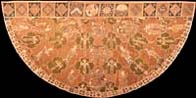
The richly embroidered Syon Cope represents many aspects of English history - from Church pomp and pageantry to the status of artists and the importance of culture. Linda Woolley unpicks some of these strands, and holds them up to view.
By Linda Wooley
Last updated 2011-02-17
The richly embroidered Syon Cope represents many aspects of English history - from Church pomp and pageantry to the status of artists and the importance of culture. Linda Woolley unpicks some of these strands, and holds them up to view.
In the 13th and 14th centuries, national identity was demonstrated through artistic expression as well as through politics and conquest. English embroidery, called Opus Anglicanum ('English work') in contemporary documents, was one art form for which England and the English became particularly famous.
In 1864 the V&A (Victoria and Albert Museum, London) bought a splendid example of this type of embroidery, the Syon Cope, named after Syon Abbey in Middlesex where it was kept by nuns in the 16th century. It was made for a priest of high rank, possibly a bishop, between about 1300 and 1320. The 'cope', a semi-circular cape, is the outer garment worn by priests for special ceremonies and they are still used today, worn, for example, by the Archbishop of Canterbury.
Fantastic sums of money were spent on embroidered clothing and furnishings.
Clerics from the wealthiest churches and cathedrals had robes as fine as any worn by nobles and princes. These influential, and often very worldly, priests wore luxurious ecclesiastical vestments, highly decorated with Biblical scenes and images of saints, rendered in embroidery and sometimes with jewels.
It is difficult to believe, in an age like the present one, when embroidery is considered mostly as a hobby, that fantastic sums of money were spent by rich prelates of church and state in the Middle Ages, on embroidered clothing and furnishings. These were second in expense only to goldsmiths' work, or to jewellery, and were held in the same high regard.
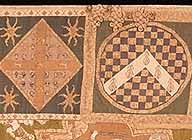 Border detail of the Syon Cope, showing heraldic shields. The shields have been identified as belonging to families in the area around Thetford and Norfolk. © The Syon Cope has embroidered on it scenes from the life of Christ and the Virgin Mary, with figures of the apostles. It is worked in costly silk, silver-gilt and silver thread, which entirely covers the linen background material. The figures are framed in overlapping units, based on the quatrefoil (a form with four lobes), which was a popular design in English architecture in the reigns of Edward I and his son Edward II.
The use of architectural shapes, which also appear in stained glass and other artefacts, was part of a lively exchange of influences between the arts in England at this time. English embroidery was described as acu pictura ('painting with the needle').
We can tell from the style of many of these embroideries, including the Syon Cope, that artists, possibly manuscript illuminators, were involved in their design. This is suggested by the charming figures of angels that decorate areas between the main scenes on the Syon Cope. They have folded wings, in a style similar to those found in contemporary illuminated manuscripts. It is further suggested by the angels shown standing on wheels, also on the Syon Cope, possibly based on the motifs of angels that decorate the first letter of a Psalm in the Ormesby Psalter, an illuminated manuscript produced by artists in East Anglia.
The identification of some of the heraldic shields in the cope's borders (orphreys), which have been found to relate to families in the area around Thetford, in Norfolk, suggests that it may have been made for a religious order in that area, but this is by no means certain.
English embroidery was described as acu pictura ('painting with the needle').
When new, the colours of such ornate embroidered vestments would have sparkled and glittered, particularly by candlelight in an impressive church or cathedral. Churchgoers and onlookers would have looked on in awe, as the priests swept by in procession. This was precisely the intention, as such rich embroideries made a conspicuous display of the power of the Church.
Although neither artists nor embroiderers left their signatures on these vestments, they do sometimes include evidence of the owner or priest for whom they were intended. In the case of the owner or donor, this served a two-fold purpose, showing-off their earthly power but also, hopefully, helping to smooth their path to heaven. The Syon Cope includes an inscription, with letters that suggest it was made for a priest named Peter, but there is nothing more to help identify him.
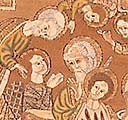 Detail of Syon Cope. Embroiderers were highly skilled professionals. Their work often took years to complete. © All of this high quality English embroidery was made of expensive imported materials, and was very labour intensive. Nuns and noblewomen did a great deal of embroidery, but large embroideries like the Syon Cope were made by highly trained professionals, both men and women, employed in workshops funded by merchants and noble patrons.
It was the merchants who took the profits, not the embroiderers, who received only modest payments for their work. Most workshops were in London, where the necessary large sums of money were available and where - as the city was the principal port of England - imported materials arrived. A few records show the considerable expense of the materials, in comparison with the labour involved. In 1271 Henry III paid £220 (the equivalent of about £100,000 today) for a bejewelled altar frontal, while the labour for the four women who made it over a period of 3¾ years cost only £36.
Large embroideries like the Syon Cope were made by highly trained professionals, both men and women...
Written records tell us the names of some of the individuals or families who did the work. Alexander Settere, a member of a great family of embroiderers, received £10 in 1307, in part payment for a choir cope that cost £40 in total. And Johanna Heyroun - the Heyrouns were also a professional embroidery dynasty in the City of London - supplied black vestments for use in Edward III's chapel, to celebrate 'the office of the dead', in 1327-8. These vestments were almost certainly made for the funeral service of Edward's murdered father, Edward II.
 Figurative detail on the Syon Cope. Bridgettine nuns of Syon Abbey left the country during the reign of Elizabeth I, taking the Cope with them. The Cope was brought back to England in about 1810. © Princes and potentates of Church and State all over Europe wanted English embroidery. We can get some idea of how highly prized it was by the fact that the Vatican Inventory of 1295 lists no less than 113 examples of this work. A small number of these Vatican pieces survive to this day, as do other examples in churches, cathedrals and museums throughout the land.
Exquisite church embroideries like the Syon Cope survived the ravages of Henry VIII's Reformation, and later persecutions, by being kept hidden or taken abroad by the persecuted Catholics. The Syon Cope was taken out of the country by the Bridgettine nuns of Syon Abbey during the reign of Elizabeth I. The order was reestablished in England in about 1810, and the Cope returned to these shores at that time.
Princes and potentates of Church and Sstate all over Europe wanted English embroidery.
Edward I sent two copes to Rome, one to Pope Nicholas IV in 1291, and a second to Pope Boniface VIII in 1295. It seems probable that one of these is a magnificent cope that survives in the Vatican today, similar in date and style to the Syon Cope.
Diplomatic gifts of ecclesiastical embroidery by an English king emphasise its significance as a representation of high, and specifically English, achievement. The Syon Cope would have made an equally impressive diplomatic gift.
... that if you look closely you can see that parts of the scenes at the top and bottom of the Syon Cope are missing, because it was originally a chasuble (a large conical shaped vestment), but was then cut up to make a cope? The strips decorated with heraldic shields have been added to the older garment to transform it into a cope.
... that the apprenticeship for a professional embroiderer lasted seven years, as long as it takes today to train a GP or dentist?
... that certain Popes employed their own English professional gold embroiderers, who worked in gold thread alone?
... that nuns were allowed to do embroidery, but only if it did not interfere with their religious devotions?
... that the highest quality embroidery was allowed to be done only during the hours of daylight?
... that there is a hierarchy of angels, and that the angels on wheels on the Syon Cope are six-winged seraphs?
... that measurements for a garment were sometimes sent to the workshop in the form of a cord of the appropriate size?
Books
Opus Anglicanum (Arts Council and V&A, 1963)
Age of Chivalry Art in Plantaganet England 1200-1400 (Royal Academy of Arts, 1987-8)
Linda Woolley is Assistant Curator in the Department of Textiles and Dress at the V&A. Her specialist area is early and medieval textiles. She has contributed to numerous publications, including the V&A publication, Dress in the Devonshire Hunting Tapestries, in conjunction with the V&A exhibition, Late Gothic Art in England from 1400 to 1547.





BBC © 2014The BBC is not responsible for the content of external sites. Read more.
This page is best viewed in an up-to-date web browser with style sheets (CSS) enabled. While you will be able to view the content of this page in your current browser, you will not be able to get the full visual experience. Please consider upgrading your browser software or enabling style sheets (CSS) if you are able to do so.

