

Discover why Ireland was able to maintain its own Gaelic identity despite hundreds of years of English rule and how the seeds were sown for two separate communities.
By Professor Robin Frame
Last updated 2011-02-17
Discover why Ireland was able to maintain its own Gaelic identity despite hundreds of years of English rule and how the seeds were sown for two separate communities.
The survival of a Gaelic Irish identity in later medieval Ireland, in the face of English invasion and colonisation, sprang in part from the simple fact that the conquest remained incomplete. Between c.1170 and c.1250 the English expanded into all the provinces of Ireland. South of a line from Dundalk to Limerick and Cork, their occupation was given depth through settlement by peasants, artisans and traders from Britain, especially in the coastal lowlands and the river-valleys.
The survival of a Gaelic Irish identity sprang in part from the simple fact that the conquest remained incomplete.
In the north and west, however, Irish rulers stayed in control of land and manpower, even though they were often subject to the overlordship of settler aristocrats. And even in the south there remained regions, such as the Wicklow uplands, which were still Gaelic in social complexion. Most of the Irish leaders had accepted the authority of Henry II and did not actually repudiate that of later kings; but for the most part they remained outside the formal legal and political structures of English rule. The economic downturn and frequent wars that marked the late thirteenth and fourteenth centuries shifted the balance in favour of the Irish, providing the context for a Gaelic cultural revival. Despite this challenge, the core areas of the colony - which included much of south Leinster and east Munster as well as the hinterland of Dublin, later known as the Pale - in their turn remained resolutely 'English'. This era of confrontation, whose beginnings may be located in the reign of Edward I, produced striking statements of both identities. To understand them, it is necessary to look back in time, and beyond the physical sharing of the island between natives and newcomers.
 Dunluce castle stands on a site of an early Irish fort. © Already before the arrival of the English, the Irish (Gaedhil) had a strong sense of collective identity. This was based around language and custom, together with a shared past which had been promoted, and to an extent invented, by the Gaelic learned classes. However, the common Irish identity was not reflected in political unity, let alone in centralised structures of government. The co-existence of a sense of cultural oneness with political fragmentation was a persistent feature of Gaelic Ireland.
The image of a Gaelic people, whose destiny it was to live under a king of Ireland, endured.
Ironically, however, the idea of a kingship of Ireland loomed large in the national narrative. Between 1000 and 1170 this kingship - in practice an impermanent and geographically restricted overlordship - formed a goal for the provincial rulers, who competed violently for wealth and status. The English presence drastically reduced the resources and freedom of movement available to Irish leaders, so making the native polity even more fragmented. However, the image of a Gaelic people, whose destiny it was to live under a king of Ireland, endured. This is apparent in two texts which can be related, somewhat indirectly, to Edward I's impact within the British Isles.
Caithréim Thoirdhealbhaigh, or 'The Triumphs of Turlough', composed in the mid-fourteenth century, describes events in southwest Ireland some two generations previously. In 1276 Thomas de Clare, brother of the earl of Gloucester and a member of Edward I's inner circle, began, with Edward's encouragement, to carve out a lordship in Thomond, the rump of the kingdom of the Ó Briain family, which lay across the Shannon from Limerick. Between 1277 and 1318 the de Clares engaged in spasmodic, ultimately unsuccessful, wars and alliances, involving rival settler lords, competing Ó Briain segments, and equally divided lesser Gaelic lords.
The Caithréim makes no bones about the internecine character of the conflicts. Indeed, its main purpose was to promote the reputation of one particular Ó Briain faction. Yet the story, which opens with the words 'the government of Ireland being now in the year 1172 come into foreigners' hands', is framed within the larger theme of the conflict between the Irish and the English. The leaders, the author favours, are presented as worthy to assume, the sovereignty of Ireland if times had been different.
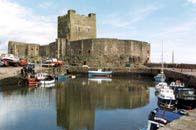 Carrickfergus Castle was built after the Anglo-Norman invasion of 1170. © Edward I's ambitions also lie behind the so-called 'Remonstrance of the Irish Princes' to Pope John XXII in 1317. This was drawn up during the occupation of eastern Ulster by Edward Bruce, the brother of King Robert I. It was partly a response to the English crown's use of armies, money and supplies from Ireland in its wars against Scotland. Edward Bruce had assumed the title 'King of Ireland' with the support of Domnall Ó Néill and other northern chiefs. The aim of the document, which may have been composed by Gaelic clergy at Armagh, was to justify the actions of Bruce's Irish backers and to persuade the Pope to transfer Ireland from Edward II to Edward Bruce.
Like the Caithréim, it shows the gap between aspirations and political realities. It purported to come from the Irish in general, under the leadership of Ó Néill. Harnessing the kingship tradition, it presented Domnall as rightful heir to an age-old Irish monarchy, which he was prepared to hand over to Bruce. In fact Irish support for the Scots was mostly limited to the north, and contemporary annals continued to stress the claims of other dynasties to national leadership. However, the Remonstrance has a fresh dimension. Much of the text is devoted to illustrating in detail the wickedness of the rule of the English king, his ministers and, above all, 'the English barons born in Ireland'. It protests about the usurpation of church lands, the dispossession of the Irish, the sweeping aside of Irish law, and the closure of the royal courts to those of Irish blood. Irish identity had acquired a new layer, created out of a sense of foreign oppression and drawing upon specific contemporary resentments.
The image of a Gaelic people, whose destiny it was to live under a king of Ireland, endured.
The colonial society, which the Remonstrance painted in such black colours, also had its tensions and paradoxes. The settlers paraded their English identity despite the spread of the Gaelic language and other signs of acculturation, especially among those outside the heavily settled areas. Nor did they always share the priorities of the metropolis, or feel at ease with officials sent from England. Yet, there is no doubt that their Englishness was central to their self-perception, however un-English they might appear to those who were sent over to govern them.
The English identity which the settlers voiced with growing stridency in the fourteenth century had older roots. The initial incursions into Ireland had been by marcher knights and other freelances from south Wales hired by Diarmait MacMurchadha, the King of Leinster. However, the rapid intervention of Henry II ensured that from 1171, the main beneficiaries of the conquests were men associated with the royal court and military household, some of whom retained estates in England and Wales. However unruly they might be in the Irish regions, they held their lands from the crown and saw themselves as the king's subjects. Royal power was sufficient to prevent the conquests from developing into an unregulated scramble and to ensure that Ireland remained politically tied to England.
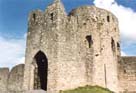 Trim Castle which was built by the Normans in the 1100s © These events occurred when England was experiencing a rapid development of the law and jurisdiction of the king's courts. In 1210 King John, during a rare royal visit to Ireland, ruled that English law should apply there. This edict made a principle out of an already emerging fact, since the settlers tended to carry their customs with them. However, the repeated enunciation of the principle, and its embedding in the institutional life of the colony, was crucial. Law was a key signal of identity in the medieval West.
The settler elite formed a single propertied class, holding their lands by charter and living under English custom
In the thirteenth century English law was sufficiently defined to be transportable, and so supersede Irish custom, which was dismissed as barbarous. So in Ireland the settler elite, whatever the ultimate origins of its individual members, formed a single propertied class, holding their lands by charter and living under English custom. It is not surprising that they thought of themselves as English. It is not known whether King John had intended English law to be available to the native Irish population but by the time of Edward I, it was the birthright of the settlers alone. Individual Irishmen could gain access to the courts only by buying charters from the king in England, which was beyond the means of most. The reception of English law by the colony ensured that its governmental arrangements were closely modelled on those of England. At every level - from county courts to parliaments, which began to meet in Ireland no later than 1264 - structures developed that, with some limited exceptions, excluded the Irish. The colonial world was defined and fortified by a rampart of institutional privilege.
The pressures of the late thirteenth and early fourteenth centuries reinforced the English identity of the settlers. The period saw the involvement of the colony in the Scottish wars; the spread of the war into Ireland under Edward Bruce, together with the beginning of serious Irish pressure on the frontiers of eastern and southern Ireland. In these circumstances the heartlands of the colony shared experiences that have been regarded as widening and deepening the sense of political nationhood in England itself. Service in the king's wars and the burdens of war-taxation drew the political communities on both sides of the Irish Sea into frequent dialogue with the crown.
On top of this, the deteriorating conditions within Ireland made the settlers increasingly conscious of their garrison role. Surrounded and threatened by 'the king's Irish enemies', his 'faithful subjects' in Ireland addressed him and his ministers through parliaments and councils. They emphasized their loyalty and the English status which, as they saw it, entitled them to royal protection and to parity of esteem with the 'English of England'.
Across much of Ireland a multitude of practical, and sometimes friendly, ties bound elements of Irish and the settler society together. In some areas - not least to outside eyes - the distinction between them was becoming blurred. Nevertheless, by the 1340s two rival national identities existed within the island, each with a developed sense of its own history, rights and grievances which could be used to underpin sophisticated political arguments.
Robin Frame was educated in Belfast and Dublin. His publications include Colonial Ireland 1169-1369 (1981), English Lordship in Ireland 1318-1361 (1982), The Political Development of the British Isles 1100-1400 (1990), and Ireland and Britain 1170-1450 (1998).





BBC © 2014The BBC is not responsible for the content of external sites. Read more.
This page is best viewed in an up-to-date web browser with style sheets (CSS) enabled. While you will be able to view the content of this page in your current browser, you will not be able to get the full visual experience. Please consider upgrading your browser software or enabling style sheets (CSS) if you are able to do so.

