
Richard I and John have gone down in history as a 'good' and a 'bad' king, respectively. Is this view of them fair? Mike Ibeji investigates.
By Dr Mike Ibeji
Last updated 2011-02-17
Richard I and John have gone down in history as a 'good' and a 'bad' king, respectively. Is this view of them fair? Mike Ibeji investigates.
The story of King John is a story of failure - he was the last of the Angevin kings, the one who failed to hold onto his territory in western France, lost his crown and many valuables in the mud of East Anglia, drove his subjects to impose the Magna Carta, and almost lost the Kingdom of England. It is the tragedy of a flawed genius, crippled by his own inheritance.
By contrast, his brother Richard has been seen by his contemporaries, and by later historians, as a superstar - his nickname, the 'Lionheart', says it all.
The popular image of John is of a classically bad king: a scheming, untrustworthy coward consumed by greed, whose rapaciousness drove his subjects to impose their will upon him. His acts of apparent cruelty are well documented. He hanged 28 hostages, sons of rebel Welsh chieftains in 1212 and starved to death William de Braose's wife and son in a royal prison.
He was the archetypical Angevin: the autocratic ruler of a vast territory.
Attempts to rehabilitate him have highlighted his administrative genius and his unstinting personal attention to his kingdom, but this view involves a fundamental misunderstanding of the nature of kingship in the Middle Ages.
To understand John, we must forget 21st-century concepts of 'good' governance, and stop seeing him as a solely English king. He was the archetypical Angevin, the autocratic ruler of a vast territory. Yet these were the traits that were most responsible for his eventual failure.
It is impossible to speak of John without comparing him to those around him, most especially his brother Richard. The historian WL Warren, puts it well, when discussing the loss of Normandy:
'If Richard had lived another five years, there would have been one notable difference in the course of the campaign. The King himself would have been on the heights above Les Andelys... and even when all else had gone, Richard would have been urging the citizens of Rouen to arms, parrying the first assault with blows of his great sword. John stayed in England biting his nails.'
By comparison with Richard, then, John has been seen as a weedy little tick.
By comparison with Richard, then, John has been seen as a weedy little tick. In the early 20th century there was a movement to overturn this view. It pointed out, quite rightly, that many of the infractions laid at John's door were begun in the reign of Richard.
Historians said, for example, that Richard's exactions were as arduous as John's, that John paid much more attention to England and that, far from being a coward, John could be the equal in generalship of both Richard and his father. All of this is true, but it misses the fundamental point that makes Richard a 'good' king and John a 'bad' one.
Richard was a superstar precisely because he was an absentee warrior king. He had the dash and flair to risk all on the most slender of odds. He was prepared to bury the hatchet and put his faith in even his most inveterate enemies and he understood that in the realpolitik of the day, you had to give in order to receive. He also left the administration of England to his subordinates, removing himself from their more unpopular measures.
John's greatest weakness was an inability to trust.
John, on the other hand, lacked flair. Although a perfectly able strategist, he would always make the percentage play, opening himself up to the charge of cowardice. Nor could he, in Warren's words: '...miss the opportunity to kick a man while he was down'. This habit created enmities that festered into feuds.
Yet John's greatest weakness was an inability to trust. The truism that 'a liar won't believe in anyone else', was never more apt than when applied to John. Time and again, when he should have trusted someone and given them power, a free rein and a say in things, he shied away, never daring to put his faith entirely in anyone. It lost him friends. It also lost him opportunities.
John's paranoia would overwhelm him, and instead of striking while the iron was hot, he would hesitate for fear of betrayal. He stayed in England 'biting his nails' because he could not believe that anyone would support him, and this of course proved to be a self-fulfilling prophecy.
John's ultimate, most unforgivable, crime was failure.
Add to this his obsession with detail, which meant he could not avoid becoming involved, and which therefore meant that all the ills of the Angevin administration were blamed on him. It did not help matters that John's most cherished hobby was collecting jewellery. He was born to be a Bond villain.
The sad thing is that, from an objective point of view, John was really no worse than his contemporaries. His father Henry II had a reputation for untrustworthiness, matched only by the utter faithlessness of the French kings Louis and Philip Augustus.
His brother Richard pulled financial stunts so rapacious that John actually felt the need to repeal his worst excesses. Yet they had a flair born of success and John's ultimate, most unforgivable crime was failure.
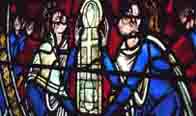 Henry II and Eleanor of Aquitaine, depicted in stained glass at Poitiers Cathedral © John was the fourth son of Henry II; the youngest of the 'Devil's Brood'. He grew up in the shadow of his older brothers and once again the comparisons are interesting.
Stories from his childhood suggest that he was probably bullied and beaten if he complained.
Warren can't help but point out that at an age when his brothers Richard and Geoffrey were stamping their authority on Aquitaine and Brittany, John had squandered his opportunities in Ireland. The criticism is reasonably justified, but to understand why, we need to look at his upbringing.
In a family so obsessed with its rights and possessions, being the last of four sons was not an enviable position. Henry was clear about his hopes for his first three sons, but until Ireland cropped up, John seems to have been left out of the picture.
Stories from his childhood suggest that he was probably bullied and beaten if he complained of his plight. It may be due to this perceived lack of character that Henry was loath to incorporate John into his schemes.
At various times, John was destined for the Church, for an Italian marriage and for piecemeal lands that belonged to his brothers (and which they refused to give him). His own father gave him the disparaging nickname 'Lackland', and it was not until the death of his oldest brother, Henry the Younger, that John began to figure in King Henry's plans.
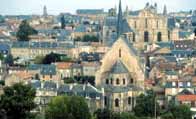 Poitiers, capital of Aquitaine © With the death of Henry the Younger in 1183, Henry II's plans for a federal Angevin empire were in jeopardy. He tried to solve this by ordering Richard to hand over Aquitaine to John, with the implication that Richard would take Henry the Younger's place as heir apparent.
Henry II's policy over Ireland was always one of reaction.
Yet his plans foundered on the mistrust of his sons and the Angevins' stubborn possessiveness. Richard would not give up Aquitaine and began fortifying his castles against any attempts to seize them from him.
In a fit of rage, Henry told John he should raise an army and seize the duchy for himself. It was not a serious suggestion, but John took him at his word, making a pact with his brother Geoffrey, in which they both invaded Poitou.
There were various conferences between the interested parties to settle this dispute - one of them is depicted in the Hollywood film The Lion in Winter. By 1185, however, Henry had given up any idea of prising Richard from his patrimony, and was more concerned with Ireland.
Henry's policy over Ireland was always one of reaction. In 1183, Rory O'Connor, High King of Ireland, retired to a monastery, leaving control of the kingdom in the hands of Hugh de Lacy, Henry's justiciary. Hugh's policy of fair dealing with the Irish seems to have been too successful, for by 1185, Henry had grown suspicious of him. (In the light of Hugh's marriage to Rory's daughter in 1180, Henry probably saw another Strongbow looming on the horizon.)
The English king's solution was typical. He knighted the 18-year-old John, gave him an army of 300 knights and a treasury, and sent him to Ireland to take charge of the situation.
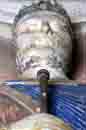 An effigy of Henry II, Fontevraud Abbey, France © Gerald of Wales was part of John's retinue, and gives us an eye-witness account of events in Ireland, albeit a heavily biased one.
John took a lot of young hangers-on with him, who ridiculed the Irish chieftains when they turned up to pay homage, and to whom he made land grants that antagonised the Norman settlers.
So when the Irish buried their differences and united against him, John found himself isolated and impeded by the locals. Unable to pay his mercenaries because of the extravagance of his way of life, he was eventually forced to abandon Ireland in September, blaming Hugh de Lacy for obstructionism. King Henry was then obliged to appoint another Hiberno-Norman, Hugh de Courcy, as justiciary.
With the death of Geoffrey in a tournament, and the worsening relationship between Henry and Richard, John became Henry's favourite. Yet there is absolutely no evidence that Henry considered passing Richard over as his heir. John had failed to oust his brother from Aquitaine and, at an age when Richard was browbeating that province into submission, he had squandered his opportunities in Ireland.
Henry seems to have recognised his youngest son's limitations, though he took a perverse pleasure in keeping Richard guessing. The paranoia this induced backfired spectacularly, when Richard made common cause with Louis of France and declared war on Henry in 1189.
Old and infirm, Henry was hounded from castle to castle, but what finally broke him was the discovery that John had betrayed him and gone over to Richard's side. He died, a broken man, on 6 July 1189.
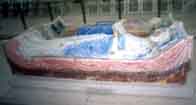 Painted effigies of Henry II and his wife, Eleanor of Aquitaine, at Fontevraud Abbey, France © Richard was crowned king on 3 September 1189. He made John the Count of Mortain and granted him extensive lands in England (including Nottingham). The new king also had enough respect for John's troublemaking tendencies to ban him from England for three years whilst he (Richard) went on crusade. However, against Richard's better judgement, he was prevailed upon by his mother Eleanor to allow John back into England. This was a mistake.
It was from the chaos and outlawry of this time that the legend of Robin Hood was probably born.
John conspired against Richard's regent, William Longchamp, and set himself up as King in all but name. A plot to divvy up the Angevin empire between himself and the new French King, Philip Augustus, was only just forestalled by his mother, when she intercepted him as he was about to take ship from Southampton. When Richard was imprisoned on his return from the crusades, by Duke Leopold of Austria, John again conspired with the French King to seize the kingdom.
Richard was unimpressed. 'My brother is not a man to win land for himself if there is any resistance', he said. He was proved right when Eleanor rallied support among the English barons, and besieged John's castles.
It was from the chaos and outlawry of this time that the legend of Robin Hood was probably born. On Richard's release John fled to France, but he was soon forgiven by his brother, who himself returned to France, where he died in 1199. On his deathbed Richard named John as his heir, although by the law of primogeniture Arthur, the son of an older brother, Geoffrey, should have succeeded him.
Thus, despite their rivalry, Richard and John conspired to keep the crown in the family, and John's coronation took place at Westminster Abbey, on 27 May the same year.
Chinon - location of the 'Lion in Winter' conference and castle in which John's wife Isabella was besieged when the Norman lords turned against him.
Château-Gaillard - fantastic Norman castle built by Richard I as the key to the defence of Normandy. Its loss signalled the end for John in Normandy.
Lusignan - ancestral seat of the Lusignans in Poitou.
Poitiers - Angevin capital of Poitou. Henry II married Eleanor here in 1152, and its surrender by the Lusignans marked the end of Angevin power in Aquitaine. The cathedral church dates to the 1160s.
Mirabeau - town and castle in central France (Anjou) where Eleanor was besieged and John defeated Arthur and the Lusignans.
Alençon - town on the Norman border. When John learned that the Count of Alençon had gone over to the other side, he panicked and gave up on Normandy.
Carrickfurgus - main stronghold of Hugh de Lacy in Ireland.
Dublin - centre of John's new Irish administration. The core of Dublin castle as it stands today was started by John.
St Asaph - centre of the Four Cantrefs taken from Llywelyn in North Wales.
Barnsdale and Sherwood Forest - recorded haunts of Robin Hood.
Runnymede - site of the signing of Magna Carta.
Rochester Castle - key loss of the Magna Carta rebels, which meant they had to turn to Louis of France. The round tower on the south corner of the keep was torn down by John and had to be rebuilt, which is why it differs from the other square towers.
Dover - besieged by Louis of France in 1217, but never fell.
Sandwich - site of the landing of Louis in 1216 and his final defeat in 1217, during which the outlaw Eustace the Monk was also killed.
Books
King John by WL Warren (1961)
King John by Ralph V Turner (Longman Medieval World Series, 1994)
The Angevin Empire by John Gillingham (Hambledon, 1994)
The Formation of the English Common Law by John Hudson (Longman Medieval World, 1996)
Robin Hood by JC Holt (Thames & Hudson, 1993)
The Outlaws of Medieval Legend by Maurice Keen (1987)
The Political Development of the British Isles by Robin Frame (Clarendon Press, 1995)
Dr Mike Ibeji is a Roman military historian who was an associate producer on Simon Schama's A History of Britain.




BBC © 2014The BBC is not responsible for the content of external sites. Read more.
This page is best viewed in an up-to-date web browser with style sheets (CSS) enabled. While you will be able to view the content of this page in your current browser, you will not be able to get the full visual experience. Please consider upgrading your browser software or enabling style sheets (CSS) if you are able to do so.

