
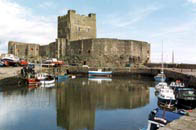
The story of Ireland in the Middle Ages is both more complicated and more tragic than any simple 'natives against imperialists' story could possibly suggest. Simon Schama unravels the story of who did what to whom, and why.
By Professor Simon Schama
Last updated 2011-02-17
The story of Ireland in the Middle Ages is both more complicated and more tragic than any simple 'natives against imperialists' story could possibly suggest. Simon Schama unravels the story of who did what to whom, and why.
The devastating wars of the British nations, which had seen Edward I invade Wales and then Scotland in the 13th century, left Ireland largely unaffected.
However, Edward, the Caesar of Britain, had inherited the English Crown's claim to be Lord of Ireland, along with the rest of his estates. Irish gold contributed to his campaigns in Wales, 3,000 Irish men invaded Scotland with him, and while Irish grain fed his war machine, Edward never visited the island himself; indeed no English king did so between John and Richard II.
Significantly, and for the first time, the grant of Ireland to Edward: 'provided that the land of Ireland shall never be separated from the crown of England...', and so left it forever a part of the Plantagenet estate.
Anglo-Norman lords had settled in Ireland in the 12th century and never left. Its landscape now featured Norman castles and abbeys, just like the British mainland.
With the king of England so distracted at home, it came as no surprise that many English lords equally stayed away from their Irish estates, allowing the gradual reassertion of influence by the native Irish princes and kings. It was into the middle of this vacuum that Robert the Bruce dispatched his ambitious brother, Edward, in 1315.
For all the devastating completeness of the Scots victory at Bannockburn in 1314, Robert I, King of Scotland, knew that it was only a battle that he had won there, certainly not the whole war.
A year later, his claim to the crown of Scotland had still not been recognised by Edward II, King of England. Bruce and the Scottish nation also knew there was always the possibility that before long another great army of English knights and Welsh archers would come lumbering up over the Tweed.
...Ireland shall never be separated from the crown of England...
All his instincts - strategically sharp as always - told Bruce he needed to hit the English while they were still on the floor, and hit them where it hurt. The war was taken over the border into Northumbria, now subjected to raids of unsparing ferocity. For over 20 years the Scots held the initiative in northern England, terrorising the population and carrying off their goods.
And then in May 1315, Bruce did something much, much, bolder. His brother, Edward, landed a formidable Scottish army, at least 5,000 strong, near Carrickfergus in the north-east of Ireland. In effect, this opened a second front in the war against the English empire.
Robert had smoothed his brother's way by writing a remarkable letter to: 'all the kings of Ireland, the prelates and clergy and to the inhabitants of all Ireland, our friends'.
The Scots would come, he said, not as invaders but as liberators, for: 'our people and your people, free in times past, share the same national ancestry and are urged to come together more eagerly and joyfully in friendship by a common language and common custom'.
What he was proposing was a Gaelic alliance, across the Irish Sea, 'so that God willing, nostra natio - our nation - may be restored to her former liberty'.
How, and when, had their liberty been taken from the Irish?
The 'when' is easy enough to pinpoint - the fateful decade when an Anglo-Norman colony of barons established itself in northern and eastern Ireland; and the fateful year, 1171, when the kings of Ireland had knelt before Henry II, in a specially built palace made of wattle, and had submitted to him as their overlord and High King.
So you would suppose that the 'how' is also a story of depressing simplicity. The aggressive, expansionist English - under the king most famous for gobbling up duchies and kingdoms - take a look out west, see something they fancy, push their horses onto ships, bludgeon their way into the land they want with blood and fire, and force themselves on the peaceful natives as conquerors. Then they sit there for the next 800 years, daring the conquered people to do something about it.
But that's not what happened. What did happen is ugly enough - and reflects no credit on the English intruders - but it was, as history often is - both more complicated and more tragic, than any simple 'natives against imperialists' story could possibly suggest.
Awful the deed done in Ireland today...
Just as in Scotland a century later, the trouble with the English began with a civil war among the natives. In 1166, the King of Leinster, Diarmait MacMurchada was forced to flee from Dublin and from his kingdom by an alliance of Irish enemies, including the new High King, Ruaidri Ua Conchobair. 'Awful the deed done in Ireland today', wrote the chronicler of Leinster, 'the expulsion overseas by the men of Ireland of Diarmait...'.
And awful were its consequences. For Diarmait landed in Bristol and asked for help from King Henry II to get his throne back. Now what happens when you ask the Godfather for a favour? He expects something, some day, in return. And, as the Song of Dermot made clear, from the beginning that something was:
To you I come to make my plaint, good sire In the presence of the barons of your empire. Your liege-man I shall become henceforth all the days of my life, On condition you be my helper so that I do not lose at all You I shall acknowledge as sire and lord...
Then the King promised him, the powerful king of England That willingly would he help him as soon as he should be able.
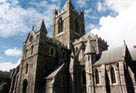 Christ Church Cathedral, Dublin © But these were the years of Henry's great crises: the feud with Becket and the church - and the coming wars with his son, the future Richard I. In 1155, the Pope had asked Henry to invade Ireland to clean up what was reported to be a corrupt and lax Christianity.
But then, as now, Henry had more urgent things to do than get directly involved in an obscure island west of England's shores. On the other hand, Diarmait's appeal had presented him with a windfall too good to turn down. So he gave Diarmait permission to recruit help from among his barons.
This is when the trouble became big trouble. For Diarmait promptly went shopping for mercenaries among the nastiest and greediest possible bunch of knights. These were the Anglo-Normans who, around the 1160s, seemed to be on the losing end of the war against the Welsh princes of Gwynedd.
They had lost castles, land and peasants. They were in an ugly mood and they were looking for somewhere to recoup their losses. Enter Diarmait.
Spread the word, the likes of Robert fitzStephen and Richard fitzGilbert de Clare (known to his friends, and especially to his many enemies, as 'Strongbow') must have said: 'Forget about Wales; forget about those unpleasantnesses in the mountains and valleys. Come west young knights. Ireland will be a piece of cake. It's said that the natives are primitive. But the pastures are green. So what are you waiting for?'.
Within a year Diarmait had his throne back in Dublin. But he also now had an army of Anglo-Normans who weren't about to go away now that the job was done. In fact, from the beginning, Diarmait had known this. He not only expected but wanted the likes of Strongbow to stick around, lest his old enemies get ideas of booting him out again.
Robert fitzStephen was quite right when he told his followers that Diarmait 'loves our race; he is encouraging our race to come here and has decided to settle them in this island and give them permanent roots...'. And Diarmait even went to the trouble of marrying his daughter to Strongbow to make sure that the alliance had staying power.
Their agreement spelled out that if none of Diarmait's sons survived (and one had been blinded, another been taken hostage, another was illegitimate), then Strongbow could even inherit the throne of Leinster himself!
The Irish kings did homage to Henry as they would to any High King...
At which point Henry II suddenly sat up and took notice of what was going on in the west. He had meant to use Diarmait's appeal to get a foothold in Ireland.
What he had inadvertently created was a monster: a colony of Anglo-Normans, who answered to exactly the kind of jumped-up superbaron Henry was busy sitting on in every other part of his enormous empire.
So in the winter of 1171, Henry crossed the Irish Sea himself, coming with an army big enough to give the likes of Strongbow serious second thoughts. It was then, in the wattle palace of Dublin, that he took the homage of all the six Irish kings, including Ruadrai Ua Conchobair.
And though everything that happened afterwards in the sad history of England and Ireland wants to say this was the moment when Ireland lost her freedom, no one at the time saw it that way at all.
The Irish kings did homage to Henry as they would to any High King, building the ritual hall through which they entered as his men, promising him one of every ten of their cattle hides in tribute.
And they saw him not as imperial conqueror at all, but as their protector against the Strongbows and the Anglo-Norman barons.
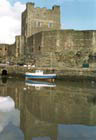 Carrickfergus Castle © At the Treaty of Windsor in 1175, Henry in his turn made it clear that he also thought of himself as protector rather than conqueror, since he restored Ruadrai to his kingship of Connacht and to all the rights and honours he had had from other Irish lords before the coming of the English.
It wasn't Henry II's presence in Ireland that lost them their freedom, then, but his absence. With Henry in France, fighting off his children, his wife and the King of France, the Anglo-Norman barons had absolutely no intention of making his Irish settlement, with its careful attention to the claims of native Irish rulers, work.
What they wanted was a colony; the nice, obedient, feudal territory they had lost over in Wales, transplanted to Ulster and the east coast. And the first thing they did to make sure they got it, was to do what barons do best - build a castle that said - unmistakably - 'We're in charge'.
It was a true colony, a completely imported world: craftsmen, artisans, peasant settlers, ironware - all brought across the Irish Sea.
At first the castles were a primitive throwback to Norman history - just a heaped up earth motte with an encircling wooden 'bailey' wall. But it was enough to do the job of dominating the countryside against Irish attacks.
In due course came the much more formidable stone buildings, such as Carrickfergus Castle, which entrenched their power in Ulster beyond any possibility of eviction.
And from these power-bases, something utterly new was created in Ireland: feudalism. Within two or three generations, northern and eastern Ireland had been totally transformed, from a country living off herding and horses, and ruled by clans, to a place of manors.
The land taken - and taken is the word - by the Anglo-Normans, was divided up in the usual way and given to their knights, as reward for military service.
But somehow - and does this sound familiar everyone? - they weren't quite English either. Almost from the beginning they knew this, since one of the Anglo-Normans, Maurice fitzGerald, rather pathetically complained that no one would help his kind: 'for just as we are English as far as the Irish are concerned, likewise to the English we are Irish and the inhabitants of this island and of the other assail us with an equal degree of hatred'.
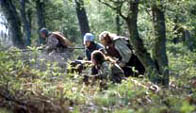 Scottish warriors © By the time that Edward Bruce arrived in 1315, there was an entrenched English colony in eastern Ireland. But the native Irish kings and much of their way of life had managed to hold on in the centre and west of the country - taking advantage of the chaos of English politics in the middle of the 12th century.
So there was reason for the Bruces to hope that their clarion call to revolt would be heard loud and clear, and that oppressed Ireland would rush to their banner to evict the imperial conquerors, much as they had done in Scotland.
Together the Gaelic brothers would rid Caledonia and Hibernia of the English scourge. And the two Bruces - Robert in Edinburgh and a King Edward in Dublin would rule the Irish Sea.
This is not what happened. And perhaps it served them right. For all their ringing national rhetoric, some of it undoubtedly sincere, Robert and Edward Bruce were transparently using Ireland to force the English to divert resources away from Scotland to this second front, and to make them accept their claim to the crown in Scotland.
That, in the end, they didn't give two hoots about Ireland was obvious when, in return for the English government (now in the hands of Queen Isabella and the Lord Mortimer) recognising the independence of Scotland, King Robert promised that he would never aid any rebellion against the English in Ireland. So much for the Gaelic brotherhood of nations!
Together the Gaelic brothers would rid Caledonia and Hibernia of the English scourge.
And perhaps you could have forecast this from what actually happened once Edward Bruce's campaign got under way. For it proceeded with the usual indiscriminate slaughters and burnings - without making any nice distinctions between Gaelic friends and English foes.
Perhaps things might have been different had not the years of the Scottish campaigns also been those of the worst famine in medieval history; so that there was nothing for the Scots soldiers to eat unless they took from the Irish. Which they did.
And even then they were reduced to such desperate straits, that it was said by one chronicler that the Scots soldiers dug up freshly made graves to eat the corpses. It was the usual story: a victory over the Ulster English; then a march down towards Dublin.
There the inhabitants tore down churches to use the stones to reinforce their walls. So they evidently were far from seeing the Scots as liberators. The city was never taken.
Then at an immense and bloody battle between opposed Irish camps in the west, where 10,000 men were said to have lost their lives, the pro-Scots side came off worst. In 1318 Edward Bruce was himself was killed in battle at Fochart, and by the end of the year the Scots were gone.
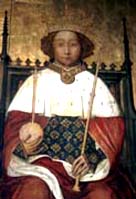 Richard II, Westminster Abbey © As grim as the story was, the Scots in Ireland had left something behind apart from widows and tragic ballads. The Anglo-Norman colony stopped expanding out from Ulster and Leinster. And just as in Scotland, the idea of the unstoppable English Empire of the Plantagenets had had the shine knocked off its myth of invincibility.
And, not least, the Bruces had given Irish leaders such as Domnal O'Neill, Edward's main ally, their voice of resistance. They wrote a 'Remonstrance of the Irish Princes' to the Pope, justifying the bestowing on Edward of the crown of Ireland.
To, 'shake off the harsh and insupportable yoke of servitude and to recover our native freedom...', the Irish princes were, '... compelled to enter a deadly war ... preferring under the compulsion of necessity to face the dangers of war like men in defence of our right, than go on bearing their cruel outrages like women...'.
In this you hear a language - eloquent, fierce, righteously belligerent - and you hear a voice which, for better or worse, would shout, roar and lament, down through the centuries.
...the Bruces had given Irish leaders like Domnal O'Neill, Edward's main ally, their voice of resistance.
This was 1317. Three years later - a case perhaps of the Irish teaching the Scots rather than the other way about - something remarkably like it was spelled out at Arbroath, once again in a letter to the Pope.
And so the wars of Britain had once again spilled into Ireland, with bloody consequences. The English estates remained, subdued to a degree but it would be over half a century before another English king set foot in Ireland to restore the crown's authority.
It was Richard II who turned Ireland into his personal crusade, only this time it was to cost the English king his throne - and his life.
Books
A History of Britain, At The Edge of the World, 3000 BC-1603 (Vol I) by Simon Schama (BBC Worldwide, 2000)
The Isles by Norman Davies (London, 1999)
Carrickfergus Castle is situated in Carrickfergus, Northern Ireland, and can be visited by the public.
Simon Schama is University Professor in Art History and History at Columbia University, New York. He was a Fellow at Christ's College, Cambridge, from 1966-76. He moved as Fellow and Tutor in Modern History to Brasenose College, Oxford, before becoming Mellon Professor of Social Sciences and William R Kenan Professor in the Humanities at Harvard from 1980-93.
His best-selling books include: Citizens (1989); Patriots and Liberators (1977); The Embarrassment of Riches (1987); Dead Certainties: Unwarranted Speculations (1991); Landscape and Memory (1995) and Rembrandt's Eyes (1999). From 1995-8 he was art critic and cultural essayist for The New Yorker magazine.




BBC © 2014The BBC is not responsible for the content of external sites. Read more.
This page is best viewed in an up-to-date web browser with style sheets (CSS) enabled. While you will be able to view the content of this page in your current browser, you will not be able to get the full visual experience. Please consider upgrading your browser software or enabling style sheets (CSS) if you are able to do so.

