
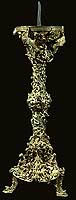
Two beautiful objects in the Victoria and Albert Museum tell a vivid tale of life in 12th-century Britain, and of the Thomas Becket mania that swept Europe. The Museum's director describes what went into their making.
By Dr Alan Borg
Last updated 2011-02-17
Two beautiful objects in the Victoria and Albert Museum tell a vivid tale of life in 12th-century Britain, and of the Thomas Becket mania that swept Europe. The Museum's director describes what went into their making.
There are two important objects in the V&A that could be described as summing up the 12th century in Britain. One is a richly decorated candlestick, and the other is a small casket. The amazing candlestick (probably one of a pair) was made for Gloucester Cathedral about the year 1110. Crafted from bronze, the stem is covered with writhing creatures, humans and monsters all fighting and struggling towards the light of the flame.
The imagery is violent, even pagan, in its references and clearly depicts conflict between the forces of good and evil. The light of the candle represents Christ, who is the only route to salvation, while sinful man is enmeshed in the coils of evil below. We are reminded that Christian doctrine entered into every aspect of medieval life.
Unfortunately for the Church, men and women then, as now, were all too easily ensnared by the forces of evil, and much of the art of the period, as here, shows the fate of sinners being swallowed up by the monsters of Hell, while the righteous are saved in Heaven. Such works of art served to teach people, many of whom could not read, the biblical messages preached by the clergy. Ironically, clergymen are often shown amongst the sinners in Hell, although others are portrayed as going straight to Heaven, sometimes as saints and martyrs.
Works of art combined pagan and Christian motifs.
The other V&A object relates to the most famous of all clerical martyrs, Thomas Becket. The object is a casket, intended to hold some of the saint's relics. It was made in Limoges around the year 1180, and is decorated in enamel with scenes of Becket's murder, burial and ascent into paradise - we see his soul carried aloft by angels. This casket was made only a few years after Becket's murder in Canterbury Cathedral in 1170, and it is the earliest and largest such reliquary to survive.
Many other such caskets were made during the next hundred years, all intended to hold a fragment of bone or cloth, testifying to the great fame and popularity of the martyred archbishop. There can hardly have been enough of Becket to go round, and some of these 'true' relics were no doubt the product of enterprise rather than faith. The really intriguing question, however, is what made the dead Saint Thomas Becket so popular, when the living archbishop had been an arrogant and controversial a figure, who inspired little real devotion.
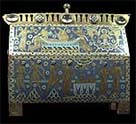 The casket belonging to the Abbot of Peterborough, which may have held relics of Thomas Becket. © Becket's story is well known, and the contemporary evidence is extensive, so that we can be sure of much of what happened. He was appointed first Chancellor, then Archbishop, of Canterbury by enry II, who believed that he could rely on his old friend to support his policy of curbing the powers of the Church. But Becket turned out not to be a political yes-man, and defended the independence of the Church and the supremacy of the papacy.
After many violent disputes and tearful reconciliations, Henry's patience finally snapped, and he is supposed to have cried out, 'Who will rid me of this turbulent priest?' - leading four knights to ride to Canterbury to slay Becket. This event became the centre of a story of Church against state, of a power struggle between an unyielding archbishop and a forceful king, and of two close friends who quarrelled and become bitter enemies.
It was a personal drama played out on an international stage, resulting in an epic in which faith, friendship, treason and death all played their part. The outcome was a saint who was revered across all Christendom and, in the short term, a victory for the powers of the Church over the powers of the king.
Who will rid me of this turbulent priest?
Becket's road to sainthood was fast and assured. This staunch defender of the faith turned out to have been a hair-shirted ascetic, at whose tomb the penitent King prostrated himself. The tomb was also a place where miracles were reported to occur. Becket was canonised swiftly, in 1173, which was no bad thing for Canterbury, for the tombs of saints attracted crowds of pilgrims, bringing both alms and trade in their wake.
Moreover, relics of the saint could be given (or sold) to carry his sanctity across Christendom. Such relics, however tiny, needed to be properly housed in a reliquary and this is where the casket comes in. Interestingly, its first recorded history suggests that it may have been at Croyland Abbey in Lincolnshire before the Reformation, and so it might be the casket in which the Abbot of nearby Peterborough placed some of Becket's relics, for transporting to his church in 1177.
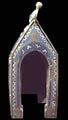 End detail of the casket showing its distinctive shape. The door, now missing, provided access to the relics. © The casket is decorated with scenes of the martyrdom, set against a blue enamel background, with details picked out in gold, and the faces of the figures raised up in relief. This style marks it out as having been made in Limoges, in France. At that time the town of Limoges fell within the Angevin domain, so it is not surprising that craftsmen from there managed to corner the market for the production of Becket reliquaries.
More than 50 of this type of casket survive, and they all follow the pattern of the one described here, shaped like a miniature house with a pitched roof. A hinged door at one end gave access to the relics inside - although these have long since disappeared.
Relics and images of Becket spread rapidly. Within a decade of his death, Queen Margaret of Sicily (who died in 1183) had been given a miniature Becket reliquary to wear around her neck, while a full-length portrait of him was included in the mosaic decoration of the cathedral of Monreale (there were of course very close ties between Britain and Sicily at the time).
Soon after this manuscripts, wall paintings and stained glass were all embellished with scenes from the saint's life. A sort of Becket mania spread across Europe, and pictures of him were to be found from Iceland to Palestine. Churches were dedicated to him, and a military order of knights founded in his name.
Becket mania spread across Europe, and pictures of him were to be found from Iceland to Palestine.
All this was to end as the Middle Ages drew to a close, but the power of the Becket story survives. TS Eliot's play Murder in the Cathedral is one tribute to its enduring interest. So too is the fact that, when the casket was offered for sale in 1996, a campaign was mounted in the national press to stop this key piece of Britain's heritage from leaving the country. Thanks to the campaign, the casket has found its present resting-place in the V&A.
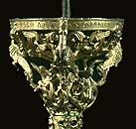 Detail of 12th century, bronze candlestick showing violent battle between the forces of good and evil. © ... that candles and candlesticks were not placed on church altars before the year 1000? The Gloucester Candlestick is the second oldest church altar candlestick known, only a pair made for Hildesheim, in Germany, is older.
... that in scenes of the Last Judgement you often see St Michael weighing souls, to find out whether they will go to Heaven or Hell - and that sometimes a cheating Devil is shown trying to tip the balance in favour of Hell?
... that Thomas Becket was born in his family home on the site of the present Mercer's Hall, off Cheapside, in London, in 1120? The family name came from a hamlet called Becquet, on the Le Havre peninsula, but his name was never (as school children used to be taught) Thomas à Becket.
... that the casket shows one of Becket's executors, a knight, carrying an axe, not a sword? In fact, they all carried swords in their right hands, but three also had carpenters' axes in their left hands, and the fourth knight is known to have carried an adze - these tools were intended to break down the doors into Becket's church, which they did not need to do, as he had left the church open.
... that after the murder, the knights looted Becket's possessions, which included gold vessels and jewels valued at around 2,000 marks? They also found two spare hair-shirts, which they threw away as having no value.
... that pilgrims to Canterbury and other Becket shrines could buy badges, usually made of pewter or lead, to wear on their hats and cloaks? Many of these Pilgrim Badges survive and can be seen in museums, especially the British Museum and the London Museum.
... that the chapel that stood on Old London Bridge was dedicated to Thomas Becket, and was filled with images of him? Until 1539 the Common Seal of the Corporation of London carried an image of Becket.
... that Henry VIII finally resolved the battle between the Church and the state at the Reformation, with the establishment of the Church of England? Not surprisingly, therefore, Henry de-canonised Becket in 1538 and instructed that images and pictures of him should be destroyed. For this reason, only a fraction of the works of art that were devoted to Becket survive to this day.
Books
Pilgrimage. An Image of Medieval England by Jonathan Sumption (Faber & Faber, 1975)
Romanesque Art by Andreas Petzold, (Weidenfeld & Nicolson, 1995)
Thomas Becket by Frank Barlow, (Orion Books, 1997)
Thomas Becket: His Last Days by William Urry (Sutton Publishing, 1999)
Dr Alan Borg was appointed Director of the V&A in October 1995, after 13 years as Director General of the Imperial War Museum. Alan Borg's specialist area is medieval art and architecture, and he has contributed to numerous publications, including The Vanishing Past: Studies presented to Christopher Hohler (BAR, 1981) and War Memorials (Leo Cooper, 1991).




BBC © 2014The BBC is not responsible for the content of external sites. Read more.
This page is best viewed in an up-to-date web browser with style sheets (CSS) enabled. While you will be able to view the content of this page in your current browser, you will not be able to get the full visual experience. Please consider upgrading your browser software or enabling style sheets (CSS) if you are able to do so.

