Henry lands in Ireland
 Strongbow had made the mistake of supporting Stephen during the 'tempus werre' ('time of war'), and as a result, Henry had deprived him of the earldom of Pembroke. So his fortunes were definitely on the wane. William of Newburgh says he went to Ireland to escape his creditors, while Gerald of Wales claims that Dermot wanted him because 'he had a great name rather than great prospects'. Even so, he had much to lose by moving to Ireland, and he was only finally persuaded when Dermot offered him the hand of his daughter, Aífe, in marriage and the prospect of succeeding to Leinster on Dermot's death. The chronology of what follows is crucial, both to understand Strongbow's motives and why Henry finally got involved.
In May 1169, Robert fitzStephen crossed to Ireland, accompanied by Strongbow's uncle, Hervey de Montmorency, and helped Dermot regain his kingdom, capturing the port of Wexford in 1170. The High-King of Ireland, Rory O'Connor, demanded Dermot's son as a hostage for good behaviour. In Autumn 1169 and Spring 1170, more of Strongbow's men arrived to help Dermot, and advised him to offer Aífe to their lord. Strongbow crossed to Ireland in August 1170 and at this point, Henry II took notice. He closed all the ports to Ireland and ordered all those who had crossed to return, threatening to confiscate Strongbow's lands if he failed to obey.
Strongbow married Aífe in Autumn 1170 and in revenge, Rory executed Dermot's son, removing the last remaining legitimate heir (in Norman eyes) to Dermot's kingdom. In May 1171, Dermot died 'within a short time of Strongbow's arrival in Ireland' and Strongbow immediately asserted his claim to Leinster. Rory responded by marching on Dublin. After a two month siege, things looked dire for Strongbow and his men. "Surely we are not looking to our own people for help?" said one of his captains. "For we are caught between two stools. Just as we are English to the Irish, so are we Irish to the English." Forced to rely on their own resources, they sallied out of the city walls and routed Rory's army.
Meanwhile, the men of Wexford had risen up against Robert and imprisoned him. The Irish appealed to Henry for aid, and while he was waiting to cross to Ireland, the men of Wexford came to Pembroke and offered him Robert as the man who had initiated the Norman encroachment into Ireland. Robert languished in prison until 1172. Throughout 1171, Strongbow sent emissaries to Henry, and eventually went to Henry in person, offering to surrender his lands in return for their fief as a vassal of the king. Henry landed in Ireland in October 1171, where he was met by the sub-kings of Leinster and other kingdoms who did homage to him in the Irish fashion. He spent Christmas in Dublin and left in 1172, leaving Strongbow in charge of Leinster, but with the strategically important locations of Wexford, Limerick, Cork and Wicklow Castle in royal hands.
Conclusions on Ireland
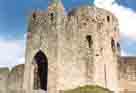 Trim Castle, Meath. The first fortification was built by Hugh de Lacy in 1172. © What do we gather from this? First, Strongbow himself only got involved in Ireland once he could guarantee that he was going to profit from it, and the timing of Dermot's death does not inspire confidence. Secondly, Henry seemed indifferent to Ireland until one of his great landholders put himself in a position of power there (like Henry and Aquitaine!). At this point, he tried to prevent Normans from going over there. Only when this failed, and the High-King of Ireland failed to assert control over this rogue vassal, did Henry intervene personally, seemingly at the invitation of those Irish opposed to their ineffective High-King. Thirdly, the Irish themselves seem to have treated Henry like an alternative High-King, even building a ritual hall in which to give their submission.
Like Wales, once the situation had resolved, Henry seems to have lost interest. He left Ireland in 1172 with Strongbow in control of Meath and Leinster, and Rory still High-King. In 1173, he was so preoccupied with the revolt of Henry the Younger that Rory could devastate Meath with impunity; then in 1175, he came to an agreement with Rory in the Treaty of Windsor. This recognised Rory's right to his ancestral kingdom of Connacht, but retained direct Norman control over Meath and Leinster. Rory agreed to hold the rest of Ireland as Henry's vassal, and was given control of Limerick and Cork.
In this respect, Henry had taken over Ireland, holding one quarter of it through Strongbow and his heirs, while exerting feudal overlordship of the rest through Rory O'Connor. Rory remained High-King of Ireland and had a free hand, but was unable to control the rapaciousness of the Norman incomers, who had several generations of practice in Wales to fall back on. In 1177, Henry once again intervened, granting the lands of Thomond and Desmond to the Normans who had taken them and taking back control of Limerick and Cork. At this time, Robert fitzStephen, who had rehabilitated himself in Henry's service in 1173, was given a half-portion of Cork to look after. Since Rory did not complain, this could be seen as Henry reasserting control over his unruly Norman barons before they got completely out of hand.
Rory retired to a monastery in 1183, leaving his daughter in marriage to Henry's vice-regent in Leinster, Hugh de Lacy (Strongbow had died in 1176). Henry responded by making his own son John vice-regent, but John was even more ineffectual than Rory had been, and succeeded only in alienating both the Irish and the Normans, even prompting Rory to come back out of retirement against him. He returned to England frustrated in 1185, leaving Rory attempting to wrest control of Connacht back from his son, Connor, with the help of Norman mercenaries.