
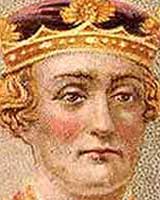
Henry II may be best known as the murderer of Thomas Becket, but he was also a complex man at war with his own family. What forces were at play in Henry's relationship with his wife and sons, and what kind of impact did this have on the monarchy?
By Dr Mike Ibeji
Last updated 2011-06-20
Henry II may be best known as the murderer of Thomas Becket, but he was also a complex man at war with his own family. What forces were at play in Henry's relationship with his wife and sons, and what kind of impact did this have on the monarchy?
Look for the key to Henry's character and look no further than his childhood. The son of Geoffrey of Anjou and Matilda (daughter of Henry I) against whom the barons of England and Normandy rebelled in favour of the usurper Stephen, his childhood was dominated by war and intrigue as his mother and father strove to regain their inheritance. From the age of 9 it was the young Henry to whom that inheritance would fall, and on whom the responsibility of holding it together lay. Consequently, Henry II, king at the age of 22, was mature beyond his years and obsessed with the restoration of his ancestral rights.
Though not handsome, Henry was larger than most men, stocky and quite powerful: a power which came across in his personality. His energy was overwhelming, and his anger legendary, as was his love of hunting. He dressed simply in hunting clothes and was rarely seen either out of the saddle or without a hawk on his arm. Yet paradoxically, this archetypal man of action was an intensely private intellectual. Multi-lingual, he liked to retire with a book, was well-polished in letters and enjoyed scholarly debate. He was also very approachable and never forgot a face. He shunned regular hours and his propensity to change his schedule at short notice was infamous. This often translated into an ability to react to unforeseen circumstances with astonishing rapidity and decisiveness.
...he understood honest opposition and could deal with it equably. What he could not abide was betrayal.
He vaunted loyalty above all else, and his fits of rage against those he deemed as traitors are so melodramatic as to be unbelievable. On more than one occasion, he is said to have frothed at the mouth in a screaming rage, and is even known to have chewed the straw on the floor in apoplexy. This Henry was frightening, and could reduce international magnates to quivering wrecks. Yet he understood honest opposition and could deal with it equably. What he could not abide was betrayal.
 Dover Castle, with Henry II's keep © Above all, he was ruthless in pursuit of his rights. He would manipulate the courts, exploit any loophole and even break his word to recover and defend his ancient rights as he saw them. His fundamental policy was to re-establish 'all the rightful customs which were had in the time of King Henry my grandfather, revoking all evil customs which have arisen there since this day.' For Henry, all else came second to this, and his interpretation of these customs was often more rigorous than they actually had been in Henry I's day. This governed all his actions: his foreign policy, his religious policy, his economic and legal policy and even his personal life; at times with disastrous consequences.
In his personal life, his intense privacy seems to have alienated those who were closest to him.
In his personal life, his intense privacy seems to have alienated those who were closest to him. The perceived betrayals of first Becket and then Eleanor (both of whom were only acting in the interests of their own personal offices) seem to have hurt him sorely; but the most wounding betrayals were those of his sons. Yet these very betrayals were a natural consequence of his obsession with his rights: he failed to make his sons trust him because he never included them fully.
Passionate, grasping, authoritative, Henry started his reign with a youth's determined arrogance, and ended with a wily old miser's cynicism. He held his kingdom together by force of his personality, but that was his greatest weakness as well as his greatest strength.
If people know of Henry II at all, beyond his classic role in Thomas Becket's martyrdom, it is probably through the Lion in Winter image of a powerful man at odds with his family. This is not incorrect. Henry's relationship with his family was a dramatic and turbulent one that not only shaped the nature of his own reign, but was to have far-reaching effects into the reigns of his successors.
The very nature of Henry's rule was in itself defined by his parentage. Henry was the son of Geoffrey of Anjou and the ex-Empress Matilda of Germany. Matilda was the daughter of Henry I, and was married to Geoffrey in an attempt to recover the marriage alliance between the Anglo-Norman king and the count of Anjou which had been broken when Henry I's son, William Audelin, died with the sinking of the White Ship in 1120. However, the marriage of a daughter into the House of Anjou was a very different thing in the eyes of his Norman barons to the marriage of a son. It meant that instead of Normandy taking over Anjou, Anjou was effectively taking over Normandy.
Henry's relationship with his family was a dramatic and turbulent one...
So when Henry I died in 1135, the majority of his barons transferred their loyalty to his nephew Stephen of Blois, against Matilda. Henry, born in 1133, grew up during the civil war that followed. At the age of 9, Matilda's claim to the throne was transferred to him after her singular failure to capture the loyalty of the barons. At the same time, Geoffrey of Anjou conquered Normandy and very astutely passed its patrimony to his son, effectively taking himself (an Angevin usurper) out of the picture. So by 1142, Henry had become the focus for opposition to Stephen's inept reign. By the age of 22, he was king of England, his attitudes forged in the fires of civil war.
 Effigy of Eleanor, Fontevraud Abbey © On 18th May 1152, the young prince Henry married Eleanor of Aquitaine, the cast-off wife of King Louis VII of France. This in itself was to have far-reaching political consequences, and at the time the marriage scandalised the houses of Europe. Eleanor was eleven years Henry's senior. Strong-willed and impetuous, she was rumoured to have had lovers in both Prince Raymond of Antioch and Henry's own father, Geoffrey of Anjou. In fact, Geoffrey strongly advised Henry not to get involved. She was also closely linked to Henry by blood, being within the fifth degree of kinship which was prohibited by the church, and this was precisely the excuse by which Louis had got his marriage to her annulled.
Still, the marriage worked. Their characters complimented each other: Eleanor was a powerful enough personality to hold her own in Henry's company, and was able to act as regent for him when he was away. She bore him 6 children who survived: among them four sons, Henry the Younger, Richard, Geoffrey and John. Yet, like Henry himself, she was fiercely protective of her inheritance, and valued it above loyalty to her husband. This would inevitably result in friction, with Eleanor supporting her sons against their father in defence of Aquitaine.
Eleanor was a powerful enough personality to hold her own in Henry's company...
Contemporary chroniclers failed to understand this driving force within her, and interpreted her 'fickleness' as a variety of women's perceived weaknesses. The most persistent rumour was that Eleanor turned against her husband out of jealousy over his infidelities. Henry undoubtedly had two bastards, Geoffrey 'Plantagenet' and William 'Longsword', and there is also no doubt that the great love of his life was Rosamund Clifford, with whom he took up in 1173 and who died in 1176. Henry is supposed to have contemplated divorcing Eleanor for Rosamund in 1175, and wagging tongues suggested that Eleanor poisoned her the year after. It has also been suspected that Henry had a liaison with Margaret, daughter of King Louis, who had been married to Henry the Younger and was then betrothed to Richard for years whilst she remained in the custody of Henry.
Certainly, it is likely that these rumours contributed to Richard's distrust of his father. But Henry and Eleanor had been to all intents and purposes estranged since the birth of John in 1167, and her actions are always geared towards her sons and Aquitaine. Henry's little peccadilloes were of more interest to the chroniclers than they seem to have been to Eleanor (though the implications of a divorce are likely to have stung her into action).
 Effigy of Richard I Fontevraud Abbey, France © Henry appears to have viewed his kingdom as a kind of family corporation to be divided between his sons; many historians happily use the term 'federal' to describe its structure. This view was explicitly laid out in his will of 1182, but is likely to have been in place at least 10 years before that. In this grand plan, the central patrimony of England, Normandy and Anjou went to his eldest son, Henry the Younger; Aquitaine was put in the charge of Richard; Geoffrey got Brittany and John was allocated Ireland. However, he did not include them fully enough in the running of the kingdom (this is especially true of Henry the Younger) and failed to keep them adequately informed of his intentions. Intensely private and notoriously scheming, Henry's great mistake was in keeping his sons guessing, until like true Plantagenets, they simply lost patience and tried to take what was rightfully theirs.
The first great family squabble occurred in 1173 when Henry the Younger, aggrieved at his lack of power and egged on by Henry's enemies, rebelled against him. He was joined by his brothers Richard and Geoffrey, and supported by several powerful English barons as well as the kings of France and Scotland. Even Queen Eleanor escaped from house arrest and tried to join him, but was intercepted en route. Henry II's position was more precarious at this point than at any previous time in his reign. If he even appeared to be losing, most of the nobles of England were poised to desert him. He fought a masterful defensive campaign, humiliating the French and Bretons, and crushing any opposition in England, whilst his agents defeated and captured William of Scotland in 1174. Henry the Younger surrendered, and his father, shaken by the experience, acknowledged many of his sons' grievances, assigning revenues to each of them.
Intensely private and notoriously scheming, Henry's great mistake was in keeping his sons guessing...
In 1183, Henry the Younger tried again. Henry's oldest son was something of a dilettante, with a puffed-up idea of his own abilities and importance. When Henry II refused to give him control of Normandy, or any other land that would help pay his debts, he made advances to the barons of Aquitaine. Richard complained and started fortifying his castles when Henry prevaricated. During the negotiations which followed, Henry the Younger attempted to ambush his father at Limoges. Battle lines were drawn: Henry brought up forces to besiege the town, while Henry the Younger was joined by troops from his brother Geoffrey and the new king Philip of France. Forced to flee from Limoges, after robbing the local shrine to pay his troops, Henry the Younger went on the run, moving aimlessly through Aquitaine until he caught dysentery and died. With his death, the rebellion petered out.
Henry II was devastated and profoundly shaken by the whole affair. He tried to restructure his kingdom, requiring Richard to give up Aquitaine to John, with the implication that Richard would get Henry the Younger's old inheritance. But Richard was in no mood to trust his father. It is one of the family conferences prompted by this tension that is depicted in the Lion in Winter. Richard's paranoia over Aquitaine was astutely manipulated by King Philip of France, the son of Louis VII, whose overwhelming ambition was to destroy Angevin rule within his kingdom. The inevitable break came in 1189, when Richard and Philip ambushed Henry after a peace conference at La Ferté. Unwell and sick unto death, Henry fled towards Anjou; but the final blow was struck when he discovered that the rebels had been joined by his favoured youngest son, John. He lapsed into a delirium during a peace conference at Ballan near Tours and died on 6th July 1189, aged 56.
With the end of his reign came the end of the dream of a federal Angevin empire.
It seems a fitting and tragic death, given Henry's history with his family. With the end of his reign came the end of the dream of a federal Angevin empire. In this respect, the great winner from Henry II's reign was King Philip of France, for with the death of the federal ideal, the structural weaknesses of the Angevin empire could be exploited to wrench it from the lacklustre hand of a weak ruler. Richard I took all the reins of power into his hands, and despite his absence on crusade, proved a capable and effective ruler, able to hold onto the hugely disparate agglomeration of kingdoms he had inherited. This is more than can be said for John. It was John who failed to maintain the proper vassal/liege relationship with the king of France, who antagonised the barons of Aquitaine and who failed to defend Normandy against the incursions of King Philip.
No-one could have predicted it at the time, but the ultimate failure of Henry and his family was the failure of the kings of England to establish themselves as anything more than kings of Britain.
Books
Henry II by WL Warren (London, 1973)
Henry II: The Vanquished King by John T Appleby (Bell, 1962)
Dr Mike Ibeji is a Roman military historian who was an associate producer on Simon Schama's A History of Britain.




BBC © 2014The BBC is not responsible for the content of external sites. Read more.
This page is best viewed in an up-to-date web browser with style sheets (CSS) enabled. While you will be able to view the content of this page in your current browser, you will not be able to get the full visual experience. Please consider upgrading your browser software or enabling style sheets (CSS) if you are able to do so.

