
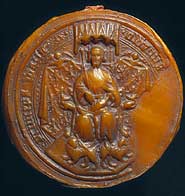
Owain Glyn Dwr, leader of the last major armed Welsh protest against English rule, was both formidable tactician and visionary statesman. Rees Davies assesses how close he came to realising his dream of an independent Wales.
By Professor Rees Davies
Last updated 2011-02-17
Owain Glyn Dwr, leader of the last major armed Welsh protest against English rule, was both formidable tactician and visionary statesman. Rees Davies assesses how close he came to realising his dream of an independent Wales.
On Thursday 16 September 1400 in a tiny village (between Llangollen and Corwen) in the valley of the river Dee in north Wales, Owain Glyn Dwr had himself proclaimed Prince of Wales. This bold act was witnessed by close members of his family, a few friends, Owain's personal prophet (the equivalent of a modern political adviser), the dean of St Asaph, and a crowd of local men and women. Once the proclamation was over, Owain and his men set out to burn and pillage English towns throughout north-east Wales.
... Owain was dead, but at least he remained unbetrayed and uncaptured.
So began the revolt of Owain Glyn Dwr, arguably the most successful and certainly the last major armed Welsh protest against English rule in Wales. The revolt reached its peak in the years 1403-5 when many castles and most of the countryside of Wales - although not the towns - were either under Welsh control or subject to Welsh raids. The revolt began to subside from 1405 onwards, and by 1408 the two last major castles still under Welsh control - Harlech and Aberystwyth - were back in English hands.
By 1415 or 1416 (we do not know the exact date) Owain was dead, but at least he remained unbetrayed and uncaptured. Soon thereafter he entered on a second, posthumous career as the most famous historical figure in the social memory of the Welsh people.
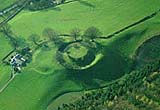 The site of Glyn Dwr's palace in Sycharth © The revolt that erupted in 1400 was totally unexpected, and so was Owain's leadership of it. The whole of Wales had been under firm English control for over a century. This control was underwritten by scores of majestic castles of formidable strength, by English boroughs and by extensive English settlements, especially in the rich lowlands of south Wales.
The Welsh, for their part, seemed to have accepted their defeat. They served in droves in English armies in France and Scotland and they acted as agents of English power and lordship in the localities. As for Owain, his career could easily have been that of an English county knight. He was well-connected within English shire society. His grandmother was a Lestrange, and his father-in-law was none other than Sir David Hanmer, one of the chief justices of the king's bench. His patron, moreover, was Richard Fitzalan, earl of Arundel, one of the most powerful lords of his day.
No one could possibly have suspected that this archetypical country squire had the makings of a rebel leader.
Owain's early adulthood likewise suggested that he would fit comfortably into the mould of Chaucer's 'parfit, gentil knight'. He had quite probably spent a period in one of the London law schools, possibly under the auspices of his father-in-law. He had a military career of which he could be proud, having served with Richard II in Scotland in 1385 and having been present in the earl of Arundel's retinue in a famous naval victory over the French in 1387.
He was very comfortably off (at least by Welsh standards) and had totally refurbished a moated family dwelling for himself in Sycharth, near Oswestry and close to the English border. No one could possibly have suspected that this archetypical country squire had the makings of a rebel leader.
Why, then did Owain - a man well used to the comforts of life and by 1400 already in middle age - allow himself to be seduced by the seemingly mad-cap idea of proclaiming himself Prince of Wales? English contemporaries offered some implausible reasons, most of which concentrated on disputes with his difficult neighbour, Reginald Grey of Ruthin.
It has also been suggested that he resented not being created a knight and felt bereft after the execution of his patron, the earl of Arundel, in 1397. But personal slights and tiffs with neighbours are not normally adequate reasons for launching a national rebellion. So one must look elsewhere, more precisely into Owain's lineage and mental world.
... Owain had the rightful title to be the true, native prince of Wales.
Owain was inordinately proud of his lineage and had good reason for his pride. He was the lineal descendant of the princes of Powys (north-east Wales) and had the blood of the native dynasty of southern Wales in his veins. Furthermore, the only other major Welsh dynasty - that of Gwynedd (north-west Wales) - had been eliminated when an English assassin had murdered its last member in 1378. This meant that Owain had the rightful title to be the true, native prince of Wales.
He no doubt believed the case to be unimpeachable - so did the poets and propagandists whom he patronised, and so did the majority of the people of Wales. All that was needed was for him to activate the claim and win general support for it.
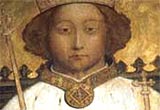 England was in turmoil after the downfall of Richard II © Such support was forthcoming because, in the words of a contemporary poem, Wales was out-of-sorts at the end of the 14th century. Recurrent visitations of plague had devastated the country (as it had in most of the countries of western Europe), and English taxation of Wales was punishingly heavy. Moreover, peace with France had put Welsh troops out of a job, and the political turbulence in England preceding and following the downfall of Richard II in 1399 had destabilised patterns of authority in Wales also.
... they felt that they were exiles in their own country.
But there were also festering grievances and prophetic aspirations, which made this mixture of circumstances even more explosive in Wales. There was huge resentment at the discrimination practised and proclaimed against Welshmen - in terms of commercial privileges, promotion to key posts in church and government and so forth. As one Welshman expressively put it, they felt that they were exiles in their own country. Added to this catalogue of resentment was the universal conviction of Welsh society that it would one day be delivered from its thraldom by a saviour, of Welsh blood, who would restore to the Welsh their dignity and glory.
Owain Glyn Dwr fitted the job-description exactly. The poets drummed that point into his ears incessantly, and his personal soothsayer no doubt advised him that the time to take up his predestined role had arrived.
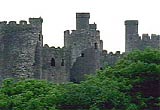 Conwy Castle, taken by Glyn Dwr during garrison prayers © Starting a revolt is easy, but sustaining it over five years and more requires great skill and luck. Such was Owain's achievement. He proved to be a wily military leader, waging war on his own terms rather than those of the enemy. He was a master of the art of the unexpected and utterly embarrassing act of military bravado - as demonstrated by his taking of the mighty castle of Conwy while the garrison was at prayer, or the capturing and ransoming of his arch-enemy, Reginald Gray.
He put the fear of the Welsh deep into English hearts ...
He put the fear of the Welsh deep into English hearts, notably by defeating them in a set-piece battle near the English border in 1402 and allowing stories to circulate that Welsh women subsequently mutilated the genitals of English victims. He exploited the deep fissures of contemporary politics (notably the disaffection of the families of Percy and Mortimer). He put Wales on the international map, sending embassies to Ireland and Scotland and persuading the king of France to send a substantial military force to help him in his attacks on English-held castles.
Within Wales itself two distinctive features make his revolt stand out from earlier Welsh protest. The first was that his leadership was never challenged and was indeed accepted in every part of Wales. This was truly Owain's revolt. The second was the quite exceptional degree of support he elicited both geographically and socially across Wales. Not everyone, of course, supported him, but his was a remarkably pan-Wales revolt.
If revolts are not to lose their momentum, they must be more than an act of protest; they must also inspire followers with a vision of the new world that they wish to create. Owain - probably guided by his ecclesiastical supporters who came to include bishops, monks, friars and many local priests - soon did provide such a vision.
He laid it out in a programme which he sent to the Papacy. He envisaged Wales as an independent political and ecclesiastical unit, on a par, say, with the medieval kingdom of Scotland. It would have an archbishopric of its own, two universities and a Welsh-speaking clergy. With this in view, he began to assume the paraphernalia of statehood - including a chancery, a great and privy seal, parliaments and diplomatic embassies.
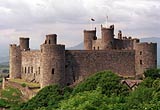 Harlech Castle, one of the last to capitulate © This grand dream was soon to be shattered, but the very existence of the dream indicates that Owain's movement was more than a protest or a revolt. It was an act of vision, one of state-creation. It was breathtaking in its ambition.
Ultimately it was a total failure. Nor realistically could it have been otherwise. It is only in a Biblical story that David triumphs over Goliath. Once the formidable English medieval state got its act together politically and financially (and that was so by 1405), then the prospects of Owain and his supporters were bleak.
The revolt rekindled the ethnic tension between English and Welsh more fiercely than ever.
They did not have the military technology to capture and hold more than a handful of castles. Their supplies ran out, and with them their will to fight, in the harsh Welsh weather. Their French allies deserted them. The last embers of revolt took a very long time to be extinguished, but by 1412 some semblance of normality had returned to most parts of Wales.
From many points of view, the revolt was an unmitigated disaster for Wales and the Welsh. The destruction and suffering were immense and lived long in the memory. The revolt rekindled the ethnic tension between English and Welsh more fiercely than ever.
The government's response was to issue a set of Penal Laws which discriminated against the Welsh and even against English married to Welsh. The harshness of these Laws is reflected in the words of a later commentator, who characterised them as 'more heathenish than Christian'.
For Owain and his family the revolt likewise was disastrous. His brother and at least one son were killed. His wife, daughter and grandchildren were prisoners in London. He himself died a refugee and was buried at night in an unmarked grave. Rarely has failure been so comprehensive.
... Owain Glyn Dwr embarked on a second career, as a national hero ...
Yet within a generation of his death, Owain Glyn Dwr embarked on a second career, as a national hero around whom stories of extraordinary valour and cunning congregated. English propagandists lambasted him as a traitor; but he had won his way into the affections and social memory of the Welsh in every part of Wales, and each district spawned its own set of stories about him.
He came fully into his own as Wales recovered its self-confidence as a country in the 19th century. His vision of an independent Wales won him the accolade of 'the father of modern Welsh nationalism'. Nor did his popular appeal wane - he scored remarkably well in the recent 'Great Britons' competition on British television, and when a similar competition was launched in Wales, he came a very close second to Aneurin Bevan. In that sense this man who was such a comprehensive failure in his lifetime seems indeed to have entered the portals of the immortals.
Books
A History of Wales by John Davies (Penguin, 1990)
Owen Glendower, Owain Glyn Dwr by JE Lloyd (Oxford, 1931)
The Revolt of Owain Glyn Dwr by RR Davies (Oxford, 1995)
The Age of Conquest. Wales 1063-1415 by RR Davies (Oxford 1987, 2000)
Recovery, Reorientation and Reformation. Wales c.1415-1642 by Glanmor Williams (Oxford, 1987)
Professor Rees Davies specialised in the History of the British Isles 1100-1400, particularly the relationship of the English to Ireland, Scotland and Wales, and aristocratic power in the British Isles 1100-1400. His publications include: The Age of Conquest. Wales 1063-1415 (Oxford, 1991), The Revolt of Owain Glyn Dwr (Oxford, 1995), The Matter of Britain and the Matter of England (Oxford, 1996), The Peoples of Britain and Ireland 1100-1400, Transactions of the Royal Historical Society, sixth series, 4-7 (1994-7). Professor Davis sadly passed away on 16 May 2005.





BBC © 2014The BBC is not responsible for the content of external sites. Read more.
This page is best viewed in an up-to-date web browser with style sheets (CSS) enabled. While you will be able to view the content of this page in your current browser, you will not be able to get the full visual experience. Please consider upgrading your browser software or enabling style sheets (CSS) if you are able to do so.

