
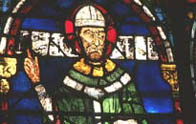
'Troublesome priest' or tormented soul - was Becket Henry's nemesis?
By Dr Mike Ibeji
Last updated 2011-02-17
'Troublesome priest' or tormented soul - was Becket Henry's nemesis?
The murder of Thomas Becket and his subsequent martyrdom has so overshadowed the reign of Henry II that it is often as difficult to see behind to what caused it as it is to see beyond to the rest of the reign.
He also acted as Henry's foil, taking on those aspects of kingship which Henry found irksome.
At its heart lies a personal dispute between Henry II, who felt betrayed by his friend, and Becket, who mistrusted the motives of the king. This bad blood between friends is what made the dispute so bitter.
Becket came to prominence at the start of Henry's reign when Henry asked Archbishop Theobald of Canterbury to recommend a candidate for the office of Chancellor. Theobald put forward his archdeacon, Thomas Becket, the son of a London merchant, who had demonstrated the brilliance of his mind in Theobald's service. Becket became Henry's friend and confidant. Like Henry, he was obsessed with the rights of his office and the crown, and was driven to do the best job he possibly could on their behalf. He also acted as Henry's foil, taking on those aspects of kingship which Henry found irksome, and representing the pomp and circumstance of Henry's court in contrast to the bluff façade of the king.
His character seems suited to his job. As a self-made man, he was always jealous of the marks of privilege and status of his office; which translated whilst chancellor into sumptuous ostentation, and transmuted when archbishop into the vestments and horsehair shirt of a religious ascetic. Proud and uncompromising, he had a fundamental urge to excel, which goes some way to explain the lengths to which he was prepared to go.
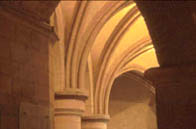 Canterbury Cathedral © Becket was probably very influential during the early part of Henry's reign. He acted as ambassador and chief negotiator in Henry's early dealings with King Louis VII of France, and played a prominent role in the ill-fated expedition to Toulouse of 1159. He was therefore close to the king at the time when Henry was at his most strident and uncompromising, and it was probably the memory of this which coloured Becket's actions when he became an archbishop.
Everyone, Henry included, expected Becket to be a yes-man for the King.
On Henry's accession in 1154, Theobald was Archbishop of Canterbury. Theobald had quite a pragmatic view of the relationship between Church and Crown. He felt that the two should co-operate through a process of sensible give-and-take; not least because this put a little distance between Canterbury and the Pope, who had recently intervened disastrously in English affairs. Theobald had been forced to clean up the mess caused by papal interference in the election of the Archbishop of York, and the Pope had also recognised the Irish Church in 1152, much to Theobald's chagrin.
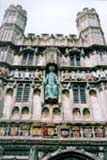 Canterbury Cathedral © When Theobald died in 1161, Henry manoeuvred Becket into the vacant seat. Knowing the way Henry went about these things (he once ordered Winchester to 'hold free and fair elections and elect my man Robert into the post'), he undoubtedly caused bad blood. It is in this context that we must see Becket's elevation to the archbishopric. Everyone, Henry included, expected Becket to be a yes-man for the King. What no one realised was that Becket would take his new role quite so seriously. He had thrown himself into the job as Henry's chancellor with gusto, now he would do the same thing with the Church. He gave notice of this by resigning the chancellorship, much to everyone's surprise.
The crunch came with Henry's attempts to deal with the problem of 'criminous clerks'. About one in six of the population of England were clergymen, many of whom were not ordained to the priesthood. These lay clergy could claim the right to be tried in ecclesiastical courts like their ordained brethren, where they would invariably receive a more lenient sentence than if tried in the criminal courts of the land. For Henry, the problem was part and parcel of the need to restore order after the chaos of the tempus werre (a term coined by the medieval chroniclers to describe the time of war and anarchy which marked the civil war between Stephen and Matilda), but for Becket, the King's concern over criminous clerks was a question of clerical immunity from secular jurisdiction. The problem was brought to a head by cases such as that of Philip de Brois, a canon of Bedford who was acquitted in the court of the Bishop of Lincoln of the charge of murdering a knight.
For three days, the bishops refused to sign as Henry ranted and railed at them.
The Sheriff of Bedford attempted to re-open the case in the Royal court, and was furiously abused by Philip. Henry angrily demanded justice on the charge of homicide and on an additional charge of contempt.
Becket attempted to solve the problem by banishing Philip, but the whole affair merely showed up the woeful inadequacy of canon law in punishing robbers and murderers.
Henry sought to solve this by proposing that clergy convicted of such serious crimes in the ecclesiastical courts should be deprived of the protection of the Church and handed over to the secular authorities for punishment. It was a neat compromise, but though innocuous on the face of it, it contained the central implication that a man handed over to criminal law was no longer a clerk, undermining the whole basis of clerical immunity. This was why Becket could not accept it, and in this he was unanimously supported by his bishops. In fact, it is highly likely that Theobald would not have agreed to this either. The letters of his clerk, John of Salisbury, tell of a case involving the murder of the Archbishop of York which Theobald dragged back from the criminal courts into ecclesiastical jurisdiction against Henry's will.
After several months of wrangling, both sides met at the Council of Clarendon in January 1164 to discuss the issue. There, Henry presented the bishops with the infamous Constitutions of Clarendon, a list of 16 clauses defining the relationship between secular and canon law (of which clause 3 explicitly outlines the criminous clerks proposal). It was a closely worded document drawn up by Henry's legal hot-shots and was a deliberate attempt to wrong-foot the bishops into committing to something they had not previously agreed. For three days, the bishops refused to sign as Henry ranted and railed at them. Then, out of the blue, Becket told the bishops they had no choice but to give in.
'It is the Lord's will that I forswear myself,' he said. 'Submit for the present and take a false oath, to do penance for it hereafter as I may.'
He prevailed upon them to sign the document with him, then in a deliberate piece of theatre, he donned the garb of a penitent, imposed a fast upon himself and publicly repented of his oath. Why he chose this option is unclear. Becket's own letters say that he opposed the Constitutions in his name only in order to divert the King's wrath from the bishops. This is as good an explanation as any.
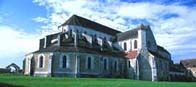 Pontigny Abbey, France, where Becket spent time in exile © It worked. The king was incandescent. This, in his eyes, was the ultimate act of treachery and he was determined to exact revenge. He tried to forestall Becket's action by getting the Constitutions ratified by the pope, but the pope prevaricated. Now the dispute entered a malevolent stage in which Henry was out to get Becket any way he could. In October 1164, he had Becket condemned on trumped-up charges of contempt of court over a land dispute in Pagham, and ruled that the archbishop should forfeit all his goods.
Henry exploded and is said to have uttered the words: 'Will no one rid me of this troublesome priest?'
Even the barons were uncomfortable with this decision, which was followed up with charges of embezzlement, and Becket was summoned to Northampton to answer for his crimes. In another piece of theatre, Becket began the day with the quote at morning mass: "Princes also sit and speak against me; but thy servant, Lord, is occupied in thy statutes," and entered the Council bearing his archiepiscopal cross of office before him. Archbishop and King sat in separate rooms as the bishops and barons shuffled between them. When the Council delivered its verdict, Becket refused to hear it, maintaining that they had no right to judge him. That night, he slipped away and fled to exile in France.
We should be careful not to get the Becket dispute out of all proportion. As it dragged on with claim and counter-claim throughout the years 1165-70, Henry had many other overwhelming things on his mind. Yet it continued to crop up at most international summits as people tried to come up with a formula that would heal the rift between them. Becket himself was under incredible pressure to conform. Not only was he in exile at the French court, but all his money and lands had been sequestered and at least 400 of his dependants were thrown out of the country also. Yet Henry could not resolve the dispute in his own favour either.
He bullied and cajoled, he even threatened to support the Holy Roman Emperor's anti-pope if Pope Alexander III did not decide in his favour, but Becket had a large international network of friends to support him, and he was essentially the 'good guy' in the dispute. Throughout, one phrase keeps on recurring - at each of the attempts to reconcile the two, Becket would find himself faced with a formula that would not quite get him off the hook and took refuge in the get-out clause: 'Saving the honour of my God,' at the end of any oath he was constrained to swear. In this way, he constantly avoided tying the Church to any formula the King's men could come up with.
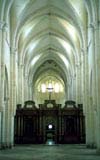 Pontigny Abbey, France © Henry finally got to Becket through his pride. On 24 May 1170, he had his son, Henry the Younger, crowned at Canterbury by the Archbishop of York. Becket could not countenance this snub to the prestige of his office, and at Fréteval on 22 July 1170, both king and archbishop agreed to a compromise which neatly ignored the original cause of the dispute and allowed Becket to come home and re-crown Henry the Younger in a second ceremony. It was not a popular reconciliation. Henry the Younger himself refused to meet Becket when he arrived at Windsor. Becket himself was now in a delicate position. He needed to recover his authority in England and avoid becoming a yes-man of the king. On his arrival in England, he immediately excommunicated his old ecclesiastical enemies, including the Archbishop of York who had crowned Henry the Younger. When this news was brought to him in his Christmas court at Bures in Normandy, Henry exploded and is said to have uttered the words: 'Will no one rid me of this troublesome priest?'
It was undoubtedly spoken in anger, but four knights took him at his word. Led by one Reginald fitz Urse, they slipped across the Channel to Canterbury, where they tried to force Becket to return with them and face the King's wrath. He refused and they retired to bed. Next morning, while he was leading morning mass, they attempted to drag him out of the cathedral, and he resisted. It was during this struggle that he received a blow on the head which seems to have tipped the whole thing over into violence and the four knights fell on him with their swords. He died later that afternoon on 29 December 1170.
His enemies clamoured for Henry's excommunication and the outrage against the murder almost precipitated a war.
The murder of Thomas Becket lost Henry the main argument. Becket became an instant martyr, and the international opprobrium poured upon Henry's head may well have been one reason why he chose to cross to Ireland in 1171 (though the Irish crisis was in itself a very real incentive). Contemporary chroniclers label Henry a murderer, his enemies clamoured for the King's excommunication and the outrage against the murder almost precipitated a war. Through all of this, Pope Alexander negotiated a very measured path, excommunicating the four knights involved and prohibiting Henry from taking mass until he had made reparation for his sin. He also sent two papal legates over to England to negotiate these reparations.
It was a canny move. With Becket out of the way, the Pope recognised that there was an opportunity for proper reconciliation between King and Church, and was careful not to overexploit the advantage which Henry's contrition provided him. It is indicative of the maturity of Alexander's policy that he did not insist upon a repudiation of the Constitutions of Clarendon before allowing Henry to purge himself of the murder. Instead, they agreed on a formula which allowed Henry to renounce the Constitutions without seeming to.
On Sunday 21 May 1172, Henry performed a ceremony of public penance at Avranches cathedral, where he swore:
On the face of it, Henry lost little by this compromise. He could still appoint bishops, he was unlikely ever to interfere in ecclesiastical appeals to the Pope, and he was also able to tie the clergy to Forest Law. But like the Constitutions themselves, the implications of his agreement were enormous in principle. At the bottom line, he was forced to give in on the problem of criminous clerks, and this fundamental concession would create problems between Church and state right down to the Reformation.
Dr Mike Ibeji is a Roman military historian who was an associate producer on Simon Schama's A History of Britain.




BBC © 2014The BBC is not responsible for the content of external sites. Read more.
This page is best viewed in an up-to-date web browser with style sheets (CSS) enabled. While you will be able to view the content of this page in your current browser, you will not be able to get the full visual experience. Please consider upgrading your browser software or enabling style sheets (CSS) if you are able to do so.

