
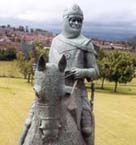
Scotland became an independent nation partly because of the dynamic interaction between native tribes and incoming settlers. Fiona Watson describes how nationalism was born as the country developed its sense of separate identity.
By Fiona Watson
Last updated 2011-02-17
Scotland became an independent nation partly because of the dynamic interaction between native tribes and incoming settlers. Fiona Watson describes how nationalism was born as the country developed its sense of separate identity.
It makes perfect sense, in this day and age, to wonder how Britain came to be made up of four distinctive countries. The essential point to be stressed is that neither the creation of Britain, nor the much earlier emergence of the nations of the English, the Irish, the Scots and the Welsh was inevitable. We could have ended up with far more national units; or far fewer.
We should also remember - and Britain exemplifies this point very well - that there was more than one route towards political organisation and the development of an overarching identity in each country. Both England and Scotland went down the road of a single, unified kingship, though the extent to which power was centralised in the hands of the king was by no means the same.
Resistance to this common enemy helped to promote unity among the native tribes.
Wales and Ireland, on the other hand, preferred to leave predominant identification and power with smaller groupings within the larger unit. As we should all be more aware these days, thanks to the recent devolution of power away from London, the desire for centralisation or decentralisation varies over time, and there is no moral or political superiority of one over other.
The accidents of history that produced the four nations of Britain happened partly because of the dynamic interaction between native tribes and incoming settlers. In England, conquest by the Romans provided a model of centralised government, administration and economic life that was eventually resurrected long after the legions had gone.
In Scotland, resistance to this common enemy helped to promote unity among the native tribes. However, contacts with continental Europe, and areas that had been imperialised closer to home, meant that native rulers could take on aspects of centralisation if they wanted to. The earliest native tax assessment known in Britain is the seventh-century Senchus Fer nAlban - a list of the numbers of men that the various families of the Scoto-Irish kingdom of Dal Riata centred on Argyll could provide for their navy.
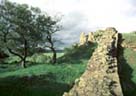 Hadrian's Wall, a Roman frontier © The collapse of the Roman Empire around AD 400 heralded both the disappearance of Roman-organised ways of life and the problematic arrival of Teutonic tribes. They had been forced west by the eastern hordes, who had helped the Empire to implode in the first place.
In Britain's case, this meant the arrival of the Anglo-Saxons. The native British tribes who met these intruders first were forced further and further west, until they held only Wales, Cornwall and the south-west, parts of the western English seaboard and south-western Scotland. In Scotland, British tribes shared the landspace with the Picts, who occupied the territory north of the Forth; and the Scots/Irish who lived west of the mountain ranges of Argyll.
The native British tribes who met these intruders first were forced further and further west...
Anglo-Saxon success at acquiring territory obviously had a profound effect on English history. But Scotland also found itself attacked, as the Anglo-Saxon kingdoms immediately to the south of the Britons, in Lothian and the Borders, began to centralise and coalesce. The newly unified kingdom of Northumbria (c.620) played as much of a role in Scottish history as it did in English history.
By c.668, the Northumbrians had annexed Pictland, south of the Forth, and also begun to challenge the Britons of Strathclyde and the Scots of Dal Riata. However, the Anglo-Saxons were not always victorious - losing most notably at the battle of Nechtansmere in 685, when the Northumbrian king, Ecgfrith, was killed.
Another major theme in the relationship between all these warrior groups is the connection between warfare and intermarriage. This led to leaders of a hostile nation becoming kings over their former enemies, so long as they had a good sword arm to back up their claims. This is certainly what happened to help the kingdom of Alba (later Scotland) to develop.
What was unforeseen was who would be taken over by whom - it was the Dal Riatan kings who eventually succeeded in permanently taking over the Pictish throne, but the Picts themselves, the Britons of Strathclyde, or even the Anglo-Saxons of Northumbria, might just as well have managed it instead.
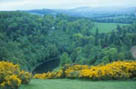 Scottish borders © It should be becoming clear by now that there is actually very little reason to ask the question: 'What makes Scotland separate?', any more than one would ask the same of England.
For most of the history of an identifiable Scottish kingdom, over the last 1,200 years, the nation has been entirely separate and independent, developing its own administrative institutions appropriate to its needs.
The process of consolidation of the Scoto-Pictish kingdom of Alba was also helped by the threat of a new invading force - the Scandinavians - who basically took over much of northern Scotland, Orkney and Shetland, and the western seaboard.
Those areas able to remain outside Viking control were thus provided with a common enemy, and had an incentive to consolidate and work on their common national identity, embryonic as it was.
England had already worked out a justification for claiming that its kings were superior to all others in Britain.
The extent to which that had happened by the end of the first millennium AD is illustrated by the fact that England had already worked out a justification for claiming that its kings were superior to all others in Britain.
This probably prompted the Scottish kings to retaliate, by articulating the origins of their nation through links with Ireland. This was stretching the truth slightly, especially considering that both Saxon and British territory was absorbed into the larger Scottish kingdom. Recent scholarship also argues that the Scots in general did not migrate from Ireland around AD 500, as the traditional story would have it.
Rather, they were essentially the native peoples of the western seaboard, who nevertheless had stronger links with Ireland than they originally did with those living beyond the mountains of the mainland. However, leadership of this Scottish kingdom of Dal Riata may have passed to an Irish family thanks to the usual process of dynastic ping-pong caused by intermarriage.
The Scots' pre-eminent role in the creation of the kingdom of Alba/Scotland led them to challenge English claims of superiority through emphatic Celtic, non-Saxon roots in Ireland - this as well as giving their name eventually to the kingdom as a whole.
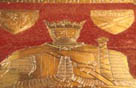 Tomb of Robert the Bruce, Dunfermline Abbey © The Scottish Church, too, had worked long and hard for several centuries before 1300 to justify its independence - and that of the nation as a whole - against attempted interference from south of the border.
These ecclesiastical civil servants were at the forefront of the articulation of Scotland's sovereign status, up to and including seeking the protection of the Pope in Rome - effectively the UN of the middle ages - against English claims. The rights and wrongs of these claims are largely irrelevant. The fact of the matter remained that Scotland had developed its own identity and political and administrative institutions, and thought of itself as entirely separate.
These ecclesiastical civil servants were at the forefront of the articulation of Scotland's sovereign status.
But there is also no doubt that these institutions have tended to suffer in comparison with those of England. This is for the simple reason that, because so much administration continued to be dealt with at a local level in Scotland, national politics and government did not develop as much as it did in England. Scotland had also given up on developing its military capacity by the later 13th century (which showed extremely bad timing, to say the least).
Military activity explains much of the development of government and administration in England. The comparative lack of military activity at the heart of Scottish government meant that national institutions, such as parliament, also remained undeveloped. On the other hand, they worked perfectly well for their own requirements.
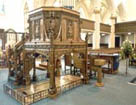 Tomb of Robert the Bruce, Dunfermline Abbey © English attempts to conquer Scotland, from the reign of Edward I onwards, certainly helped to underline the separateness of Scottish identity, though it would be quite nonsensical to argue that it did not exist before.
Even those of Anglo-Norman extraction, who began to dominate southern Scotland and often the Scottish royal court, in the centuries after the Norman conquest of England, quickly became 'Scottish', not least because intermarriage, yet again, blurred racial distinctions.
English attempts to conquer Scotland, from the reign of Edward I onwards, certainly helped to underline the separateness of Scottish identity.
Historians argue long and hard about when it is reasonable to claim that nationalism has become a force in a nation's politics, or at what point it becomes clear that supporting the state in war and peace is a civic duty.
However, it is difficult to suggest that a document such as the Declaration of Arbroath, written by Scottish clerics on behalf of King Robert Bruce in 1320, does not reflect a form of nationalism. It is such a clear articulation of the right of a nation to self-determination.
The fact that it is also an extraordinary piece of propaganda on behalf of Bruce, does not really detract from its rhetorical appeal, even in the 21st century.
For so long as 100 of us remain alive, We will never in any degree be subject to the rule of the English. For it is not for glory, riches or honour that we fight. But for liberty alone, which no good man loses, but with his life. - Declaration of Arbroath
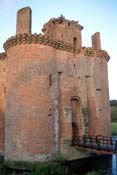 Caerlaverock Castle, Dumfries destroyed during Border Wars and rebuilt © The wars with England undoubtedly did much to add a layer of defiant anti-Englishness to the multi-faceted Scottish identity. Those wars were violent, bitter and long drawn out, and the last English campaign into Scotland was as late as the 1540s.
However, Scottishness was not entirely defined by anti-Englishness - the medieval kingdom of Scotland was striking in its self-confidence (certainly in comparison with Scottish self-image today), perhaps even its over-confidence.
Due to England's position as a great European power, which was often at odds with other great powers such as France, the Scottish king wielded more diplomatic clout than the political importance of his kingdom actually merited.
Scottish nationalism usually only raised its head in times of crisis, which was a fairly common phenomenon.
For so long as Scotland remained an independent kingdom, Scottish nationalism usually only raised its head in times of crisis, which was a fairly common phenomenon. With the union of 1707, which dissolved both the English and the Scottish parliaments and created a new joint one in Westminster, many Scots worried about the undue influence that the Auld Enemy would now have on Scottish affairs.
Many others, however, foresaw the opportunities that underpinned this new relationship with England - they saw the chance, finally, to reap the benefits of Empire, an empire that the Scots did much to build all over the world.
But then towards the end of the 19th century, Britain began to lose its pre-eminence in world affairs. This was a turn of events that hit the Scottish economy hard, strongly based as it was upon heavy manufacturing industries.
The immediate reaction was a crisis of confidence, followed by a reassertion of Scottish distinctiveness in culture and politics. Scottish nationalism, in the modern political sense, was born. And it was as if Scotland's own particular identity, and its foundation in a long-standing history, had never gone away.
Fiona Watson is Director of the Centre for Environmental History and Policy at Stirling University, and is a senior history lecturer at the same university. She has presented a number of programmes for Radio Scotland, and the BBC Scotland TV history series In Search of Scotland.




BBC © 2014The BBC is not responsible for the content of external sites. Read more.
This page is best viewed in an up-to-date web browser with style sheets (CSS) enabled. While you will be able to view the content of this page in your current browser, you will not be able to get the full visual experience. Please consider upgrading your browser software or enabling style sheets (CSS) if you are able to do so.

