On-board wives
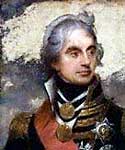 Viscount Horatio Nelson © In Nelson's navy, warrant officers were the ship's specialist officers, and included the carpenter, gunner, cooper, purser and master (the person responsible for the ship's navigation and sailing). Their name comes from the fact that they received a warrant from the Admiralty, rather than a commission, which is what the captain and his lieutenants received. A number of these men took their wives and children to sea with them.
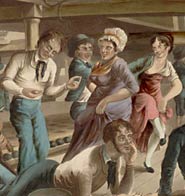
The presence of the women was largely hidden, for official purposes, as they were not paid or fed by the Navy, and therefore were not entered onto the ships' muster books. However other records, such as order books written by ships' captains, refer to their existence, as do memoirs and records of courts martial.
The story of George Casey, his wife, and Nicholas Maeger is a good example. On Friday 5 January 1797, Commodore Horatio Nelson was presiding over the court martial of Lieutenant Nicholas Meager of HMS Dromedary. Lieutenant Meager was charged by George Casey, the ship's Master, because he '... took hold of me by the nose and pulled with all his strength', in public view on the deck of the ship.
Prior to the attack one witness recalled that 'I was walking on the larboard [left] side of the quarter deck, Mr Casey and his wife were walking on the starboard [right] side, the prisoner [Meager] came out of his cabin and as he passed Mrs Casey he spit in her face'. It is not recorded why Maeger spat in Mrs Casey's face, but this record attests to the fact that a warrant officer had his wife with him while at sea, was promenading with her in public view, and the court saw nothing unusual in this. And what is more, in a separate court martial also involving Casey and Maeger, it came to light that the Caseys also had a child, which stayed onboard with them.
Passengers and nurses
Royal Navy ships were constantly carrying passengers on board. These could be government officials coming or going to foreign stations, discharged invalids going home, or soldiers being transferred from one post to another - and a number of them were women.
During the 1801 Egyptian campaign, over 60 Royal Navy vessels carried and escorted 12,000 troops to Aboukir Bay, Egypt, in an attempt to drive French forces out of Egypt. Out of every 100 men, three soldiers were allowed to bring their wives, which meant that there were at least 360 women in the fleet, as well as their children. These women and children are recorded in the ships' muster books. For instance the muster book of HMS Charon records that there were 30 women and 20 children onboard 'belonging to the 30th Regiment [now the Queen's Lancashire Regiment]'.
After the successful landing in Aboukir Bay, many of the troopships were turned into hospital ships, and although some of the women and children left to join the army now camped ashore, many stayed on board ship, and volunteered to act as nurses to the sick and wounded. In appreciation of this, Admiral Lord Keith, the expedition's naval commander, allowed them to be fed from the ships' stores, and encouraged them to volunteer for this service.
The Royal Navy of the time had a comprehensive health care system, which included compulsory vaccination against smallpox, free medical treatment for sailors, a sick bay and a surgeon on every ship - as well as an extensive network of hospitals and hospital ships. However, the nurses who attended the sick and wounded at these establishments had quite a bad reputation, and were continually being sacked for prostitution, drunkenness and helping the sailors desert.
One sailor wrote that, '... those ladies are exceedingly bold and audacious ... I had a great deal to do to repulse the temptations I met with from these sirens'.
Burials on Nelson's Island
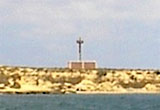 Nelson's Island from the sea © In 2000, Italian archaeologist Dr Paolo Gallo, while excavating Hellenistic and Pharaonic structures on Nelson's Island, Aboukir Bay, discovered a lost Royal Navy burial ground from Nelson's time. A British team was invited by Dr Gallo to excavate these burials, which subsequently revealed graves containing officers, sailors, soldiers, marines, women and children.
A poignant discovery was that of three infants. Two were either stillborn or had died shortly after birth, and one had died at just a few months old. Each was buried in a wooden coffin, wrapped in a shroud held together with small bronze pins, and one had been carefully packed in wood shavings.
Directly next to one infant was the grave of a woman in a wooden coffin, and it is likely that this was her child. She had been laid to rest in a dress, and her face had been covered with what looks like a handkerchief. On the coffin lid had been nailed a large metal letter 'G'. There are currently three possible candidates for this burial. John Nicol, one of Nelson's sailors who took part in the Battle of the Nile (1798), wrote that a woman from Leith, Scotland, was injured whilst serving the guns on HMS Goliath, subsequently died of her wounds, and was 'buried on a small island in the Bay'.
Two other women from the army regiments from the 1801 expedition were recorded to have died on board the ships moored in Aboukir Bay. One was Mrs Lambe, of the 3rd Guards Regiment (now the Scots Guards), and the other was Sarah Webber of the Coldstream Guards. Any one of these could have merited the mysterious 'G' (standing perhaps for 'Goliath' or 'Guards').
The historical and archaeological record thus makes it clear that women fought, nursed, accompanied their husbands, gave birth, entertained and even enlisted in disguise to serve in Nelson's Navy. These findings have forced us to re-examine the social and organisational nature of Nelson's crews, and has painted a much fuller and more complex picture of those who inhabited the 'wooden world'.