Discipline and punishment
Cook's determination to avoid deaths from scurvy, and his success, was a vital step in the creation of the British Empire. So important was the avoidance of the disease that Cook resorted to disciplinary measures to make his men eat their rations. We modern-day adventurers had to take a vitamin pill. Other diseases, such as dysentery and typhus, were avoided through an insistence on keeping the ship, the crew and their clothes clean - this cleanliness became a Royal Navy mania, and kept the sailors very busy. However, there were further medical terrors in store - malaria and yellow fever could decimate crews in tropical climates.
In the modern age, discipline has become conflated with punishment, but in the 18th century it meant organisation; good discipline meant that the ship was well ordered, not that the men were soundly flogged. Men were punished, however, if they failed to do their duty, and put the ship and the rest of the crew in danger. Among the worst offences were falling asleep on duty, refusing to follow orders, or 'unclean behaviour' - such as relieving bodily functions inboard, rather than using the rudimentary toilet facilities. All of these offences threatened the safety of the ship and her crew.
Contemporary naval punishments have become legendary, and strike us as inhuman; flogging with the cat-o'-nine-tails and hanging were the major punishments, while the men were occasionally 'started', or encouraged to work, with a blow from the end of a rope. There was no system of imprisonment, or financial penalty, although the rum ration could be stopped. However, we must remember that 18th-century society on shore relied on similar corporal and capital punishment. If anything, naval punishment was less severe, for sailors were a scarce and valuable resource that no captain would waste; also, flogging meant that the punishment was quickly completed, and the man could return to duty. There was no alternative, because the navy was, in all things, a reflection of the society it served.
Formal punishments were always inflicted in public, using consciously theatrical methods to ensure the maximum deterrent effect. The crew would be formed up on deck, with the marines separating the officers from the seamen, while the punishment was carried out according to established custom. Some crimes were handled by the crew - thieves were forced to 'run the gauntlet', allowing their shipmates to strike them with rope ends. This was a highly effective means of deterring a man from committing any fundamental breach of the trust that had to subsist between men who literally depended upon each other for their lives.
Professional sailors
Sailors generally went to sea as boys. By the time they were 16 they could be rated as seamen, and normally served at sea for another ten years, before settling down and taking a shore or local sailing job. The idea of being single, free of responsibilities and well paid would have made a career at sea obviously alluring, but the attractions could also undoubtedly wear off, and only a small percentage of men stayed on at sea, rising to be naval petty officers and merchant shipmasters.
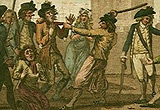 The press-gang would be used in time of war to recruit men to the navy © In wartime the Royal Navy needed another 60,000 men to fit out the fleet, so it would draw in professional seamen from the merchant service, usually by impressment, an age-old right of the Crown to the labour of seafarers. As there were no spare seamen, however, both fleets sometimes needed the additional labour of landlubbers, attracted by the pay and opportunity, or of foreign sailors, who made up a significant proportion of all British crews. Cook had at least three such men on the Endeavour. The resulting dilution of skills was acceptable on large warships, where only 20 per cent of the crew was needed for skilled work aloft. The rest of the work, including the heavy hauling, was done by the 'landmen' or 'waisters' - those who worked in the waist area of the ship.
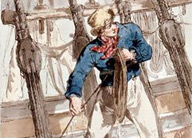
By contrast, the prime seamen, rated as Able or Ordinary, saw themselves as an elite group within a vertically stratified working community. The topmen, who worked on the highest yards, spent much of their day aloft, in the tops, which on a battleship would be spacious areas out of sight of the officers, and far above the inferior members of the crew. They would form their own mess, a group of six to ten men who cooked and ate together, and avoided 'waisters', marines and other deck-bound labourers.
To work aloft was to be among the elite of the 18th-century working class, and this was something that seamen delighted in advertising through their unique and colourful clothes, hairstyles, personal jewellery and - after contact with the Polynesian societies of the South Pacific - tattooing. This distinctive dress also marked them out when on shore, where their carefree, spendthrift and often riotous adventures led many to see them as simple, careless creatures and figures of fun. Yet this was a fundamental mistake. Professional sailors were skilled, daring and resourceful men. Their true worth was known to the state they served, and it was they, more than anything else, that gave Britain command of the sea.